


- Detection - Measurement
- Electrical Measurements
- Digital ratiometer
- Weshine Electric Manufacturer CO Ltd
Digital ratiometer VS-6628for transformers

Add to favorites
Compare this product
Characteristics
- Options
- for transformers, digital
Description
The transformation ratio of a transformer is equal to the number of turns of the primary winding divided by the number of turns of the secondary winding. The transformer ratio provides the desired performance of the transformer and the corresponding voltage required by the secondary winding.
If the secondary voltage is required to be lower than the primary voltage - a step-down transformer - the secondary winding should have fewer turns than the primary and vice versa for a step-up transformer; when the transformer's ratio reduces the voltage, it increases the current and vice versa, Therefore, the voltage and current ratio of an ideal transformer is directly related to the transformation ratio.
Unfortunately transformers are not perfect, in a real transformer the voltage or current ratios may not match the physical ratios of the transformer due to various electrical losses such as in the transformer's iron core (hysteresis and eddy current losses) and copper . losses (due to the resistance of the primary and secondary windings); therefore, manufacturers try to design transformers to minimize these losses for maximum efficiency at full load, power conversion above 95%, thus providing a difference of no more than 5% from the transformer voltage ratio/turn ratio.
Weshine invented the transformer turns ratio test, or TTR test, for measureing Turns Ratio of Transformer and confirms that the transformer has the correct ratio of primary turns to secondary turns. Using this test correctly can help to identify tap changer performance, shorted turns, open windings, incorrect winding connections and other faults inside transformers.
Catalogs
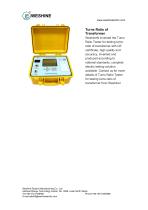
Turns Ratio of Transformer
6 Pages
Other Weshine Electric Manufacturer CO Ltd products
Transformer Test


Related Searches
- Portable testing system
- Digital testing system
- Automatic test equipment
- Benchtop testing system
- Manual test kit
- Portable test kit
- Installation tester
- Insulation testing system
- Cabling tester
- Tester with LCD screen
- Resistance testing system
- Compact testing system
- Electrical installation tester
- Digital test kit
- Frequency response analyzer
- Insulation resistance testing system
- Universal tester
- Signal analyser
- R&D testing system
- Tabletop testing device
*Prices are pre-tax. They exclude delivery charges and customs duties and do not include additional charges for installation or activation options. Prices are indicative only and may vary by country, with changes to the cost of raw materials and exchange rates.