|
|
Actel's comprehensive FPGA design and development software that combines the latest design creation and Designer physical implementation tools from Actel plus best-in-class synthesis and verification tools from leading EDA vendors into a single package. Libero supports all Actel FPGA devices.
Included with Libero IDE, Designer physical implementation software is also available "stand alone" for users that already have their own design creation, synthesis, and simulation tools. Designer includes place and route, timing constraint entry and analysis, power analysis, and program file generation.
|
|
modEva-Board MTCS-ME1
Application board for True Colour Sensors
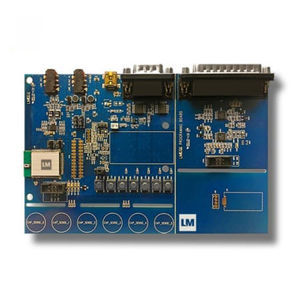
As a supplement to its colour sensors, MAZeT offers a MTCS-ME1 hardware solution, based on the MTCS product line. A modularly structured evaluation board, it is intended for colour detection and colour measurement according to the standard tri-stimulus function under DIN5033. It consists of one mainboard which can be configured with one sensor plug-in module, optics and software as required to match the particular application.
MTCS-ME1 mainboard
- µC-controlled signal collection
- digitization with 12-bit resolution
- free memory space for balancing and correction data
- interrupt and IO pin terminals for integration into control processes
- voltage supplied via USB (for RS232 and I²C: separate terminal option)
- programmable voltage source for operation control of target illumination sources
- prefabricated configuration versions for interfaces (USB, I²C, RS232) and plug-in modules
|
|
Fusion: All-inclusive, low-cost evaluation kit for the Actel Fusion family.
The Fusion Starter Kit is an all-inclusive, low cost evaluation kit for the Actel Fusion family. Explore the various benefits of Fusion mixed-signal FPGAs, including ISP, device serialization, and FlashLock® on-chip system security.
ProASIC3: Complete kit that enables quick evaluation and design prototyping of Actel's ProASIC3 family.
The ProASIC3 Starter Kit is a complete package that enables you to quickly evaluate Actel's ProASIC3 family and prototype your design. Explore the various benefits of nonvolatile ProASIC3/E FPGAs, including ISP, device serialization, and FlashLock® on-chip system security. Evaluate the performance and functionality of designs for cost-sensitive, ASIC-alternative applications.
ProASICPLUS: Low-cost kit contains everything needed to start using the advanced features of Actel's ProASICPLUS family.
Axcelerator: Complete kit that enables quick evaluation and design prototyping of Actel's Axcelerator family.
The Axcelerator Starter Kit is a complete solution, enabling quick evaluation and design prototyping of the Actel Axcelerator family.
|
|
ARM RealView tools are unique in their ability to provide solutions that span the complete development process from concept to final product deployment. Each member of the RealView portfolio has been developed closely alongside the ARM hardware and software IP, ensuring that it maximizes the IP's performance.
Working with ARM RealView tools gives the user an extensive and cohesive product range that empowers architects and developers alike to confidently deliver optimal products into the marketplace faster than ever before.
RealView system development tools allow system architects to create and validate their hardware design ideas in a virtual environment. Processor design engineers will find the RealView system development tools vital for creating detailed processor models and the tools required to generate and debug code on them. System architects can create executable specifications of a design, run benchmarks and simulate different architectures very early in the design cycle. RealView system development tools give you confidence in your final product much earlier in the design cycle, therefore lowering risk and increasing delivery of products that are right first time.
|
|
The E11x evaluation board demonstrates the capabilities of the QT110, QT113 and QT118H QTouch™ ICs.
Quantum recommends the use of either the QT100 or QT102 for new single-channel touch sense designs. The E11x board is available in limited volumes.
|
|
-Design your applications with an integrated compiler and debugger of Mikro Elektronika.
- Easy Programming.
- Design your Application in Minutes.
- Write your source code using the highly advanced Code Editor.
- Inspect & Debug program flow with the PICFlash programmer.
- Get detailed reports and graphs on code statistics.
- Use the included libraries to speed up development.
|
|
PIC Tools
* In Circuit Emulator Systems for Microchip PIC devices
* PIC C & Basic Compilers
* Low Cost PIC Programmers
|
|
This paper will focus specifically on Synopsys EDA software tools, process flows, and compute resources
used for the “Mask Data Preparation (or MDP)” process flow area of semiconductor manufacturing.
(Synopsys product; CATS®). Often referred to as the critical link from design to manufacturing CATS is a
software package which converts semiconductor design data into a useful format for making the circuit
templates (also referred to as “photomasks”) for semiconductor manufacturing. Topics discussed will include
|
|
saia motor controller
Caractéristiques :
• logiciel destiné au développement, au test et à l’optimisation de systèmes de moteurs pas à pas
• logiciel fonctionnant sous Windows
• logiciel simple d’utilisation
• réglage rapide des paramètres
• visualisation de la vitesse et de la position
• courses de positionnement
Dimensions (mm) :
Boîtier en métal 160 x 100 x 30 (euro-PCB)
Pilote : pour moteurs polaires et bipolaires
Tension d’alimentation (V/CC) : de 3 à 55 V/CC – 24 V/CA
Alimentation du moteur:
tension constante et courant continu (commandé par hacheur)
Mode de pas : pas entier, demi-pas et micro-pas
Source d’impulsion : interne, programmable
Entrées de commande :
• 3 entrées numériques
• 4 sorties signal
• 1 entrée analogue 0 … 10 V/CC
• contact à relais
Configuration : RS 232, USB
|
|
The development kit DVK90109 has been developed by Melexis to create specific applications using 125 kHz protocols and to evaluate the advantages of the MLX90109 transceiver IC.
The DVK90109 results of the combination of the development board DVKRFID and the evaluation board EVB90109. The EVB90109 is plugged on the DVKRFID through a 10 pins connector (including Coil, VCC and Ground) and controlled by the microcontroller ATMEGA128.
A set of commands has been elaborated by Melexis to define the communication between the Computer and the evaluation board EVB90109.
Other products available:
|
|
|
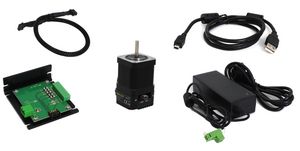
PMD's motion control Developer's Kits are integrated board and software packages available to designers who need to do electro-mechanical and software design using PMD's motion processors. These motion control developer's kits include the surface mount card, interconnection cables, a full set of manuals, and a CD-ROM containing PMD's powerful Pro-Motion GUI and C-Motion to simplify development.
|
|
Jennic's IEEE802.15.4 evaluation kit provides a complete environment for the rapid development of wireless sensor network applications based on the JN5139 wireless microcontroller. All the hardware and software required for product development is included, with five network nodes, an unrestricted software development kit, test environment and support applications. Multiple wireless networks including point-to-point, star, and mesh types can be supported.
A demonstrator of a home automation system is included that monitors data from remote sensors and displays the results onto the controller's LCD display, while commands sent between the nodes activate control signals. This is provided as an example to be directly used as the basis for many product developments.
The test environment supplied includes Daintree Networks' Sensor Network Analyser that demonstrates advanced wireless sensor network data capture and monitoring. A basic packet sniffer and network test application also aids program development.
|
|
The Development box is particular useful in connection with detailed analysis of motor performance.
Bonus material: 2 Consultancy Certificates each of 30miniutes are included – Value €200.
Several new features are included in version 4 of the development box. Most notably is the built-in ability to measure the DC supply current to the motor driver.
As the motor is operating in resonance at approximately 40kHz and is driven by a two-phase drive voltage of more than 100Vrms, it is highly desirable to have a simple way of monitoring the motor operation without measuring the drive current itself.
The DC current supplied to the motor driver is closely correlated to the motor performance (resonance, speed & stall momentum) and is convenient to measure during operation as well as for production testing.
The panel above for the control SW shows the new features:
DC current readout: Continuous monitoring of current
Results from frequency sweep: Current at the resonance peak
Track frequency: Compensate for temperature drift
The motor resonance frequency is mostly determined by mechanical constants of the PCB-material and it is necessary to compensate for the change in resonance frequency for the best performance over temperature. For continuous operation the new tracking feature in version 4 is an effective way of setting the optimum frequency to compensate for the self-heating in the motor.
We are looking forward to implementing the new features in a new version of our stand-alone driver, which make it easier for our customers to use the same approach in the production version of the motor controller/driver.
|
|
|
DHB1500 combines the core composition of MetroGain™ with the bow-tie geometry of the HB range of fibers. It is invaluable in mode-locked fiber lasers or in any specialised EDFAs that demand polarisation maintenance. The standard specification enables polarisation extinction ratios of up to -30 dB to be achieved over typical gain lengths of 8 - 14 metres under normal packaging conditions with amplifier performance closely matching that of MetroGain™ 5. DHB1500 is designed for 980 nm pumping.
|
|
The main functions of the new ADEUNIS RF wireless Demokits include evaluating ADEUNIS RF products, measuring RF and developing a prototype.
* Immediate connection to a PC serial port, permitting in particular, simple and rapid configuration of the radio module with the parameters required by the application.
* Implement measurements of sensitivity, power and all RF parameters.
* All the DemoKits have chip areas as well as direct access to all the radio module's signals permitting easy addition of additional electronics.
* configuration using AT commands
These Demokits are available for the following products:
* UART TTL wireless modules - ARF34 / ARF44 / ARF54
European and American versions
Short (300m) - Medium (1500m) - Long (6000m) distances
* Bluetooth® class1 & Class2 modules - ARF32 / ARF52
Bluetooth® certified "end user" solution
Conforms in full to Bluetooth® V2.0 standard
Data or Audio version
* Remote controls - ARF18
Mono or bidirectional versions
1 to 24 logic states
Technology risks can be limited and "time to market" optimised, and at very competitive prices - thanks to its ease of implementation and configuration, even for those who are not specialised in RF, using AT commands.
Demokit available from 99 Euros.
For any information http://www.adeunis-rf.com or +33 (0) 4 76 92 07 77
|
|
Universal Evaluation Kit
For Single Frequency FM Radio Modules
This Evaluation Kit can be used to evaluate single frequency Radiometrix VHF/UHF transmitter, receiver and transceiver modules. LED indicators are provided to show system status and to facilitate range testing and site surveys. The board is controlled by the Eval-RPC chip and incorporates several useful diagnostics & debug modes. Link-selectable 9.6kbps or 64kbps data rate.
Features
- Range Testing
- Target Environment Testing
- Noise and Interference Identification
- Antenna Evaluation
- TX1(H)/HX1/RX1, NTX2/NRX2, TX2(A)/TX2H/RX2(A), TX3A/RX3A, BiM1T/
BiM1R, CVR1, BiM/1/2/3A and NiM2 hardware test
- Transient Analysis
- Communication Eye Diagrm
- Analogue and digital data transmission
- Received Signal Strength Indicator (RSSI) meter
- Linking external hardware directly or via on board Eval RPC
- Responses up to 9.6kbps (A) or 64kbps (F)
|
|
|
The CMX850 combines a dual-port V.22bis modem with an 8051 microcontroller including 8k of RAM to form a powerful communications processor. Extended addressing offers page-mode access to 4Mbytes of external FLASH memory. The 8051 runs from the ~12MHz oscillator with a choice of sub-multiple frequencies down to ~12kHz giving a range of low power operating modes.
|
|
The Wi.M900X-EVM™ evaluation module features our high performance, low cost Wi.M900X-R™ module. The purpose of this device is to greatly simplify implementation of the Wi.M900X-R™ module into working designs. The module comes with onboard power supply, SMA antenna and is pin compatible with all Radiotronix Wi.232™ family evaluation and FCC certified modules.
The Wi.M900X-EVM™ has a sister radio for the European 868-870MHz frequency band in a pin compatible radio module. Antennas are available from Radiotronix to support this module.
|
|
|
picoChip's picoTools is a fully-integrated development environment for the picoArray which includes symbolic debugger, breakpointing with single-step operation, graphical views of design data, simulator and a powerful monitoring and display environment for in-system testing. picoChip also supply a Library of Example Designs and a range of Development platforms.
|
|
ROM emulation is a powerful and versatile method of microprocessor testing. ROM emulation has emerged as the technique of choice for microprocessor test and diagnostic applications. A microprocessor-based board is tested by replacing the boot ROMs on the Unit Under Test (UUT) with memory emulation pods. Each pod handles eight bits of the data bus. Processors from 8 to 32 bits can be controlled with one to four pods (even the most advanced CPUs such as the Intel Pentium generally use only an eight-bit boot path). The emulator takes control of the UUT by resetting the processor and, under the test program's control (monitor program), exercises all functions on the board. Synchronization with the UUT is automatic and requires no additional hardware or connections.
|
|
SEE-TECHNICAL is so easy to use that many clients finish their first project the same day they get the software. Symbol libraries, standard page formats, drawing tools... everything is just a mouse click away. Designed for those looking to increase productivity, SEE-TECHNICAL is more efficient than any standard drawing package.
Over 2000 standard symbols used in the following fields:
- Layouts
- Electricity
- Professional diagrams
- Industrial Engineering (Hydraulic, Pneumatic)
- (HVAC)
- Air conditioning
See-technical is dedicated to electrical designers. Connection points are created automatically. Symbols break the wire at insertion. Wires are redrawn automatically when a symbol is moved or deleted.
A specific text function allows you to quickly and efficiently assign a wire number to each connection.
See-technical allows you to quickly and easily create numerous and various styles of drawings. The drawing functions are powerful and specialized. See-technical allows you working to scale. The dimensioning capabilities help to create dimension automatically and dynamically.
|
|
|
With Freescale's new pricing and packaging structure, CodeWarrior development tools are now sold in suites. By purchasing a suite entitlement, you are able to register for any or all of the CodeWarrior products contained within this suite. This allows you to gain access to Freescale's entire portfolio of CodeWarrior tools across the suite you purchase.
|
|
|
Physical effects of semiconductors are becoming more and more interrelated. Each design decision can create unintended consequences. In addition to the old problems generated by wire capacitance, engineers can no longer manually balance the myriad effects such as leakage current, inductive noise or IR drop. Manufacturing processes and environmental variation can render your functional chip useless or economically unviable. Market forces are creating demands of higher volumes at lower and lower price points. Investors are losing their appetite for risk and paying a premium for predictable success. Designers must walk a tightrope of price and performance to reach their time-to-market goals.
|
|
| ... products without technical information |
| |
|
|