|
|
Features
... fibre-optic cables
High-quality glass fibre-optic cables with silicon-, metal- or PU-coating
Resistant to high temperature (from -40°C to +180°C)
High resolution
Large scanning or sensing ranges
Flexible probes
Lateral light outlet
Silicone-metal sleeve for high mechanical loads and high protection class
Auxiliary optics can be used
Fibre layout rectangular, coaxial, statically mixed
... fibre-optic professional amplifiers
Robust die-cast zinc casing
Application as diffuse reflective sensor or through beam sensor
Scanning ranges up to 200 mm, sensing ranges up to 1800 mm
Sensitivity, scanning range and sensing range adjustment via multi-turn potentiometer or teach function
High operating frequency
High ambient light immunity due to pulsed emitted light
Green light variety for glass detection
Output function switchable or antivalent
Devices with timer function using time module
Short circuit and incorrect connection protection
Customer-specific versions
|
|
LightPath's® line of connectorized aspheric collimator assemblies
combine the outstanding performance of glass molded aspheric
professional lenses with the ease of assembly of a fiber professional connector interface.
The assemblies have a threaded exterior, which allows a quick
connection to an optical bench or within an instrument. LightPath's®
connectorized collimators are available with either FC or SMA
fibre optic connectors and are individually aligned and tested for
the specified wavelengths, and will offer excellent performance
throughout the entire range of their AR coatings. |
|
As the speed of optical networks grow and as switching functions are increasingly pushed into the optical layer, demands for Dynamic Signal Control (DSC) technology become enormous. We have determined that DSC mainly includes the following technologies:
Dynamic polarization control
Dynamic power control
Dynamic timing and phase control
Dynamic dispersion control
DSC technology plays a critical role in the deployment of next-generation optical networks because of its capability of restoring the integrity of optical signals when they travel at high bit rates (over 10 Gb/s) and/or for long distances (over 300 kilometers). DSC based products can also dynamically conduct gain flattening, add/drop wavelengths and control the timing of optical transmission in order to enable all-optical networks. As of today, very few products in the DSC category are available to fulfill the needs of network growth. General Photonics is positioned to be a leader in DSC technology by providing an array of key dynamic signal control products. |
|
| Electron multipliers (EMT) are used for the detection and measurement of electrons, charged particles such as ions, VUV radiation and soft X-rays. Hamamatsu electron multipliers have high gain and low noise, making them suitable for the detection of very small or low energy particles. An EMT has CuBeO dynodes for producing gain via secondary emission. The dynodes are connected by a built-in voltage divider (1M ohm per stage) and are supplied in an evacuated glass industrial bulb. The first dynode can be replaced by a photocathode of CsI or KBr for use in VUV photometry. Mcps (MCP) can also be used as electron multipliers. EMTs are used in applications such as mass spectroscopy, field ion microscopy, electron or VUV spectroscopy, Auger spectroscopy, AES and ESCA. |
|
Fiber Bragg gratings (FBGs) have quickly established themselves as one of the key enabling technologies behind the 'DWDM Revolution'. EDFA gain-equalising professional filters, WDMs and add-drop multiplexers, created as periodic variations in the refractive index of the core of the fiber itself, have all played their part in delivering almost unlimited bandwidth - and in accelerating the transition of the entire telecommunications industry from a digital electronic to a digital photonic world.
FBGs can also be used in the fabrication of optical strain and temperature sensors manufacturers, with quasi-distributed measurements possible using gratings written sequentially into a continuous length of fiber. |
|
Description
The Micron Optics si425 is a complete, stand-alone, multi-sensor measurement system that provides a high optical power, rapid measurement rate up to 512 FBGs on four fibers. The si425 has been designed with an advanced professional laser capable of a maximum scan rate of 250 Hz and is expandable from 1 to 4 DUT channels. The user can choose scan frequencies from 1 to 250 Hz at fixed increments. Four standard screen views are available either throught the build-in LCD or via Ethernet on a remote PC.
Sensor Wavelength View: shows vs. Time for selected sensors.
Table View: simultaneously professional displays for all sensors on all channels.
Channel Power View/ sets gain level for each channel.
FFT View: Clearly and accurately identifies the fundamental frequency of oscillations.
Features
- Stand-alone instrument that can simultaneously monitor up to 512 sensors.
- Resolution 1pm, fast scanning at 250Hz, repeatability of 2pm.
- Standard Ethernet port provides easy data access and remote control.
- Built-in, single-board computer with color display
- Rack mountable
- Three standard configurations with customizable, modular feature sets.
Applications
- Strain measurement for civil structures including bridges, roads and dams.
- Continuous monitoring of structural health of ships and aircraft.
- Deep-hole oil pressure and temperature sensing.
- Deep-sea oil platform riser monitoring. |
|
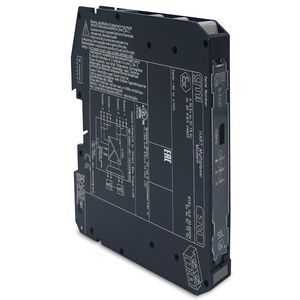
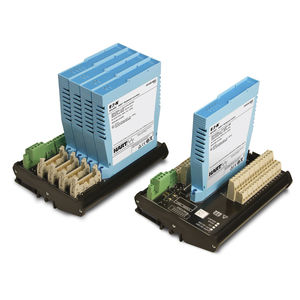
| These new fiber-optic professional amplifiers for mounting on Din rails (DIN/EN 50022) are distinctive thanks to their narrow housing width of just 10 mm, which permits their optimum stacking in large numbers. The devices are further distinguished by their long sensing range, which extends from 0 to > 200 mm, depending on the optical fibers used (no blind zone). The operating distance can be adjusted between 20 and 200 mm. Adjustment is effected by means of a 12-turn potentiometer with an illuminated professional scale. The devices are simple to operate and feature an excellent switch-point stability as well as a high switching frequency of 1.5 kHz. The switching output can be set to either light- or dark-On directly on the device. Besides this, these fiber-optic devices have an aditional excess light output and are largely insensitive to environmental influences (IP 64). They are available with both red light and blue light (sensing range 0 to > 100 mm, adjustable from 20 to 100 mm). In addition, the Contrinex range also includes high-performance devices with sensitivity adjustment by teach-in. |
|
The Erbium–doped Fiber Professional amplifier (EDFA–C band) is a general–purpose optical amplifier for the C band. This single pump optical amplifier features over 17 dBm of saturated optical output power, together with a high small–signal gain and low noise figure. A benchtop instrument version is also available on request.
-Key features and advantages
-High saturated output power
-High power stability
-Integrated control electronics
-Robust OEM enclosure with integrated heat sink
-Choice of supplier of connector type
-Custom specifications on request
-Benchtop instrument version available on request
|
|
The Erbium–doped Fiber Professional amplifier (EDFA–C band) is a general–purpose optical amplifier for the C band. This single pump optical amplifier features over +17 dBm of saturated optical output power, together with a high small–signal gain and low noise figure. Several front panel analog control options are available, including variable output power control and variable pump current control. A built-in power coupler with front panel suppliers of connector is also available as an option. An OEM module version is also available on request.
Key features and advantages
-High saturated output power
-High power stability
-Integrated control electronics
-Choice of connector type
-Custom specifications on request
-OEM module version available on request
|
|
The polarization maintaining (PM) single polarization EDFA is made for applications where the signal has to be amplified to overcome insertion losses of PM components like amplitude and phase modulators or other PM photonic devices. The PM EDFA features single polarization input and output isolators to assure high polarization extinction ratio and stable polarization of the amplified output.
Key features and advantages
-Single polarization PM output
-High polarization extinction ratio
-Single polarization input and output isolators
-Stable output polarization
-Low noise figure
-High saturated output power
-High power stability
-Integrated control electronics
-Robust OEM enclosure with integrated heat sink
-Benchtop instrument version available on request
|
|
The Ytterbium–doped Fiber Professional amplifier (YBFA–PM) is a general purpose polarization maintaining single polarization optical amplifier for the wavelength region 1030 nm–1070 nm. The amplifier is a dual stage PM Ytterbium–doped Fiber Amplifier. Performance is optimized for 1064 nm at maximum setting of each pump supplier of laser diode. This double pump optical amplifier features over +16 dBm of saturated optical output power, together with a high small–signal gain and low noise figure. Several front panel analog control options are available, including variable pump current control for each pump diode (shown in picture above). An OEM module version is also available on request.
Key features and advantages
-Single polarization PM output
-High polarization extinction ratio
-Stable output polarization
-Low noise figure
-High saturated output power
-High power stability
-Integrated control electronics
-Custom specifications on request
-OEM module version available on request
|
|
This light wave professional amplifier contains one (LWV-SE) or two (LWV-KS) optical industrial transmitter and receiver.
The received signal will be amplified and coupled back into the optical fiber cable by the transmitter. Using these devices makes unlimited transmission paths possible.
In addition to amplifying we can realise a media conversion (e.g. Multimode to Singlemode). |
|
| The Spatial Light modulators (SLMs) from Meadowlark Optics provide precision retardance control for spatially varying phase or amplitude. Our SLMs consist of liquid industrial crystal pixels, each independently addressed, acting as separate variable retarders. Meadowlark SLMs are easily incorporated into optical systems requiring programmable professional masks and variable input-output devices. Applications include femtosecond pulse shaping, adaptive optics, optical data storage, correlation and spectroscopy. |
|
LIEKKI offers a range of fiber components for use in manufacturer of fiber lasers and professional amplifiers:
• LIEKKI pump and signal combiners
• LIEKKI fiber Bragg gratings (FBGs)
• LIEKKI end caps
• LIEKKI splicing services
These fiber components are manufactured in cooperation with our carefully chosen partners according to our specifications and with our passive fibers. The combination of LIEKKI’s active fibers, passive fibers and fiber components allows the development of all fiber professional lasers and amplifiers.
Our LIEKKI components can be interconnected with standard splicers eliminating bulk optics and greatly improving reliability.
|
|
FIBER OPTIC COMPONENTS
Pasternack supplies a complete line of Fiber Optic Adapters and Attenuators for RF & Microwave applications. Our Components category includes Fiber Optic Adapters and Fiber Optic Attenuators. |
|
The Lambda Driver series consists of multi-functional, compact and modular CWDM/DWDM systems specifically designed for metropolitan service providers and enterprises requiring a flexible, cost-effective system to multiplex, transport and switch high-speed data, storage, video and voice applications. The LD systems can create up to 64 independent virtual fiber links over a single pair of fibers over distances of up to 100km. The system supports different network topologies such as Point-to-Point, Star, Linear Optical Add/Drop Mux and Ring. Service providers and Enterprise customers deploy the LD systems to maximize the bandwidth and service flexibility of their networks.
LD1600 chassis can host 16 transponders plus OADMs, Muxes/Dmuxes, 1+1 redundancy, service and 2 management modules (for redundancy).
The LD800 chassis can host 11 transponders, OADMs, Mux/Dmux, 1+1 redundancy, service module and 1 management module.
The LD400 chassis can host 5 transponders, OADMs, Mux/Dmux, 1+1 redundancy, service module and 1 management module. |
|
MRV provides several fiber-optic multiplexer products, which combine several streams of data onto a single fiber:
FiberDriver Modular, Managed Transport Solutions
E1/T1 Multiplexers
E1/T1 and Ethernet Multiplexers
FiberDrver-MM Unmanaged Standalone Solutions
E1/T1 Multiplexers
|
|
The Lambda Driver series consists of multi-functional, compact and modular CWDM/DWDM systems specifically designed for metropolitan service providers and enterprises requiring a flexible, cost-effective system to multiplex, transport and switch high-speed data, storage, video and voice applications. The LD systems can create up to 64 independent virtual fiber links over a single pair of fibers over distances of up to 100km. The system supports different network topologies such as Point-to-Point, Star, Linear Optical Add/Drop Mux and Ring. Service providers and Enterprise customers deploy the LD systems to maximize the bandwidth and service flexibility of their networks.
LD1600 chassis can host 16 transponders plus OADMs, Muxes/Dmuxes, 1+1 redundancy, service and 2 management modules (for redundancy).
The LD800 chassis can host 11 transponders, OADMs, Mux/Dmux, 1+1 redundancy, service module and 1 management module.
The LD400 chassis can host 5 transponders, OADMs, Mux/Dmux, 1+1 redundancy, service module and 1 management module. |
|
MRV's eWDM systems provide a simple, efficient, flexible and cost effective solution for deploying Gigabit Ethernet services in Campus, Metropolitan area access networks, highways, the transportation industry and Cable TV MSOs.
The Ethernet WDM (eWDM) solution's building blocks are:
OptiSwitch WDM
pluggable module with WDM SFP
LDP300 All Optics Chassis (passive)
CWDM Optical Add-Drop Multiplexers (OADMs)
Easy Deployment and flexible implementation:
Passive Optical Solution
No-power required
No configuration needed
Can work with standard LD family OADM/MUX modules
Interfaces directly to WDM (SFP/GBIC) pluggable optics
High availability and redundancy protection:
OADM: O-BPSR and O-UPSR for system and fiber cut protection
OptiSwitch GER module for fiber signal redundancy
Protocol (RSTP, MPLS) redundancy
Investment protection: |
|
A variety of casings can be offered for piezosystem jena switches. Depending on customer requirements, plug-in casings are available as well as screw slot casings and special custom size rack mount casings.
The casing not only protects the mounted fiber, it’s also the basis for easy integration of this part into your existing system.
Optical Interface
All fiber switches come standard with 1m output optical fibers and assembled connectors suppliers per customer request. Also, switches with plug in connectors (bulk head) are available. In this case, the customer can select his socket type. In each case, the customer is free to select an additional outside cable length according to his requirements.
PC connection
The switches can be controlled by TTL signal (for type 1x1 up to 1x2 channel configurations) and BCD Code (via parallel port) for 1x3 up to 1x81 channel configurations. Controlling Demo-Software comes with every switch.
Power dispenser
The operating voltage for the switch configuration 1x1 and 1x2 is 7-12 V DC or 7-9 V AC. The multiplexer with a channel configuration of 1x3 up to 1x81 needs 5V DC.
piezosystem jena offers wall power supply modules for each switch as an option. |
|
Optical isolators provide industrial lasers with immunity from back-reflection, thereby improving the signal to noise ratio for laser diode manufacturer based industrial transmitters. This is especially important for high data rate transceivers and transponders, or those devices requiring long span lengths between professional transceiver pairs. All of our isolators are based on dichroic polarizing glass and Faraday rotating crystals for highest performance. These devices are available in a single stage, 1.5 stages, or double stages, with multiple stages providing progressively higher isolation.
LightPath offers isolators in various form factors including: Cylindrical, Surface-Mount, and Sub-Mount. In addition, we manufacture isolators with either an epoxy-free optical path or with a laminated core. The primary benefits of our approach to manufacturing include reduced costs as a result of higher yields, throughput and product consistency as a result of automation. LightPath is capable of delivering a total solution to its OEM customers, from prototype and development contracting through high-volume production. |
|
When circularly polarized light is reflected, its propagation direction reverses, changing left-circular polarization to right-circular polarization and vice versa. Therefore, the same polarizer that produces circular polarization of the incident beam will block the return beam with an isolation of at least 99.8 percent.
Achieving optical isolation using Meadowlark's circular polarizers requires that a given reflection be specular and that there is no medium intervening between the reflector and optical insulation to cause significant depolarization or polarization modification.
|
|
|
|