|
|
We are a medium-sized, globally renowned high-tech company from the Stuttgart area, and for almost fifty years have provided a range of decorative and marking technologies offering unparalleled opportunities.
Since the invention of the industrial tampon printing process by owner Wilfried Philipp in 1968, the opportunities in the field of ‘tampon printing’ have been subject to constant development. New materials and the ALFALAS laser system technology in particular have also contributed to this.
The extensive range of standard tampon printing machines includes a wide range of models and options that allow us to tailor the machines and automated systems precisely to the needs of the customer.
The best trained employees, state-of-the-art production facilities and effective organisational structures are just the start of what we have to offer.
The DIN ISO 9001 certification requirements are fulfilled. |
|
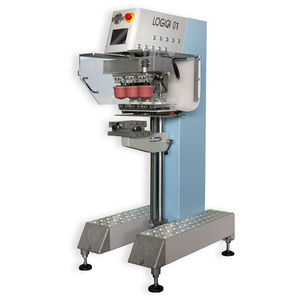
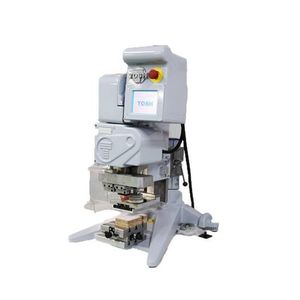
Serie LOGICA is a range of machinery studied and realized to simplify the pad printing process.
Their technological contents, as the CN electric operation, make these machines versatile and useful for any needs.
Serie LOGICA is splitted in 2 lines dedicated to different exigencies:
HIGHSPEED LINE main characteristics are high working cycles on small/medium size objects and an easy setting to be transformed in a real pad printing plant.
With HIGHSPEED LINE, TOSH improves the pad printing application opportunity even on applications where pad printing was excluded by machines technical limits.
FLEXIBLE LINE, developed for multicolour print on medium/big size objects (till 10 in a single cycle), distinguish itself with a great operative flexibility that mix very fast production changes with high production cadences. |
|
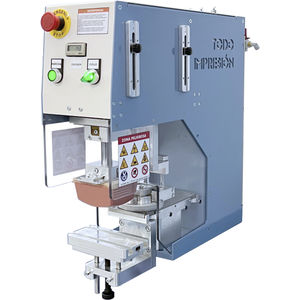
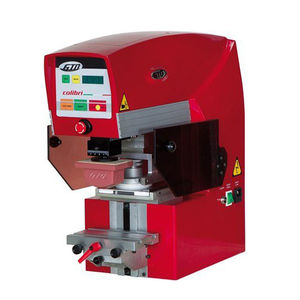
PAD PRINTING MACHINE GTO COLIBRI’ EVO
A structure entirely in aluminum alloy. Electro-pneumatic operation. Control panel with pieces-counter, automatic cycle program with introducible pauses, displays with self-diagnosis. Double-ink-loading program (this function enable a greater cover on the printing area), speed control of single movement through flow controls. This machine is the best choice to print small objects in 1 color. Technical Sheet:
Printing color 1
Steel plate size 100 x 165 mm
Max printing area 60 x 60 mm
Closed ink tray Ø 70mm
Print speed 3000 cycles./hr
Maximum print thrust 400 N
Power 220 volt
Air pressure supply
6 bar
Dimension 54 x 46 x 24 cm. |
|
ROTOTAK 3
Rotating two-colour pad-printing system for the realisation of 1 or 2-colour prints on moulded heels, en bloc soles, such as leather-effect, floral decorations, backgrounds, etc.
Evo Slider 2 GTO Pad-Printer
No. 2 printing plates max. dimensions 545x150 mm;
Electro-pneumatic operation;
Differentiated pad descent system;
Max. printing area 300x130 mm;
Ink flooding system via ink cup with Ø 140 mm ceramic ring;
No. 2 standard cups;
Structure: fusion in aluminium alloy;
Heel/en bloc soles handling system:
special sole/heel handling, consisting of a 3-axis system managed by interpolated C.N.C. The 1st axis performs a linear piece transferring movement; simultaneously and in synchronisation a 2nd axis carries out the rotary movement of the piece underneath the pad; the 3rd axis performs the pad’s upward and downward movement to adapt to the shape of the heel/sole in order to avoid excessive pressure on the pad.
The heels will be manually positioned by the operator into a blocking device made up of no. 2 barbed jaws, suitably shaped for perfect tightening of the components.
By dismantling the rotation system and lifting the printing surface, insoles can also be printed in 1 or 2 colours.
Software:
Customised with settings both via the keyboard and through self-learning;
Possibility to store the data regarding the production of each model on a floppy disk.
Standard protection system on the machine, EC conformity declaration.
Hourly production: is estimated at 300 pcs/hr in 2 colors, 400 pcs/hr in 1 colour |
|
ROTOTAK 5
The rotary 1-colour pad printing system used to print shaped heels or monoblock soles in one colour to obtain a leather effect, floral decorations or other effects. System description:
Pad printing machine GTO EVO MAXI 1 C. SLIDER:
Type block dimensions: max 600x200 mm.
Adjustable stroke on two sides.
Electro-pneumatic operation.
Max. printing dimensions: 150x300 mm.
Hermetically sealed inking system with ceramic ring Ø 180 mm.
1 standard cup.
Structure: cast in aluminium alloy
Standard columns on enclosed bearing structure.
Heel handling system:
Handling system of the heel made up of 5 NC interpolated axis system. The 1st axis makes the linear movement of the piece, a 2nd axis turns the piece under the pad simultaneously and in a synchronised manner, the 3rd axis raises and lowers the piece to adapt to the shape of the heel in order to avoid straining the pad excessively. The 4th axis tilts the piece to adapt to the last print, given by the second pad unit. Finally the 5th axis turns around the vertical axis.
The heels are manually positioned by the operator in a blocking device made up of nr. 2 relief and shaped jaws that perfectly grasp the items.
Automatic piece discharger.
Software:
Customised with settings made using a keyboard and through self-learning function.
Possibility to save the operational data on disk for one colour for each model.
Safety systems:
Installed on the actual machine in compliance with current norms, plus EC declaration of conformity.
Page 2
Hourly production: Roughly 400 pcs/hour with women and men heels, 200 pcs/hour with monoblock soles. |
|
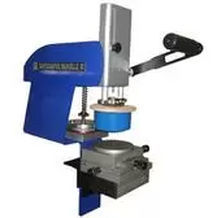
Suitable for non-deforming materials especially for uneven printing surface, such as computer keys, stationery, golf ball, etc.
Specification
1. Micro-computer control, with single/automatic operation, printing quantity / printing & flooding
times setting, light/beeper indication.
2. X / Y table left-right & up-down adjustment
3. Tampon pad / Doctor blade pressure adjustment. |
|
| This machine has been designed for print sizes from 80 mm, with 90 mm Øeter sealed ink cup, one colour, for bench use or with base. Up to 7 electronically controlled speeds; with microprocessor-controlled pneumatic movement, manually adjustable vertical stroke. High productivity. |
|
Pad printing is an indirect gravure printing process. The copy or image is etched into a steel plate called a cliche. The cliche is inked and then cleaned with a doctor blade. This leaves the ink in the etched areas only. A flexible silicone pad picks up the image from the cliche and then transfers the image to the product.THIS SYSTEM is adaptable to a variety of shapes and contours on parts with a variation in the surface, yet fine detail and precise copy can be achieved. Two color process is obtained with exact registration. Pad Printing is ideal for decorating toys, plastic housewares, and injected mold components.
This technology also lends itself to marking electronic components such as resistors, canisters, and connectors. Any part, plastic, ceramic, or metal can be production marked by this process. The equipment can be semi or fully automated, yet remains a low capital expenditure. |
|
There are six models in our line of Printex G2 pad printing machines. Although each model is separated by size and multifunctional capabilities, they are united by a common design criterion that bring advanced and practical advantages to the end user.
Our modular concept incorporates built in mechanical; electrical; and control interface features which enables every model G2 printer ready to mate with automation (yours our ours).
By using an array of optional “plug and play” devices such as our pneumatic or servo actuated slides, motor driven turn tables, carousel or over/under indexers, as well as transverse ink cup drive devices, the user can easily transform a G2 printer to meet different printing situations and requirements.
Six years since its introduction, the G2 “modular concept” has been a proven success, from concept to application, this is what separates G2 from the competition. |
|
Our latest concept in pad printing machine design is where the
customers requirements are converted into a product that totally
meets their printing needs. During the design and development of
these machines, attention is given to the smallest of detail to
ultimately provide a machine with a very high operating flexibility,
and which is still operator and maintenance friendly. At the heart of
the entire new generation SL-pad printing machines is the use of the
latest technologies.
The machine is fitted with a free programmable PLC, which gives
the control advantages detailed below.
- Individual print job programs and parameters are stored in
memory and can be recalled at the press of a button. This
gives ease of machine set up and a reduction in both set up
and down times giving increases in both production and profit.
- The parameters once set, can be locked by an access code
to prevent alterations by unauthorized personnel.
- Operating control by visual touch screen panel.
- Machine self-diagnostic check
- Machine can be used as a stand alone or integrated into an automated system.
Machine movement is provided by two, frequency controlled electric motors. These drive the pad stroke and
printing plate movement, and by using the electric drive coupled to the controllability of the PLC, the following
printing advantages becomes available.
- Speed and movement can by finally adjusted to give a smooth printing action with guaranteed print quality.
- Having an electric drive the machines dies not suffer from air pressure fluctuations, the result being you
get better and more constant print quality.
- Low running costs, which increases your companys competitiveness.
- Increased printing force allows you to optimize your printing operations by allowing you to use pads that
are larger, harder and with steeper sides. |
|
No. 1 ROTOTAK 1 EVO MODEL
Pad-printing machine used to decorate women%u2019s heels with angle open on two sides, front and back, with two strokes for leather, cork and other desired effects.
System description:
- Machine structure cast in aluminium alloy, base included;
- Equipped with No. 2 closed ink cups with 110mm-diameter ceramic ring; the cups are internally and externally coated with Teflon to facilitate the cleaning operations;
- Printing plate dimension for colour 120x450mm.;
- Max. printing dimension 200x90 mm.;
- Control keyboard;
- Electronic and differentiated adjustment for the two pads in printing phase carried out directly through the keyboard with values displayed;
- Printing pause and pick-up pause differentiated adjustment;
- Speed adjustment of each movement by means of flow regulators;
- Printing plates micrometric adjustment on the two axes and diagonal adjustment to obtain a quick centring;
- Heel-holder unit adjustment on the 4 axes, including the oscillating one;
- Possibility to use the machine in single or automatic cycle.
Hourly production: is estimated at 400/500 pieces/hour. |
|
Our range includes 8 types of cliché for all common commercial tampon printing systems, ready for print or unprecessed.
Fast service in the area of clichés and creating print templates is becoming more and more important. TAMPOPRINT is able to offer this fast service in spite of the large range of cliché materials offered, in particular by using our ALFALAS laser systems.
The extensive range of cliché materials and production types available today allow our customers to select the clichés designed to meet their requirements exactly.
The best trained employees, state-of-the-art production facilities, extensive hardware and software plus effective organisational structures are just the beginning of what we have to offer.
So it should come as no surprise that in many cases the certification guidelines required by DIN ISO 9001 are actually exceeded.
|
|
Available in hundreds of standard dimension and in different materials.
Two diverse thick steel plates depending from number of impressions and precision needed or in 3 different quality of photopolymer, ideal for small and medium runs.
TOSH experts are available for a personal photoengraving service with a guarantee quality. |
|
Printex offers three types of Image Plates:
Photo-Polymer Image Plates
A photo-sensitive nylon, laminated to a thin steel backing. Short to mid size production runs. Very cost effective, with the ability to produce in house with minimal equipment. A wide variety available through various manufacturers.
Different characteristics include thickness, speed, ability to hold fine detailed graphics vs. bold graphics and developing solution. There are two different methods of developing the image plate, alcohol and water. Some inks contain alcohol which would break down the plate during production. Typical life of a Photo-Polymer cliché can range between 5,000 up to 100,000 impressions Photo-Polymer Image Plate
Thin Steel Image Plates:
These thin steel plates offer relatively longer life than a photo-polymer plate. With a typical production run of 250,000 + these plates are ideal for mid to long production runs.
Permanent Steel Image Plates:
These plates are the longest lasting, and most durable due to their material composition. Images are etched directly into a hardened 3/8” thick steel plate.
Their cost is the highest, but yields the most impressions during a production run.
These plates will run continuously, up to a million impressions before wearing down. These plates, like the thin steel have to be made by Printex due to the process and equipment needed. Permanent Steel Image Plate |
|
| TOSH offers series of equipments that permit the steel plates or photopolymer plates making having different developing process (water or alcohol) in a very easy, fast and economic way. |
|
| The cliché is made from steel or photopolymer upon client's request. Through the graphic analysis of any proposed logo or text, that is the creation of the graphic films, we provide steel engravings that are suitable for large runs, reliable in time for life, quality and conservation; or else photopolymer engravings that are quick and easy to prepare, cheap, for small and medium runs. For further information regarding this product contact our company directly. |
|
Printex offers the UVAC series of high-quality exposure units for photopolymer printing plates processing, offering customers the convenience of plate making in their own shop.
The UVAC exposure unit features an adjustable digital timer, a reliable vacuum hold-down system with on-board vacuum gauge to provide vacuum status information at a glance. The built in safety interlock prevents accidental exposure to UV light.
UVAC units use widely available UV fluorescent lamps, which minimize maintenance costs and light quality changes. The vinyl vacuum blanket is durable, but removes easily for replacement if necessary.
For more information, please download the complete PDF brochure document below. |
|
More than 1000 standard tampons in more than 4 quality levels and shore hardnesses directly ex stock from TAMPOPRINT AG - the ORIGINAL. For "open" and "hermetic" tampon printing systems as well as "rotary tampon printing automations".
Special forms available at any time by request. Tests and advisory service in our application engineering department. Decades of experience at your disposal. |
|
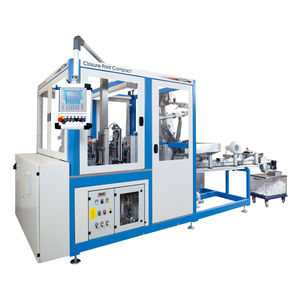
The remit for the construction of the ‘Rotoprint’ model was a compact design while still achieving a high output.
The concept allows an output of up to 100,000 or 150,000 units/hour for closures with a 28 mm diameter, depending on the settings.
For closures with a 38 mm diameter, the machine achieves an output of approximately 75,000 or 110,000 units/hour.
The ‘Rotoprint’ can be set up for print images with 1–3 colours.
With all variants, parts are fed using the well proven sorting elevator, eliminating the need for unnecessary machine stops due to closures being the wrong way round. The storage reservoir of the sorting elevator can be filled on request using the Octabin tilting stations.
The system is fitted with exchangeable mandrels. This guarantees a quick and economical process changeover on the system when printing several cap types.
The ‘RTI 2000’ printing unit is operated without the use of any tools and requires no external ink supply systems. This dramatically reduces set-up times and ensures trouble-free operation. Gas is used in the process of end drying. This guarantees that the ink dries quickly and assists ink adhesion.
The products are discharged in correct position on a cold-air drying conveyor.
|
|
Suitable for non-deforming material or rigid substrate flat surface printing, such as acrylic sheets, transferring paper, computer keys, stationery, golf ball, etc.
Suitable for non-deforming material or rigid substrate round / conical / oval printing, such as bottles drun, glass, etc. |
|
Reliability and economy were united with the screen
printing machines of the SP-series, which
corresponds to the requirements of a modern
production. The ST machines is characterised by
longevity and robustness, this sets new yardsticks
with printing machines. An optimal operator and a
very low maintenance and thus a economical
enterprise round the advantages off
The drive of the blade carriage and the blade stroke
take place by means of steered electric motors.
Squeegee pressure is adjusted with one
mechanically, fitted with springs cam disc. The
speeds and movements can be stopped individually.
The operation been made by a Touch screen on
which all machine functions to be indicated and
selected.
The machines are prepaired for the use of peripheral devices, like round formwork tables, inflation devices,
indexations for multi colorprinting etc..
Also with a few steps can the machine be converted to round printing.
The operation of the machine is made by a Touch-screen. |
|
| The result of years of research and experience in the field of pad printing, this machine is able to print from 1 to 6 colours. Computerised electronic control with 4 axes, movements by means of motors and ball screws. Independent horizontal strokes of pads and sealed ink cups (or open plate-holding inktray) and vertical strokes of pads and piece-holder axes. The machine is designed for a wide variety of accessories giving very great control and for maximum printing precision, also over time. High productivity. |
|
2 COLOR PAD PRINTING MACHINE GTO EVO 2C
Designed for two colour medium format printing.
- Stand in aluminium alloy with adjustable feet.
- A structure entirely in aluminum alloy.
- Electric-pneumatic operation.
- Self-diagnosis electronic card.
- Control panel with single and double color ink-loading program. The double ink loading program enable a greater cover on the printing area as needed.
- Speed control of each single movement through flow control.
- With 2 hermetic ink-cups Ø 110 mm. Inking system with an internal and external "teflon coated" process which reduce cleaning time.
- Max printing area 110x90mm.ù
- Cliché size 250x125mm.
- Cliché-holder with adjustable registration on 2 axis.
- Electronically controlled descent of the pads with different strokes displayed on the control panel.
- Piece-counter displaying the hour-average of printed cycles.
- Piece-holder adjustable on the three axis complete of platform balance regulation to facilitate printing on object with diagonal surface.
- Lateral sliding protection doors.
- Decibel reduction filters.
- Dimensions: 161x90x181 cm.
- Weight 210 Kg.
- 3 years guarantee. |
|
Table pad printers without stand. This machine is to print small objects in 1 or 2 colors.
- Electro-pneumatic operation.
- A structure entirely in aluminum alloy.
- With # 2 closed hermetic ink-cups Ø 70 mm. with ceramic rings with separately regulation on the two diagonal axis with micrometric screws
- Clichè size 175x80 mm.
- Max printing area 65x60mm.
- Shuttle with speed control adjustable on three axis with differentiated runs of pad and ink cups
- Control panel with single and double color ink-loading program. The double ink loading program enable a greater cover on the printing area as needed.
- automatic cycle program with introducible pauses from the control panel
- Keyboard of commands with pieces-counter
- Automatic cycle program with introducible pauses.
- Commands by pedal of automatic and single printing cycle.
- Self-diagnosis electronic card.
- 3 Years guarantee. |
|
Our latest concept in pad printing machine design is where the
customers requirements are converted into a product that totally
meets their printing needs. During the design and development of
these machines, attention is given to the smallest of detail to
ultimately provide a machine with a very high operating flexibility,
and which is still operator and maintenance friendly.
At the heart of the entire new generation SL-pad printing machines
is the use of the latest technologies. The machine is fitted with a
free programmable PLC, which gives the control advantages
detailed below.
- Individual print job programs and parameters are stored in memory
and can be recalled at the press of a button. This gives ease of
machine set up and a reduction in both set up and down times giving
increases in both production and profit.
- The parameters once set, can be locked by an access code to
prevent alterations by unauthorized personnel.
- Operating control by visual touch screen panel.
- Machine self-diagnostic check
Machine can be used as a stand alone or integrated
into an automated system
- Machine movement is provided by two, frequency controlled electric motors. These drive the pad stroke and
printing plate movement, and by using the electric drive coupled to the controllability of the PLC, the following
printing advantages becomes available.
- Speed and movement can by finally adjusted to give a smooth printing action with guaranteed print quality.
- Having an electric drive the machines dies not suffer from air pressure fluctuations, the result being you get
better and more constant print quality.
- Low running costs, which increases your companys competitiveness.
- Increased printing force allows you to optimize your printing operations by allowing you to use pads that are
larger, harder and with steeper sides. |
|
| ... products without technical information |
| |
|
|