|
|
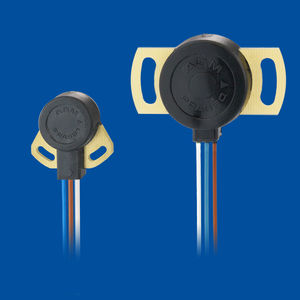
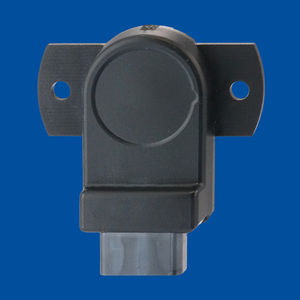
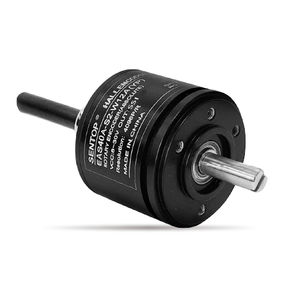
Magnetic angle sensor 0 - 360 degrees in a 36 mm dia. housing
- With 10 mm shaft or 6 mm hollow shaft
- 36 mm dia. housing
- Protection class IP67/IP69K
- Magnetic measurement principle
- Output Voltage 0.5 ... 4.5 V, 0.5 ... 10 V; Current 4 ... 20 mA
- Redundant second channel as option
|
|
Analogue AWS Angle Sensors for harsh industrial environments feature a long service life and simple evaluation options. They are supplied as potentiometers or with calibrated voltage or current outputs.
|
|
These transducers are shaft encoders which give absolute measurements on more than one revolution of their shaft.
The encoders have a mechanic gear train which transmits the movement of its master disc to a series of slave discs for shaft revolution counting.
An electronic circuit cancels any mechanic backlash of the gear train, thus yielding a detection's.
They are mechanically strong and properly engineered in their electronics, optical and mechanic parts, being thus able to withstand heavy duty conditions.
|
|
Absolute Rotary Encoders
Compared to other systems of angle measurement, like inclinometers, rotary encoders provide a comparably high measuring frequency and a constant precision over the full measuring range, which extends beyond 360°.
Resolution Per Revolution up to 16 Bit (65536 Steps)
Up to 16384 (14 bit) Revolutions
Operating Temperature -40 to +85 °C
Environmental Protection IP 65 Enclosure and IP 66 Flange
Hollow Shaft or Solid Shaft Flanges
Stainless Steel and Explosion Proof Encoders Available
UL Certified
|
|
MAGNETOCODE - Absolute Magnetic Rotary Encoder
Interface SSI
36.5 mm Diameter
12 Bit Resolution per Revolution
13 Bit Revolutions, Others Upon Request
Operating Temperature -30 to +70 °C
Environmental Protection IP 54
Blind Hollow Shaft or Synchro Flange
Connection: Cable axial
Low-cost, very compact version with cable pull adapter for linear measurement available
|
|
General Optical Encoder Specifications
* Resolution per Revolution up to 16 bit (65536 Steps)
* Up to 16384 (14 bit) Revolutions With Mechanical Gearing, No Battery Back Up
* Operating Temperature -40 to +85 °C
* Environmental Protection up to IP 67
* Hollow Shaft or Solid Shaft Flanges
* UL Certified
* Six diagnostic LED's
* Programmable IP address
* Robust electrical connection with M12 Plugs
Profinet IO
* IRT-Functionality (Isochronous transmissions )
* Integrated IRT switch
* Programmable According to Class 3 + 4 of Encoder Profile V4
EtherNet/IP
* Integrated switch
* Programmable According to CIP-Specification
|
|
Lika's range includes absolute encoders for measurement of linear and angular movement, resolution up to 25 bit. Versions with shaft, hollow shaft and low profile are available.
Lika's range includes single turn and multi turn absolute encoders with Profibus-DP output. Programmable resolution up to 8192 x 4096, preset and offset.
Lika absolute encoders are also available with DeviceNet and CANopen outputs.
Moreover, SC1 is an absolute multiturn encoder, with digital indicator size and mounting, RS485 interface, Bus capable and reset button.
|
|
Model 500 Series (Robust)
“Versatile” and “modular” are catchwords that differentiate the incremental and absolute encoders in the Model 500 Series of robust encoders. Used in many different types of industrial applications such as electric motors, cranes, elevators and general automation, the series’ mechanical, optical and electrical interfaces have become industry standard. If the standard selection of interfaces does not suit the application’s particular requirements, customised, cost-effective solutions may be provided with short lead times.
|
|
To meet the increasing demand for reliable, low cost, high-speed rotary encoding, Renishaw has introduced a range of OnAxis magnetic encoders.
These high-speed rotary magnetic encoders are designed for use in harsh environments, such as marine, medical, print, converting, industrial automation, metal working, motor control, and instrumentation.
|
|
Compact encoder
For industrial standard applications
The traditional type, but at the same time extremely flexible. Absolute encoder available with solid shaft, hollow shaft, blind shaft or integrated coupling.
Double encoder
For redundancy applications
Two redundant absolute encoders with a common shaft or two detection units with a central disc. Various combinations of interfaces possible.
|
|
|
|
|
|
The wide diversity of knowledge and experience, built up over many years within the Wachendorff group of companies, has logically konsequent been used to integrate a new product series into the production program. This has resulted in an innovative range of absolute encoders for CANopen, “Made by Wachendorff in Germany”, that are based on the magnetic principle. They come in single or multiturn versions, with a clamping or synchro flange, or as blind hollow shaft encoders.
The WDGA series was first shown at the SPS/IPC/DRIVES 2008 exhibition in Nuremberg and met with a lot of interest.
The Wachendorff absolute encoders are designed in accordance with the communication profile CiA DS-301 and to the device profile for encoders CiA DS-406 V3.2 class C2. An LED is provided for status signalization as per DR303-3. The WDGA absolute encoders can be configured, without a bus cover, via LSS (layer setting services) to DS-308, or optionally via SDO (service data objects). They offer comprehensive CANopen functionality: position, speed and acceleration objects, limit switch and cam switch functions, up to four individually configurable Transmit-PDO (process data objects), Heartbeat and Nodeguarding as well as other comprehensive diagnostic possibilities, which take into account important aspects of safety.
As ever, the WDGA absolute encoders boast an industrially rugged construction, offer a high level of precision measurement and withstand high bearing loads.
|
|
Incremental encoders
Solid shaft encoders
Incremental encoders generate a certain number of pulses per revolution. The number of pulses is a measure of the distance moved (angular or linear).
Hollow shaft encoder
Hollow shaft encoders are always used when reduced installation length is required or when precision is important where the drive is subjected to high acceleration.
Absolute encoders
Singleturn
Absolute encoders provide a specific numerical value (code value) for each angular position.
Multiturn
Multiturn encoders not only detect angular positions but also distinguish between several revolutions.
|
|
The encoders of the FIELD BUSSES series are absolute Single-turn or Multi-turn rotary shaft encoders with an interface to connect to field bus systems according to the PROFIBUS, INTERBUS, CANopen, DeviceNet or Ethernet standard.
PROFIBUS: PROcess FIeldBUS (in according to EN50170 vol.2 Standard), was one of the first open bus for constructors. DP VERSION is oriented to fast switch of a reduced number of data in automation sector.
CANopen: Controller Area Network; transmission protocol to message oriented. Used in automotive sector.
DeviceNet: field bus similar to CANopen, but much more open and with more restrictive specifications.
InterBus: first open bus realized in the world ( in according to EN50254 and IEC 61158 Standard). It is able to realize real-time functions.
|
|
Model 600 Series (Robust)
Field bus interfaces based on Ethernet, PROFIBUS or CAN are examples of the communication protocols often used in automation. These interfaces are available on the Model 600 Series absolute coded singleturn or multiturn encoders. A robust mechanical design in shaft or hollow shaft design ensures that installation and start-up of these models are always reduced to a minimum. Serial point-to-point interfaces such as EnDat or the popular SSI are examples of other communication interfaces often used for position feedback from absolute coded encoders.
|
|
Absolute encoders MEM always provide the actual position data at the system power on, despite possible shaft rotations; therefore there is no need to reset to the zero point after a power down.
The encoders serieS MEM operating principle is thoroughly electronic - no gear involved - and allows to achieve high acceleration and long lasting.
The data reset function is available for any position.
- High resolution: 5÷13 bits/rev. x 15 bits rev.
- SSI serial output
- Data memory >13 years
- Position reset function
- Binary or Gray code
- Strong and reliable
- Different mechanical versions available:
MEM520 Ø 58 mm round flangeservo coupling (SIZE23)
MEM540 Ø 58 mm round flange Ø 36 mm centering mask
MEM620 63.5x63.5 mm square flange (SIZE25)
|
|
|
|
|
|
Absolute rotary encoders provide a distinctly coded numerical value for each shaft position. In positioning tasks in particular, the absolute encoders relieve the controller of computation tasks and keep costs down by eliminating the need for additional input components.
Moreover, reference runs when the machine is switched on or after power failures are no longer required as the current position value is available immediately. Parallel absolute encoders transmit the position value to the analyzing electronics through several parallel cables. Serial absolute encoders transmit their output data via standardized interfaces and protocols.
In the past, point-to-point connections were frequently set up for serial data transmission but today fieldbus systems are being used more often.
Interfaces:
The Pepperl+Fuchs rotary encoder portfolio includes the most varied range of current interfaces for absolute encoders to be found on the market:
Parallel Interface
SSI-Interface
AS-Interface
CAN
DeviceNet
Ethernet
PROFIBUS
PROFINET
|
|
Utilise a very modern technology; a particular code-reading
method allows to eliminate every mechanic action of gears
to assure a real absolute value of the recording.
Furthermore it permits to choose the code and the
increment directionhaving in basic configuration as gray
code as binary code as up/down discriminate.
|
|
The absolute rotary encoder is used to establish an informational link between the key components of machines, industrial robots, comparators and DCC, NC or Digital Readout units. It gives information about the value and direction of the motion components. The encoder is used in automatic control, on-line gauging, in process monitoring systems, etc. The encoder keeps information about the position of the shaft even if the power is turned off.
Model: A58K
Type: Absolute rotary encoder;
Diameter, mm: 58;
Number of pulses per revolution: 4098 (12 bit);
Output signals/Power supply: Grey code/+5V;
Accuracy, arc. sec.: ±0.5 bit.
|
|
Singleturn and multiturn encoders with Fieldbus, SSI, parallel- or analogue interfaces
Technologies:
- Absolute multiturn encoders with mechanical gear or electronic multiturn stage
- Intelligent Sensing Technology (IST)®
- Integrative Technology®
- Safety LockTM Design, OptoASIC Technology
- Latest field bus profile
These characteristics are ideal, for example, in the following applications:
- Trains, buses, construction plant, agricultural vehicles and other mobile equipment
- Movement of materials, storage, transport and storage technology.
- Plant engineering & Construction
- Elevators
- Gears & motors
- Wind power
|
|
Its outstanding performance figures makes the absolute rotary encoder GEL 235 clearly superior to both conventional encoders and optical systems. Using an innovative technique that reinterprets the familiar vernier principle, the GEL 235 is able to achieve unprecedented precision. This absolute rotary encoder operates wholly reliably even under the most rugged conditions, such as widely fluctuating temperatures and moisture conditions or strong vibration.
|
|
|
By converting shaft rotation into electronic pulses, encoders are used to electronically monitor the position of a rotating shaft. The encoder’s output pulses are counted and evaluated by a control unit to determine machine position and velocity, which provides exceptional accuracy and flexibility when controlling motion. The high mechanical and electronic operating speeds associated with optical encoders increase system speeds and accuracy, decrease cycle times, and boost overall productivity in the manufacturing environment. Autonics rotary encoders of various sizes and types offer high-quality and precise measuring of the operating position and speed of the rotating shaft, etc. for more precise control of the objects.
|
|
These encoders have a special gear mechanism and count revolutions and put out binary signals. They are free from noise and accumulated error.
* Resolution per turn (C/T) is between 1 and 256 allowing for a wide range of applications.
* Output signals are sent out from each bit in parallel in the form of electrical signals.
* These encoders are vibration and shock resistant and can be used to construct highly reliable systems.
* They are light-weight and compact, dust-proof and drip-proof.
|
|
Water Resistant Encoder for Tough Environments
IP65 drip-proof/oil-proof with sealed bearing
8 mm stainless steel shaft
NPN, or PNP open collector or voltage outputs
Optimum angle control
Response frequency: 20 kHz max., 5,000 rpm max.
|
|
Sherborne Sensors can supply an extensive range of absolute rotary shaft encoders with an emphasis on robust products to work reliably in the most demanding of applications including.
Typical applications include:
Steel Industry
Paper industry
Robotics
Cranes and lifting equipment
Materials handling
Angular alignment
Measurement and inspection
Laboratory testing
|
|
Absolute encoders are devices used to measure lengths or angles and are used as distance gauges in machine tools, in handling and automation technology and on testing units.
Absolute encoders
These output positional information in the form of a numerical value (code). This numerical value is unique across the entire resolution range of the absolute encoder. For this reason no initial reference run is required, as is the case with incremental encoders.
With rotary encoders, a distinction is made between single-turn encoders, which provide a resolution on just a single rotation and then revert to 0, and multi-turn encoders that provide a resolution over several rotations. A further distinction is made between optical and magnetic encoders.
|
|
The Hollow-Shaft Optical Encoders are rugged,
high-performance devices designed for
use where precise motion sensing is critical.
The Series 835H is available in three different models. They have the same mechanical and electrical features,
but differ in performance and price.
The following features are common to all models:
Optional zero index Fits any size shaft up to 1.2"(30mm)
diameter Simpler design of user's shaft: No threads, shoulders,
or critical length requirements Internal flexible coupling
for easier installation Combination synchro/face mount
or square-flange mount Shielded ABEC Class 7 bearings
for protection against contaminants Precise chrome-on-glass disc.
|
|
Specifications:
Resolver without slots for very high speed. Single step tranformer with more output power. For radiation environments.
Accuracy: 60 min
Pole: Speed 1
Excitation frequency: 6...12kHz
Supply voltage: 2...12 VAC
Tranformations ratio: 0,5 (+-5%)
Zero voltage: < 0.01%
Size: 15
Housing: 36,83mm x 20mm
Hollow shaft size: 6 or 10mm
Working temperature: -60°C... + 155°C
|
|
Absolute Single-turn
Absolute encoders, contrary to the incremental ones, deliver their position even after cut of the supply voltage and do not require mechanical repositionning. Single turn encoders allows the positionning in the revolution (0-360°).
Absolute encoders provide Gray, binary or other specific code upon request.
Three ranges are available: the 58mm POSI+TM the 90mm ROBUSTECHTM, the 200mm MAXXTM.
Absolute Multi-turn
In addition to the position in the revolution, absolute multiturn encoder provides the number turns which have been made, up to 65,536 revolutions (16 bit).
A complete range of multiturn encoder is available with a mechanical or a patented all electronic memorisation of the number of turns.
|
|
Absolute coders MT
The multi-turn absolute coders seize the mechanical movement of rotation of a drive on several revolutions. Absolute coders ST
The absolute coder ST
delivers for each angular position a value of coded position single. The value of absolute position is available as of the interlocking of the system. For this reason, a race of reference during the interlocking of the system is superfluous.
|
|
|
Absolute encoders have a unique value (voltage, binary count, etc) for each mechanical position. When an absolute encoder is turned on, the position of an absolute encoder is known.
|
|
|
|