


{{product.productLabel}} {{product.model}}
{{#if product.featureValues}}{{product.productPrice.formattedPrice}} {{#if product.productPrice.priceType === "PRICE_RANGE" }} - {{product.productPrice.formattedPriceMax}} {{/if}}
{{#each product.specData:i}}
{{name}}: {{value}}
{{#i!=(product.specData.length-1)}}
{{/end}}
{{/each}}
{{{product.idpText}}}
{{product.productLabel}} {{product.model}}
{{#if product.featureValues}}{{product.productPrice.formattedPrice}} {{#if product.productPrice.priceType === "PRICE_RANGE" }} - {{product.productPrice.formattedPriceMax}} {{/if}}
{{#each product.specData:i}}
{{name}}: {{value}}
{{#i!=(product.specData.length-1)}}
{{/end}}
{{/each}}
{{{product.idpText}}}


... an environmentally friendly reservoir breather / air filter that features replaceable LEIF® filter elements and silicon end caps. Utilizing high-efficiency glass fiber media (3 micron absolute for air), the breather serves ...
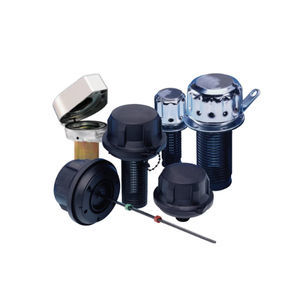
... The Parker AB Series comprises a broad range of top-mounted breathers and filler breathers. The filler breathers protect hydraulic systems from airborne particle ingress, while allowing sufficient airflow ...
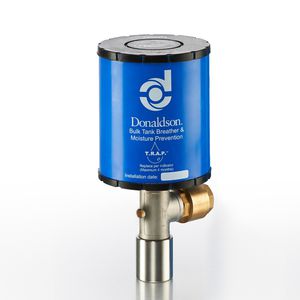

... Advanced Protection (T.R.A.P.) Breather assembly protects the contents of your storage tank from airborne moisture and particulate contamination. It combines a high-capacity 3 micron air filter with a deliquescent breather ...
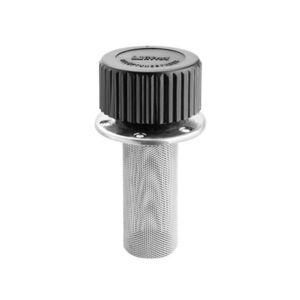

... With filling filter 6 hole flange Nominal flow rate up to 250 l/min (66 gpm) Application Filling / ventilation of tanks for hydraulic and lubrication systems as well as gearboxes. Special features The profiled metal flange with elastomer ...
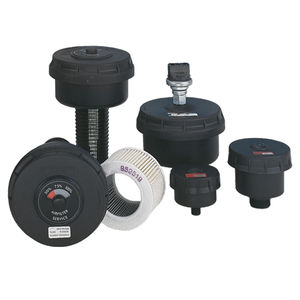

... circuit. Our breather filters also protect the environment of your equipment from harmful oil aerosols that can escape from the tanks. By using the unique MOL elements, the oil mist is separated and returned to the tank. Our breather ...


... The Eaton tank breather filters of the Series BFD prevent water and other contaminants from entering fluid reservoirs where differential pressures can occur through thermal expansion and contraction of the fluid, or during filling or ...
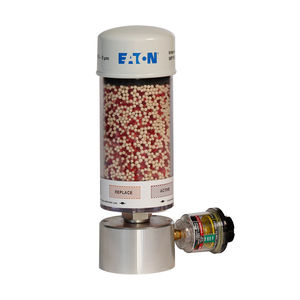

... The Eaton tank breather filters of the Series BFD prevent water and other contaminants from entering fluid reservoirs where differential pressures can occur through thermal expansion and contraction of the fluid, or during filling or ...
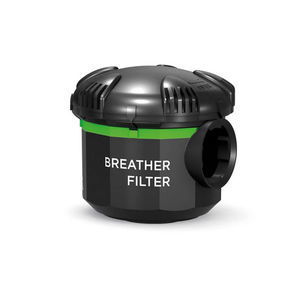

... Without effective
breather filtration, incoming air can carry fine dust and particles that accelerate wear, clog valves and cause premature system failure.
Product types and benefits Spin-on
breather filters ...
MANN+HUMMEL Filters


... 5/16″ hex head breather with a sintered filter element (opposite to 10-32 or M5 male thread). The breather is used to keep foreign material from entering a fluid circuit. 5, 20, 40 micron sintered filter elements available. Features ...
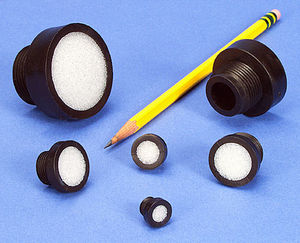

... . These Breather Vents incorporate a solid base of HDPE Plastic and a porous disc of polyethelene. The disc has an average pore size of 60-80 microns. They can be used for low pressure applications of 1 to 5 psi delta P. The breathers ...
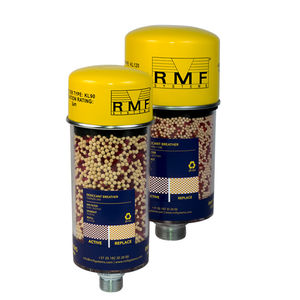

... Toughest desiccant breather on the market The Titan series operate by the same efficient process as the other air breathers within the RMF Systems range. The difference is the housing of the Titan Desiccant Breather, ...
RMF SYSTEMS B.V.
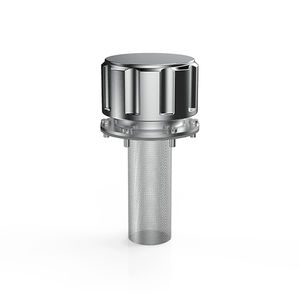

... needs of hydraulic systems and tanks for most industrial and mobile applications. Whether you require simple filler breathers or precise electrical level switches, UFI Hydraulics accessories range will provide you with the choice ...
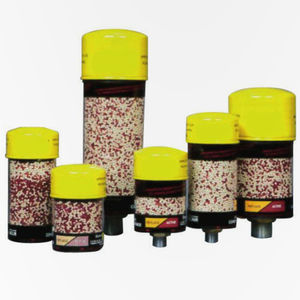

... Complete range of hydraulic filters and accessories for any hydraulic equipment. Suction Low - medium - high pressure Return Tank accessories, Filtration unit, Absorbents ...
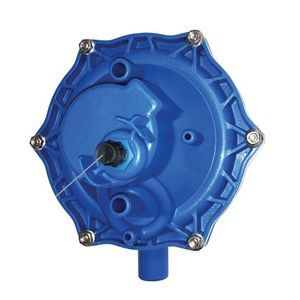

... Pressure-Activated Sump Breather with Wireless Monitoring Capability The patented Model 3 Diaphragm Sump Breather is an advanced, pressure-activated solution that protects the vacuum system’s controller from moisture ...
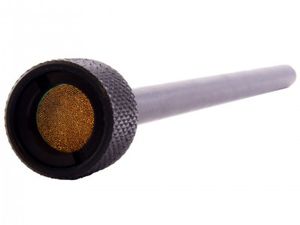

... The BLD9723 converts the standard BLD6693 Breather into a Breather Desiccator by adding a desiccant cartridge to the rear. Similar in design to our stick desiccators this is one of the smallest units we offer and eliminates ...
Brownell Diatero


... 100g Silica Gel Filled Unit M50x1.5 Thread Our range of static panel mounting desiccator are combined with relative humidity indicators which are a visual indication of when the desiccator has fully adsorbed. This style of unit can be recharged with ...
Brownell Ltd
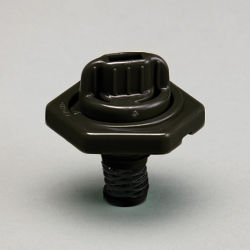

... supplied with a black Breather Vent as standard. Adapter 17-00497 is available to install a desiccant breather in place of the breather vent for contamination removal. Breather ...
Trico


... caps with air breather Nylon made filler caps with air breather Cloche air filters Air filters with spin-on element Aluminum level gauges with thermometer Ikron accessories include filler caps with or without air ...


... Solberg’s Breathers are designed to protect hydraulic tanks, lube oil reservoirs, gearboxes and other enclosures that need bidirectional venting. Our line of breathers improve flow dynamics, reduce noise, help maintain ...
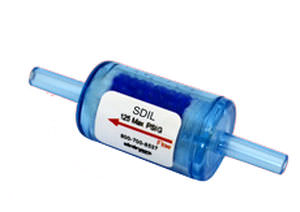

SDIL uses silica gel to adsorb water vapor. The silica gel color changes from blue to pink when saturating, indicating time to replace.
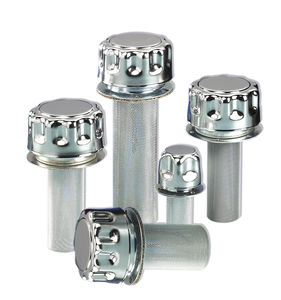

... The FT Series, manufactured by Filtrec, is a filler breather filter that is well suited for minimal labor cost, maximum productivity and efficient connections. This is specially designed to lock out water or dust. It also enables passage ...
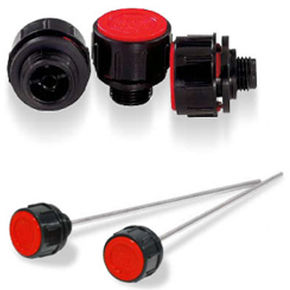

... This TSV/TSAV/TSAF is manufactured by Misellisrl. The filler breathers TSV-TSAV have small external space requirements; they are used in applications where a pressure needs to be maintained within the tank. The check valve will open when ...
Miselli
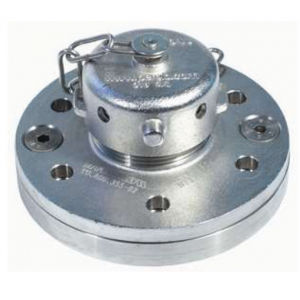

... 2” H2O2 breather – used on Hydrogen Peroxide tanks to vent the tank during transport – This product is composed by 2 sintered discs. One in the body acts as a filter for the compressed air when pressurizing the tank in unloading operations. ...
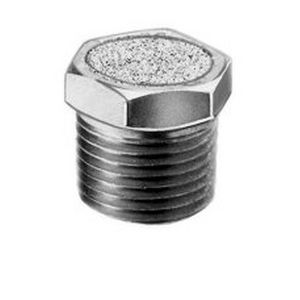

... Used on single-acting valves and cylinders to prevent dirt from entering the ports open to the atmosphere. Other uses are for vacuum relief or pressure equalization in gearboxes, reservoirs and air tanks. 40 micron filtration. Selection based on ...
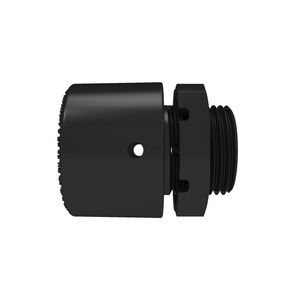

... The Hawke 385 plastic breather drain is a cost effective fitting to prevent condensation and drain moisture from hazardous area enclosures. Dual Certified ATEX/IECEx (along with many more) for use in Increased Safety (Exe) and Dust (Ext) ...
Hawke International U.K
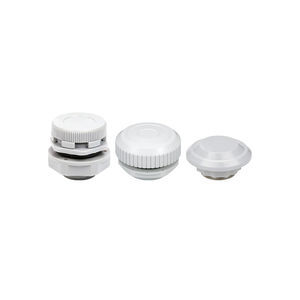

... Summary
A screw-in pressure-compensation
breather designed to allow air and water vapor to pass while equalizing pressure between the interior and exterior of sealed cabinets and enclosures.
Features
- Physical:
the best suppliers