|
|
Compressed air condensate generally has far more oil than
20 mg/l content. The user has two possibilities.
Firstly, he can have the condensate taken away by a specialist waste disposal firm at great cost. Alternatively, the user can process the condensate on site by separating the oil and the water, which forms the largest
proportion.
ZANDER’s ecosep S high efficient oil-water separator and
the ecodrain automatic drain, offer compressed air users a
complete condensate management system to achieve an oil content, in water of 10 mg/l or below which can be discharged into the effluent system.
-ecosep SL 1 - SL 60
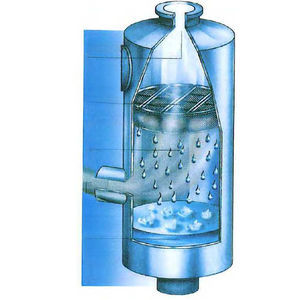
Separating system for non emulsified compressor condensate. Usable to connect several condensate drain systems. The adsorption charcoal filters adsorb the remaining oil droplets and garant high safety in application.
Standard complete and ready for operation.
Optionally a heater is available.
|
|
| All separators are manufactured in accordance with Atlas Copco's Quality and Environment Management System. These systems comply fully with ISO 9001 and ISO 14001. All Atlas Copco separators are tested to perform under the most demanding conditions. |
|
Inlet capacity: 35 to 2360 l/s, 75 to 5003 cfm
Filtration: oleophilic and activated carbon filters
Oil content: less than 15 mg/l
|
|
OSC - Advanced technology for all compressed air condensates
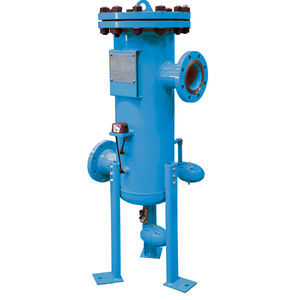
The new and extensive OSC range from Atlas Copco uses patented technology to separate all kinds of compressed air condensate.
The multi-stage separation process, using both buoyant oleophilic filters and activated carbon, ensures exceptional performance, long and proven filter lifetime and trouble-free operation.
All separators are manufactured in accordance with Atlas Copco's Quality and Environment Management System. These systems comply fully with ISO 9001 and ISO 14001. All Atlas Copco separators are tested to perform under the most demanding conditions.
Inlet capacity: 35 to 2360 l/s, 75 to 5003 cfm
Filtration: oleophilic and activated carbon filters
Oil content: less than 15 mg/l |
|
In order to prevent paraffin separation and clogging of the filter at low ambient temperatures, pre-warming with electric heating elements or recirculation of fuel that has been warmed by the engine is used in our fuel filters.
For newer generations with even higher requirements, MAHLE has opted for two separate filter stages during water separation.
The first filter phase consists of a cellulose filter medium with an untreated melt-blown contact surface for increasing the contaminant absorption capacity. This melt-blown contact surface optimally causes the many small droplets to coalesce into larger ones. The particulate filter in the shape of a pleated star even agglomerates the finest water droplets.
The second filter phase consists of a water separator, whose hydrophobic fabric with a mesh width of 25 µm divides the barely stable emulsion, thus separating the water. As this occurs on the clean side of the filter, it is referred to as clean-side water separation.
|
|
The new and extensive OSC range from Atlas Copco uses patented technology to separate all kinds of compressed air condensate.
The multi-stage separation process, using both buoyant oleophilic filters and activated carbon, ensures exceptional performance, long and proven filter lifetime and trouble-free operation.
All separators are manufactured in accordance with Atlas Copco's Quality and Environment Management System. These systems comply fully with ISO 9001 and ISO 14001. All Atlas Copco separators are tested to perform under the most demanding conditions.
- Inlet capacity: 35 to 2360 l/s, 75 to 5003 cfm
- Filtration: oleophilic and activated carbon filters
- Oil content: less than 15 mg/l |
|
| ... products without technical information |
| |
The oil separator effectively removes oil from the discharge gas in the strainer elements and returns the oil through a high precision float valve to the crankcase or oil control system. The efficiency of oil recovery is dependent on the reduction of gas velocity in the separator itself. Providing the oil separator is correctly applied, this will be about 97 % to 99 %.
The use of ESK oil separators protects the compressor from defects cause by lack from lubrication and improves the heat transfer in the evaporator.
Oil separators should be installed whenever the following applications are considered:
• Evap. temp. below <-10 °C
• Blast freezers
• Capacity control
• Two stage plants
• Parallel systems
• Cascade plant
• Flooded systems
• Booster |
|
The Parker oil separator removes oil from system refrigerant by means of a highly efficient coalescing filter. The filter is 98.5% efficient, filtering oil and particles down to 1/10 of a micron while leaving a trace amount of oil necessary for adequate system lubrication. The separator is ideal for recovery and reclaim operations.
|
|
The STA DPS system is a plate phase separator for static separation of two fluid phases which differ in density by at least 5% (e.g. coolant lubricant emulsion and hydraulic oil). Using gravitation (sinking of the heavy phase) and coalescence (merging of droplets), the light phase is made to float when flowing through the unit, and continually runs off.
Plate phase separators are used more and more frequently on account of increasing requirements regarding purity of industrial fluids, e.g. the separation of mineral oils from waste water, emulsions and degreasing baths. They can be operated with very low operating costs and can be used universally.
|
|
Applications
Extracting oil from de-greasing baths
Extracting oil from soluble cutting oil baths
Features
The SIEBEC H50 oil extractor consists of:
- a Polypropylene filter body fitted with a fast-opening lid
- a removable Polypropylene micro-fibre container (capacity 11.5 litres)
- an automatically primed magnetic drive centrifugal pump (230V/400V -50 Hz) whose flow can be regulated by an exit valve to between 0 and 11 m3/h.
|
|
- Separates insoluble oils that migrate from machining fluids.
- Recovers the original characteristics of the machining fluid.
- Speeds up the oil coalescence process.
- Prevents the development of bacteria owing to a programmable oxygenation system.
Standard capacities: 600 - 1200 - 2000 - 3000 Litres
Options: Swarf/chip separation basket - fine filtration - treatment of bacteria by ultra-violet process |
|
Filters separator diesel water/gas oil RACOR
Description:
- A broad range of filters for the protector of the engines with the series SPIN ONE of Parker RACOR conceived for the systems of modern injection.
- Flow of 57 with 600l/h.
- Filtration of 2,10 or 30 microns
Advantages:
- Almost indestructible transparent Bowl, resistant to UV and winter temperatures.
- Powerful pump of starting and heaters integrated in the head of the filter.
- Filter Media hydrophobic Aquabloc.
- Water Presence detector.
Applications:
- Filtration of diesel biodesel and gasoline for TP, Bus, Truck, Agriculture, Mobile, Navy, Generator sets |
|
| ... products without technical information |
| |
|
|