


{{product.productLabel}} {{product.model}}
{{#if product.featureValues}}{{product.productPrice.formattedPrice}} {{#if product.productPrice.priceType === "PRICE_RANGE" }} - {{product.productPrice.formattedPriceMax}} {{/if}}
{{#each product.specData:i}}
{{name}}: {{value}}
{{#i!=(product.specData.length-1)}}
{{/end}}
{{/each}}
{{{product.idpText}}}
{{product.productLabel}} {{product.model}}
{{#if product.featureValues}}{{product.productPrice.formattedPrice}} {{#if product.productPrice.priceType === "PRICE_RANGE" }} - {{product.productPrice.formattedPriceMax}} {{/if}}
{{#each product.specData:i}}
{{name}}: {{value}}
{{#i!=(product.specData.length-1)}}
{{/end}}
{{/each}}
{{{product.idpText}}}


... Features molded-in beam guides to simplify installation and alignment - Rugged metal IP67-rated housing - Selection switch for light/dark operate - Ideal for counting, sensing parts on conveyor rails and belts, detecting edges and gear ...
BANNER ENGINEERING CORP.

... Slot Sensors - Holds easy-to-use opposed mode sensor pairs in rugged U-shaped housing - Available with 10 mm sensing slot (SL10 models) or 30 mm sensing slot (SL30 models) - Ideal for detecting registration marks, holes or gear teeth edge guiding and ...
BANNER ENGINEERING CORP.

... - Features easy push-button TEACH-mode setup - Responds in 150 or 500 microseconds, depending on model - Uses visible red light beam ...
BANNER ENGINEERING CORP.


... Photoelectric fork sensors •Quick set-up: no need to align transmitter and receiver •Fine and precise light beam across the whole fork width •Metal housing reduces distortion • Light-on/dark-on ...
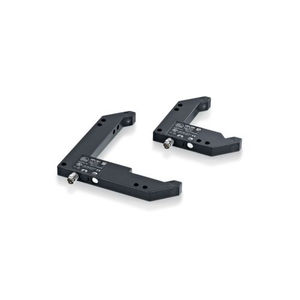
... sensors •Quick set-up: no need to align transmitter and receiver •Fine and precise light beam across the whole fork width •Metal housing reduces distortion • Light-on/dark-on mode selectable via ...
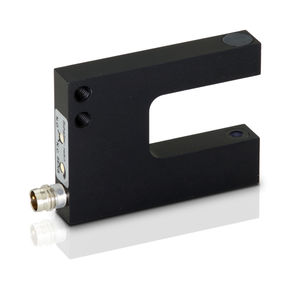

... the N/C and N/O contacts of the laser fork light barriers can be switched. The sensitivity can be adjusted using an adjustment screw. LASER LIGHT ...


... in the direct and polarized reflection, with reflector for infrared light or polarized red light, barrier with emitter and receiver versions. All versions are provided with cable or M12 connection. ...
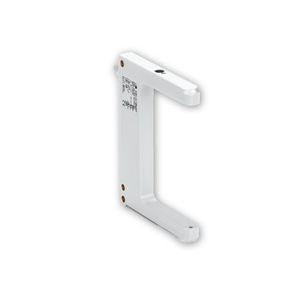

... - Precise small part detection from 0.2 mm - Indicator LEDs with all-round visibility over entire fork edge - Simple sensor mounting via dovetail guides - Sensitivity adjustment via teach-in button or control line - Robust metal plug ...
SensoPart Industriesensorik GmbH


... Fork sensors work with a collimated laser light beam with a diameter suitable for the detection of small objects. The emitter and receiver are housed in a plastic or corrosion-free stainless steel housing, ...
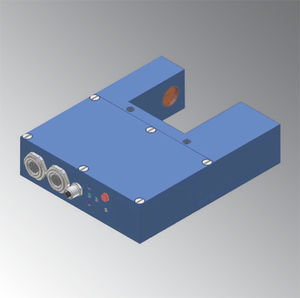

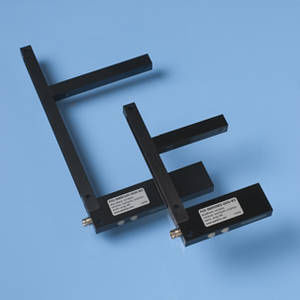

... A new gerneration of fork sensors has been introduced at the Hannover Fair 2009. These fork sensors are designed as a full modular system. The detecting distance is free adjustable. Different fixed detecting distances ...
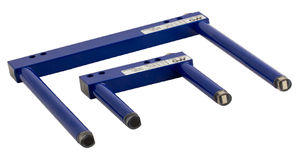

The FC5 Series manufactured by Micro Detectors is a photoelectric sensor. This device is made from metal housing materials and has a decreased dimension 0.8 mm. It is equipped with a red LED emission that operates with a high power and has a plug and ...
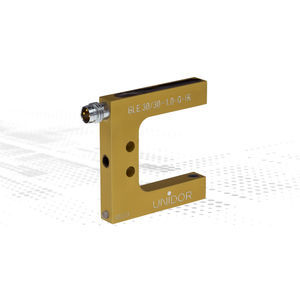

... In the GLE fork light barrier series, the control electronics are integrated in the light barrier. Different sized apertures enable reliable detection of parts and openings ...
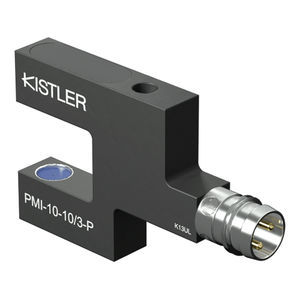

... • Fork width: 5 mm, fork depth: 10 mm • Switching function normally open (NO) • Connection: M8 plug, 3-pin Metrological characteristics Repeating accuracy, maximum 0.02 mm Electrical properties Operating voltage 12 ...
Kistler
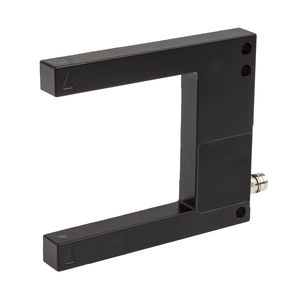

... Special design of through-beam sensor. Transmitter and receiver are located in the fork or angular limbs and are perfectly aligned to each other. ...
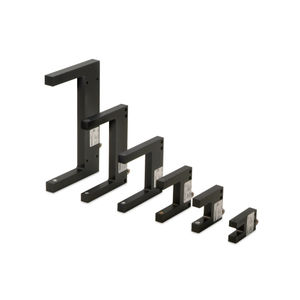

... wide array of optical fork sensors that constructed in a rigid, U-shaped aluminum framework that is operated through a thru-beam mode. They are available either with infrared, visible red light or high-power infrared. ...
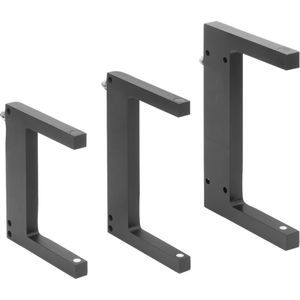

... anodised. NOTE Fork photoelectric sensors combine transmitter and receiver in one device and are therefore perfectly aligned with each other. They have a precise visible red or invisible infrared light beam. The fine ...
the best suppliers