

- Detection - Measurement
- Electrical Measurements
- Galvanic signal isolator
- Datcon Industrial Electronics Ltd.

- Company
- Products
- Catalogs
- News & Trends
- Exhibitions
Galvanic signal isolator DT1122currentvoltage4-20mA

Add to favorites
Compare this product
Characteristics
- Type
- galvanic
- Electrical characteristics
- current, voltage, 4-20mA
- Other characteristics
- dual output
Description
Product features
Product description
The DT1122 transmits the signal of a transmitter (or other signal source) connected to its input to two galvanically isolated outputs.
This feature may be required for applications where two parallel signal processors (PLC, DCS) are operating or a local indicator of the transmitter signal is required in addition to the signal processor.
Galvanic isolation is 4-way, i.e. the input, outputs and power supply are galvanically isolated of each other.
The input and output signal ranges can be selected in any combination using the front switches.
The signal ranges are as follows:
The device has two inputs:
and two outputs:
Front LED indicators provide information on the presence of power and possible fault conditions.
Technical specification
Safety data: The connection terminals of the input the outputs and the supply voltage are isolated from each other, the isolation is in
compliance with the standard EN 61010-1, taking into consideration the following:
- signal splitting: transmission of an input signal to two independent outputs
- switch-selectable signal ranges on inputs and outputs: 0-20 mA / 4-20 mA / 0-10 V / 2-10 V (in any combination)
- 4-way isolation
- 20 V transmitter power at the input for two wire transmitters
- non-linearity: < 0,02% TYP
- temperature coefficient: 25 ppm / °C TYP
- 24 VDC ±10% or 230 V AC/DC ±10% power supply
- TS-35 rail mounting, 12.5 mm width
Product description
The DT1122 transmits the signal of a transmitter (or other signal source) connected to its input to two galvanically isolated outputs.
This feature may be required for applications where two parallel signal processors (PLC, DCS) are operating or a local indicator of the transmitter signal is required in addition to the signal processor.
Galvanic isolation is 4-way, i.e. the input, outputs and power supply are galvanically isolated of each other.
The input and output signal ranges can be selected in any combination using the front switches.
The signal ranges are as follows:
- 0-20 mA / 4-20 mA current or 0-10 / 2-10 V voltage.
The device has two inputs:
- current: 0-20 mA / 4-20 mA *
- voltage: 0-10 V / 2-10 V *
and two outputs:
- output 1: 0-20 mA / 4-20 mA / 0-10 V / 2-10 V
- output 2: 0-20 mA / 4-20 mA / 0-10 V / 2-10 V
- DT1122: 24 VDC ±10%
- DT1122 PS: 230 V AC/DC ±10%
Front LED indicators provide information on the presence of power and possible fault conditions.
Technical specification
Safety data: The connection terminals of the input the outputs and the supply voltage are isolated from each other, the isolation is in
compliance with the standard EN 61010-1, taking into consideration the following:
- Pollution level: 2
- Measurement category: II
- Input signal: DC current
- Ranges: see previous page
- Input resistance: 10,6 ohm
- Overload: 400 mA
- Input signal: DC voltage
- Ranges: see previous page
- Input resistance: 102 kohm
- Overload: 100 V
- Transmitter power supply: > 20 VDC @ 20 mA load
- Overcurrent protection: 25 mA
- Number of output channels: 2
- Output signal: DC current
- Ranges: see previous page
- Load resistance: ≤ 500 ohm
- Overdriving ability: 22.5 mA
- Output signal: DC voltage
- Ranges: see previous page
- Load resistance: ≥ 500 ohm
- Overdriving ability: 11 V
- Output signal error: 0.1% FSR @ 25 ºC ±2 ºC
- Non-linearity: 0,02% (max.)
- Temperature coefficient: 25 ppm / °C TYP, 50 ppm max.
- Supply-voltage effect: practically zero
- Settling time: 250 ms (10-90%) / 300 ms (99%)
- Working voltage: 250 Veff (between the input, the outputs and the power supply terminals)
- Test voltage: Type test: 4250 VDC (1 min.), Routine test: 2500 VDC (1 min.)
- Supply voltage: DT1122: 24 VDC ±10%, DT1122 PS: 230 V AC/DC ±10%,
- Power consumption: DT1122: ≤ 2,2 W DT1122 PS: 3,3 W, 5,2 VA
- Operating temperature range: 0-50 °C (-20 °C-60 °C for customer request)
- Relative humidity: 90% (max., non-condensing)
- Place of installation: cabinet
- Mounting position: vertical (horizontal rail position)
- Noise emission: Group 1, Class B
- Immunity: industrial area
- ESD: 4 kV/8 kV surface / air
- BURST: 2 kV/1 kV power / signal
- SURGE: 1 kV
- Conducted RF immunity: 3 Veff
- Housing: TS-35 rail mounting housing material: polyamide PA6.6
- Connection: Pluggable screw-terminal
- Connecting cable: 0,25-2,5 mm2
- Dimensions / Weight: 12,5 × 99 × 115 mm (width × height × depth) / 0,15 kg
- Protection: IP20
Catalogs
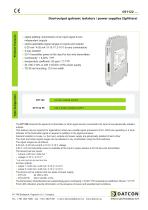
Leaflet of DT1122
2 Pages
Other Datcon Industrial Electronics Ltd. products
GALVANIC ISOLATORS


Related Searches
- Power meter
- Volt meter
- Ammeter
- Energy meter power meter
- Digital voltmeter
- Panel-mount ammeter
- Active power power meter
- AC voltmeter
- Galvanic signal isolator
- AC ammeter
- Apparent power power meter
- Reactive power power meter
- Current signal isolator
- Multi-function power meter
- Digital ammeter
- Ammeter for industrial applications
- ATEX signal isolator
- Panel-mount voltmeter
- ATEX signal isolator
- Voltage signal isolator
*Prices are pre-tax. They exclude delivery charges and customs duties and do not include additional charges for installation or activation options. Prices are indicative only and may vary by country, with changes to the cost of raw materials and exchange rates.
About DirectIndustry
DirectIndustry is a marketplace that offers B2B players a complete experience, from product sourcing to purchase. DirectIndustry is an entity of VirtualExpo Group.
Are you a buyer?
Are you a supplier?