

- Metrology - Laboratory
- Analytical Instrumentation
- Laser diffraction particle size analyzer
- JINAN WINNER PARTICLE INSTRUMENT STOCK COMPANY

- Company
- Products
- Catalogs
- News & Trends
- Exhibitions
Laser diffraction particle size analyzer Winner2309Aopticallaserfor the cosmetics industry


Add to favorites
Compare this product
Characteristics
- Technology
- laser diffraction, optical, laser
- Applications
- laboratory, for research, for quality control, for the pharmaceutical industry, for the food industry, for the cosmetics industry
- Other characteristics
- automatic, particle size distribution, wet type, dry-type, multichannel, benchtop, modular
Description
Product Overview
Winner2309A is an intelligent fully automatic laser particle size analyzer. It adopts advanced international Mie scattering and Fraunhofer diffraction principles and integrates modular wet and dry dispersion systems. A high-sensitivity, high-resolution photoelectric detection system and imported Canon-lens optical path ensure accurate and repeatable particle size distribution measurement. The instrument is suitable for quality control in industrial production and for research institutions.
Measurement Range
Wet: 0.01-3500 μm; Dry: 0.1-3000 μm
Application
Suitable for powders, suspensions and emulsions. Typical industries and materials include chemicals, magnetic materials, pharmaceuticals, cement, coatings, food, pesticides, nuclear industry, electronics, battery materials, paper, metallurgy, ceramics, building materials, cosmetics, abrasives, metal and non-metal powders, calcium carbonate, talc, kaolin, alumina, rare earths, cemented carbide, catalysts, foaming agents, refractory materials, fillers, graphite, pigments, etc.
Advantages
Dispersion Methods
Wet: ultrasonic (40 kHz, 60 W, adjustable time), mechanical stirring (0–3000 rpm adjustable), built-in circulating dispersion (flow 1–8 L/min, rated power 120 W). Dry: turbulent dispersion, automatic sample introduction, one-click testing.
Software & Output
Specifications / Technical Data
Winner2309A is an intelligent fully automatic laser particle size analyzer. It adopts advanced international Mie scattering and Fraunhofer diffraction principles and integrates modular wet and dry dispersion systems. A high-sensitivity, high-resolution photoelectric detection system and imported Canon-lens optical path ensure accurate and repeatable particle size distribution measurement. The instrument is suitable for quality control in industrial production and for research institutions.
Measurement Range
Wet: 0.01-3500 μm; Dry: 0.1-3000 μm
Application
Suitable for powders, suspensions and emulsions. Typical industries and materials include chemicals, magnetic materials, pharmaceuticals, cement, coatings, food, pesticides, nuclear industry, electronics, battery materials, paper, metallurgy, ceramics, building materials, cosmetics, abrasives, metal and non-metal powders, calcium carbonate, talc, kaolin, alumina, rare earths, cemented carbide, catalysts, foaming agents, refractory materials, fillers, graphite, pigments, etc.
Advantages
- Automatic optical path alignment with a precise four-phase hybrid stepper motor enables micron-level positioning for stable and optimal optical alignment.
- Separated modular wet and dry dispersion units: flexible assembly according to sample characteristics for simple and fast operation.
- Automatic sample dispersion system with modular piping reduces particle settling, improves uniform dispersion, lowers maintenance and simplifies cleaning.
- Instrument software uses unconstrained free-fitting technology to collect scattering data and automatically analyze multimodal particle populations; excellent resolution for particles below 2 μm (validated across 12 size grades).
- Optical path employs patented reverse Fourier (folded) design with detection angles from 0.015° to 145° to extend measurement range and resolution; sealed optical path offers effective dust protection.
Dispersion Methods
Wet: ultrasonic (40 kHz, 60 W, adjustable time), mechanical stirring (0–3000 rpm adjustable), built-in circulating dispersion (flow 1–8 L/min, rated power 120 W). Dry: turbulent dispersion, automatic sample introduction, one-click testing.
Software & Output
- Analysis models: free distribution, R-R distribution, log-normal distribution and category-based statistical models.
- Statistical comparison: compare multiple test results across batches or process conditions to guide quality and cost control.
- Data processing: intelligent statistical analysis to produce representative test results.
- Custom analysis: configurable outputs for any characteristic particle sizes between D1 and D100, cumulative percentages above/below sizes and specified ranges.
- Output formats: characteristic particle size values, differential (interval) distributions and charts, cumulative distributions and curves.
- Report export: Word, Excel, image (BMP), text (TXT) and PDF.
- One-click operation: fully automated sequences for wet or dry methods covering sampling, air/bubble removal, dispersion, measurement, cleaning and data processing.
- Interface languages: Chinese and English; additional languages available on request.
- GMP: optional.
Specifications / Technical Data
- Model Name: Winner2309A
- Principle: Mie and Fraunhofer scattering
- Measurement Range: Wet 0.01–3500 μm; Dry 0.1–3000 μm
- Test Speed: Fastest 10 seconds
- Refractive Index: User-configurable for a wide range of materials
- Sampling Frequency: Up to 10 kHz
- Number of Channels: 116
- Accuracy Error: Wet ≤ 0.5%; Dry ≤ 1.0% (CRM D50)
- Repeatability Error: Wet ≤ 0.5%; Dry ≤ 1.0% (CRM D50)
- Dispersion: Ultrasonic 40 kHz, 60 W (time adjustable); Stirrer 0–3000 rpm; Circulation flow 1–8 L/min, power 120 W; Dry: turbulent dispersion with automatic feed and one-click test
- Sample Injector: Wet: WinModule-201; Dry: WinModule-301
- Sample Tank Volume: 600 ml
- Light Source: Main laser λ = 639 nm, P > 2 mW; Auxiliary laser λ = 405 nm, P > 2 mW
- Optical Bench Alignment: Automatic
- Optical Path: Reverse Fourier (folded)
- Laser Safety: Class 1
- Dimensions: Main unit 870 × 340 × 380 mm; Wet module 415 × 280 × 335 mm; Dry module 260 × 245 × 295 mm
- Net Weight: Main unit 32 kg; Wet module 15 kg; Dry module 7 kg
- Operation Mode: SOP fully automated
- Outputs & Reports: Differential and cumulative particle size distributions, histograms/curves, exportable reports (Word, Excel, BMP, TXT, PDF)
VIDEO
Catalogs
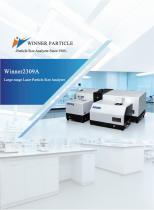


Other JINAN WINNER PARTICLE INSTRUMENT STOCK COMPANY products
Wet and Dry Integrated Laser Particle Size Analyzer


Related Searches
- Concentration analyser
- Liquids analyser
- Automated analyzer
- Desktop analyzer
- Dust analyzer
- Real-time analyser
- Laboratory analyser
- Digital analyser
- Temperature analyser
- Quality control analyser
- Conductivity analyser
- Industrial analyser
- Data acquisition analyzer
- Laser analyser
- Particle sizer
- Pharmaceutical product analyzer
- Analyzer for the chemical industry
- Laser diffraction particle size analyzer
- Laboratory particle size analyzer
- Research particle size analyzer
*Prices are pre-tax. They exclude delivery charges and customs duties and do not include additional charges for installation or activation options. Prices are indicative only and may vary by country, with changes to the cost of raw materials and exchange rates.