

- Detection - Measurement
- Flow, Pressure and Level Measurements
- Thermoelectric heat flux sensor
- NETZSCH Analyzing & Testing


- Company
- Products
- Catalogs
- News & Trends
- Exhibitions
Heat flux sensor with auto-calibration HFM 706 Lambda LargethermoelectricR&Dcalibration

Add to favorites
Compare this product
Characteristics
- Options
- calibration, thermoelectric, R&D, with auto-calibration
Description
Product overview
The HFM 706 Lambda Large is a heat flow meter designed for accurate determination of thermal conductivity (λ) of insulation materials and other solids. The HFM 706 Lambda series includes three sizes (Small, Medium, Large) intended for R&D, laboratory and quality control. The Large model accepts samples up to 611 mm × 611 mm with heights up to 200 mm.
Device variants
Measurement principle and method
Steady-state heat flow method: the specimen is placed between two temperature-controlled plates. A defined temperature gradient is applied, specimen thickness (L) is measured or entered, and two calibrated heat flux sensors measure the heat flow Q through the sample. After thermal equilibrium, thermal conductivity λ and thermal resistance are calculated from measured heat flow, thickness and temperature gradient.
Measurement & hardware highlights
Calibration & accuracy
Software & data analysis
Energy efficiency & operation
Standards compliance
Support for and alignment with relevant standards (e.g., ASTM C518, ISO 8301, JIS A1412 and DIN EN 12667 / DIN EN 12664 depending on model and application).
Accessories & optional kits
Applications
Technical characteristics / specifications
The HFM 706 Lambda Large is a heat flow meter designed for accurate determination of thermal conductivity (λ) of insulation materials and other solids. The HFM 706 Lambda series includes three sizes (Small, Medium, Large) intended for R&D, laboratory and quality control. The Large model accepts samples up to 611 mm × 611 mm with heights up to 200 mm.
Device variants
- HFM 706 Lambda Small – for small specimens and laboratory work.
- HFM 706 Lambda Medium – for medium specimens and versatile applications.
- HFM 706 Lambda Large – for large or oversized specimens (up to 611 × 611 × 200 mm).
Measurement principle and method
Steady-state heat flow method: the specimen is placed between two temperature-controlled plates. A defined temperature gradient is applied, specimen thickness (L) is measured or entered, and two calibrated heat flux sensors measure the heat flow Q through the sample. After thermal equilibrium, thermal conductivity λ and thermal resistance are calculated from measured heat flow, thickness and temperature gradient.
Measurement & hardware highlights
- Two high-sensitivity heat flux sensors with large coverage on both specimen faces for continuous and sensitive measurements.
- Bidirectional Peltier plate temperature control for fast and precise heating/cooling; external chiller for additional support.
- Motorized plate movement and motorized door for high throughput and automated workflows.
- Optional second opposite opening (Large) to measure very long or untrimmed specimens (e.g., VIPs, long samples).
- Pressure/force control: variable contact force up to 1900 N (approx. 5 kPa on 611 × 611 mm) for reproducible thickness/pressure settings; Drive-to-Thickness function for compressible materials.
- Automatic mean thickness measurement and parallelism/inclination check at four corners using a two-axis inclinometer; measurement of slightly wedge-shaped specimens possible.
- Specimen chamber with optional gas purge (dry gas flush) to minimize condensation and control relative humidity.
Calibration & accuracy
- Factory calibration with certified reference material; support for NIST SRM 1450 D and NETZSCH EPS standard.
- MultiCalibration option: combine multiple calibrations to reduce uncertainty and cover different thickness ranges.
- Typical performance (verified with NIST SRM 1450 D, thickness 25 mm): repeatability ±0.25 %, reproducibility ±0.5 %, accuracy typically in the ±1–2 % range depending on material and λ.
Software & data analysis
- NETZSCH software (Proteus / SmartMode): intuitive interface, setup wizards, predefined and user-definable method sets, favorites and automated sequences.
- AutoCalibration function (generate calibration curves at up to 99 temperatures).
- MultiCalibration for combining calibrations of different types/thicknesses.
- Report generator with standard templates (including ASTM C518 reporting), λ90/90 calculation, plotting (plate/mean temperatures, conductivity values), export to Word/Excel and full export (data + graphs); tamper-proof binary data storage.
Energy efficiency & operation
- Eco mode: fully switch off plate control and chiller to minimize energy consumption (e.g., overnight/weekend).
- Idle mode: chiller runs at low power (0.5–1.0 kW) while plate temperatures are maintained for quick restart of measurements.
Standards compliance
Support for and alignment with relevant standards (e.g., ASTM C518, ISO 8301, JIS A1412 and DIN EN 12667 / DIN EN 12664 depending on model and application).
Accessories & optional kits
- Extension sets for thermocouples (additional thermocouples for materials with higher thermal conductivity).
- Special accessories for very stiff specimens / low thermal resistance (thin rubber pads, special thermocouple arrangements).
- Reference materials (NETZSCH EPS standard, ERM-440) for calibration/validation.
Applications
- Insulation materials (mineral wool, rigid PU foam, EPS/XPS, aerogels, VIPs).
- Building materials (concrete, brick, plaster), polymer materials, phase change materials, nonwovens, natural fibers and others.
Technical characteristics / specifications
- Standards: ASTM C518, ISO 8301, JIS A1412, DIN EN 12667, DIN EN 12664 (model-dependent).
- Thermal conductivity range: typical approx. 0.001 to 0.5 W/(m·K), extendable to ~2.0 W/(m·K) with optional extension kit; accuracy depends on material and thickness (see calibration data).
- Plate temperature range: −20 °C to 90 °C (Peltier plate control).
- Heat flux sensor area: 254 mm × 254 mm (large sensor/plate coverage).
- Sample dimensions (max, Large): 611 mm × 611 mm × 200 mm (L × W × H).
- Contact force: 0 to 1900 N (≈5 kPa on 611 × 611 mm); force-controlled setting and Drive-to-Thickness function.
- Plate thermocouples: 3 thermocouples per plate (Type K); extension set available.
- Thickness measurement: automatic mean thickness measurement; inclination measurement at four corners (two-axis inclinometer) for parallelism check.
- Cooling system: external chiller for constant target temperature across plate area.
- Sealed chamber: specimen chamber with optional gas inlet / dry gas purge to avoid condensation.
- Software features: SmartMode / Proteus, AutoCalibration, MultiCalibration, report generator (including λ90/90), data export (Word/Excel), measurement wizards, reuse of calibration/measurement files.
Catalogs
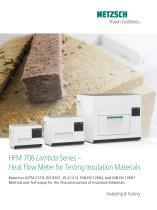
HFM 706 Lambda Series
16 Pages
Other NETZSCH Analyzing & Testing products
Heat Flow Meter (HFM, GHFM) / Guarded Hot Plate/Pipe (GHP) / HotBox Test Chambers (TDW)


*Prices are pre-tax. They exclude delivery charges and customs duties and do not include additional charges for installation or activation options. Prices are indicative only and may vary by country, with changes to the cost of raw materials and exchange rates.
About DirectIndustry
DirectIndustry is a marketplace that offers B2B players a complete experience, from product sourcing to purchase. DirectIndustry is an entity of VirtualExpo Group.
Are you a buyer?
Are you a supplier?