

- Health - Safety - Environment
- Building Security and Machine Safety
- Granular absorbent
- QINGDAO SOCO NEW MATERIAL CO.,LTD.


- Products
- Catalogs
- News & Trends
- Exhibitions
Granular absorbent ORESORB™wateruniversalfor chemicals


Add to favorites
Compare this product
Characteristics
- Type
- granular
- Applications
- water, universal, for chemicals, for mining
- Other characteristics
- biodegradable, pollution control, mineral, biological, for dust suppression
Description
Product overview
ORESORB™ is a superabsorbent polymer (SAP) series engineered for mining operations. It is formulated for tasks such as ore surface dewatering, dust suppression, sludge solidification and rheology control in tailings and slurry systems, offering saline‑tolerant grades for brine environments.
Key advantages
Background & industry challenges
Our solution: ORESORB™
Implementation notes
Applications
FAQs (summary)
Technical specifications
ORESORB™ is a superabsorbent polymer (SAP) series engineered for mining operations. It is formulated for tasks such as ore surface dewatering, dust suppression, sludge solidification and rheology control in tailings and slurry systems, offering saline‑tolerant grades for brine environments.
Key advantages
- Ultra‑high absorption capacity: up to 500× its own weight in water.
- Saline performance: approx. 70× in 1% NaCl and ~16× in 0.5% CaCl2 solutions.
- Fast absorption kinetics: rapid uptake to near saturation for short contact‑time operations.
- Safe handling profile: non‑toxic, non‑corrosive formulations tailored for mining use.
- Customizable grades: adjustable polymer types and particle sizes to match site chemistry and process goals.
Background & industry challenges
- Excess surface moisture on ores and fines causes conveyor and bunker adhesion, screening loss and increased risk during bulk shipping (liquefaction potential).
- High water and energy demands for mechanical dewatering, dust control and drying increase operating costs and environmental footprint.
- Common operational issues include airborne dust from haul roads and stockpiles, water‑rich sludges from drilling/processing, unstable tailings rheology and localized corrosion from moisture hotspots.
- Effective solutions must perform in saline/alkaline conditions while reducing water use, emissions and energy consumption.
Our solution: ORESORB™
- Dust suppression: forms a moisture‑retentive gel layer that binds fines, lowering airborne dust generation and extending reapplication intervals (typical reduction range: ~30–60% depending on context).
- Ore surface dewatering: extracts surface moisture to reduce stickiness and carryback on conveyors and binners, stabilizing feed rates without altering ore chemistry.
- Sludge/drilling mud solidification: agglomerates fines and water into a cohesive mass with low expansion (~1% reported), simplifying handling, cleanup and transport.
- Tailings / rheology control: adjusts viscosity and yield stress of slurries to reduce segregation and support water recovery in closed‑loop processing.
- Localized dehumidification: deployable as desiccant packs, coatings or sealants to create moisture‑resistant barriers in critical zones and complement mechanical dewatering.
Implementation notes
- Verify dosage with quick jar or field tests accounting for moisture load, solids fraction, ionic strength (NaCl/CaCl2), temperature and required handling time.
- Target hotspots first (adhesion points, dust sources, sludge accumulation, corrosion sites) to maximize operational impact and reduce energy use.
- Request custom formulations to match ore mineralogy, brine chemistry, particle size distribution and site objectives.
Applications
- 01 Absorb ore surface moisture: Objective: rapidly remove surface moisture to improve screening, crushing and conveyor throughput. Benefit: high uptake (up to 500×), functions in saline conditions, reduces sticking and carryback.
- 02 Polymer for sludge management: Objective: safer handling of drilling and process sludges. Benefit: rapid solidification and agglomeration, improved dewatering and lower transport costs.
- 03 Dust suppression polymer for ore handling: Objective: reduce airborne dust from haul roads, stockpiles, crushers and conveyors. Benefit: extended moisture retention and film formation that reduces particle lift‑off.
- 04 Polymers for tailings management: Objective: improve tailings stability and water recovery. Benefit: rheology control for reduced segregation and enhanced dewatering/solidification.
- 05 Mine rehabilitation and waste stabilization: Objective: remediate waste sites and control migration risks. Benefit: moisture control to limit leachate, encapsulation of fines and support for closed‑loop treatment.
FAQs (summary)
- Primary uses: dust suppression, dewatering, freeze control, rheology modification and sludge/water treatment in mining processes.
- How it suppresses dust: forms gels/films that retain moisture and bind fines, improving air quality and visibility.
- Rheology modification: alters flow properties of slurries to improve pumping and handling efficiency.
- Environmental profile: many formulations are designed to be non‑toxic and compatible with sustainability requirements; verify local compliance.
- Customization: suppliers can adapt grade, particle size and chemistry to site‑specific needs.
Technical specifications
- Absorption capacity: up to ~500× its dry weight in water (dependent on temperature and salinity).
- Saline performance: ~70× in 1% NaCl; ~16× in 0.5% CaCl2.
- Absorption kinetics: rapid uptake to full or near‑full saturation.
- Sludge solidification expansion: low expansion, ~1% volume increase reported.
- Chemical profile: non‑toxic, non‑corrosive formulations intended for mining use; verify specific MSDS for each grade.
- Formulations: multiple grades available and customizable for ore type, brine chemistry and particle size.
- Functional behavior: gel formation, agglomeration/encapsulation of fines, rheology control and promoted water recovery.
- Typical applications: dust suppression, surface dewatering, sludge solidification, tailings control, localized desiccant/sealant use.
- Expected dust suppression impact: typical reduction range ~30–60% depending on application context.
VIDEO
Catalogs
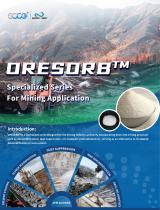
ORESORB™
2 Pages
Other QINGDAO SOCO NEW MATERIAL CO.,LTD. products
Sodium Polyacrylate


Related Searches
*Prices are pre-tax. They exclude delivery charges and customs duties and do not include additional charges for installation or activation options. Prices are indicative only and may vary by country, with changes to the cost of raw materials and exchange rates.