


- Power Transmission - Mechanical components
- Mechanical Transmission
- Strain wave gear reducer
- Reach Machinery Co.,Ltd.
Strain wave gear reducer RCSG seriesharmoniccoaxialhollow-shaft

Add to favorites
Compare this product
Characteristics
- Type
- strain wave, harmonic
- Shaft orientation
- coaxial
- Shaft configuration
- hollow-shaft
- Torque
- 200 - 500 Nm, 100 - 200 Nm, 20 - 50 Nm, 50 - 100 Nm, 500 - 1000 Nm, 1 - 2 kNm
- Performance
- low-backlash
- Applications
- for robots, for servo motors, for aeronautical applications
- Other characteristics
- mechanical transmission
- Rotational speed
Min.: 3,800 rpm
(23,876.1042 rad.min-1)Max.: 8,000 rpm
(50,265.4825 rad.min-1)- Gear ratio
Min.: 30 unit
Max.: 160 unit
Description
Strain wave gearing (also known as harmonic gearing) is a type of mechanical gear system that uses a flexible spline with external teeth, which is deformed by a rotating elliptical plug to engage with the internal gear teeth of an outer spline.
Main components of strain wave gear: Wave Generator, Flexspline and Circular Spline.
Working Principle
Harmonic reduce working principle refers to the use of relative motion of the flexspline, circular spline and wave generator. The motion and power transmission is mainly achieved by using the controlled elastic deformation of the flexspline. The elliptical cams in the wave generator rotate inside the flexspline to deform the flexspline. While the teeth of the flexpline at the long end of the elliptical cam of the wave generator enter into engagement with the teeth of the circular spline, the teeth of the flexspline at the short end are disengaged from the teeth of the circular spline. For the teeth between the long and short axes of the wave generator, they are in the semi-engaged state of gradually entering engagement in different sections along the circumference of the flexspline and the circular spline, called engagement. And in the semi-engaged state of gradually exiting engagement, called engagement-out. When the wave generator rotates continuously, the flexspline continuously generates deformation, so that the teeth of the two wheels continuously change their original working state in four kinds of motion: engaging, meshing, engaging and disengaging, and generate the motion of misaligned teeth to realize the motion transmission from the active wave generator to the flexspline.
Catalogs
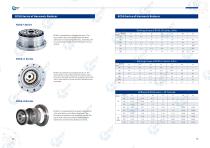
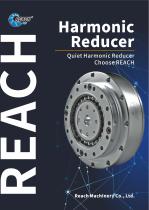
Harmonic reducer_REACH
72 Pages
Exhibitions
Meet this supplier at the following exhibition(s):

Other Reach Machinery Co.,Ltd. products
Harmonic Reducer


Related Searches
- Reach Machinery coaxial gear reducer
- Precision gearbox
- Compact gearbox
- Solid-shaft gearbox
- Flexible shaft coupling
- Shafts coupling
- Reach Machinery hollow-shaft gear reducer
- Reach Machinery friction brake
- Transmission gearbox
- Shaft gearbox
- Two-stage gearbox
- High-performance gearbox
- Low-noise gearbox
- Low-backlash gearbox
- Torque shaft coupling
- High-torque gearbox
- High-precision gearbox
- Reach Machinery robot gear reducer
- Transmission shaft coupling
- Rigid shaft coupling
*Prices are pre-tax. They exclude delivery charges and customs duties and do not include additional charges for installation or activation options. Prices are indicative only and may vary by country, with changes to the cost of raw materials and exchange rates.
About DirectIndustry
DirectIndustry is a marketplace that offers B2B players a complete experience, from product sourcing to purchase. DirectIndustry is an entity of VirtualExpo Group.
Are you a buyer?
Are you a supplier?