


- Production Machines
- Forming Machine
- Electric press
- SCHMIDT Technology
Electric press 660 assemblycrimpingfor the aerospace industry

Add to favorites
Compare this product
Characteristics
- Operation
- electric
- Function
- assembly, crimping
- Applications
- for the aerospace industry, for the automotive industry
- Other characteristics
- economical
- Force
110 kN, 160 kN
- Stroke
350 mm
(13.78 in)
Description
High-quality yet economical assembly is the guarantee for product success on the market. The goal is to join precise assemblies from inexpensive individual components with tolerances. Electrically driven screw presses – servo presses – are ideally suited for such tasks in terms of precision. In addition, the modules are characterised by high dynamics over the entire force and stroke range as well as excellent repeat accuracy.
The ServoPress systems offer the perfect solution in the interaction of ServoPress modules and the PressControl 700 or PressControl 7000 controllers developed for this purpose. These meet the most complex requirements, in single workstations as well as in fully automated production lines.
The full-load modules of the SCHMIDT® ServoPress series are EC type-approved in combination with the safety technology options SmartGate, SmartGuard and light curtain. Furthermore,
SCHMIDT® ServoPress 660 with integrated energy management and intermediate storage of braking energy for use in the high power range, e.g. in the following industries:
Electro mobility
Crimping cable lugs
Moulding of battery packs
Aeronautics
Moulding of stringers (aluminium profiles)
0.1 µm resolution position control
5.4 μm/inc resolution measurement data acquisition – way
48 N/inc resolution measurement data acquisition – force
Catalogs
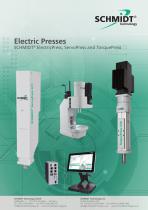
Electric Press
15 Pages

SCHMIDT® ServoPress
13 Pages
Other SCHMIDT Technology products
ServoPress


Related Searches
- SCHMIDT industrial press
- SCHMIDT forming press
- SCHMIDT automatic press
- SCHMIDT joining press
- SCHMIDT electric press
- Vertical press
- SCHMIDT pneumatic press
- SCHMIDT ram press
- SCHMIDT manual press
- Punching press
- Stamping press
- Cutting press
- SCHMIDT process press
- Mechanical press
- SCHMIDT frame press
- Production press
- SCHMIDT bending press
- Compression press
- Cambering press
- SCHMIDT straight-side press
*Prices are pre-tax. They exclude delivery charges and customs duties and do not include additional charges for installation or activation options. Prices are indicative only and may vary by country, with changes to the cost of raw materials and exchange rates.
About DirectIndustry
DirectIndustry is a marketplace that offers B2B players a complete experience, from product sourcing to purchase. DirectIndustry is an entity of VirtualExpo Group.
Are you a buyer?
Are you a supplier?