

- Power Transmission - Mechanical components
- Motor and Motor Control
- Brushless gear-motor
- Suzhou Honpine Precision Industry Co., Ltd.


- Company
- Products
- Catalogs
- News & Trends
- Exhibitions
DC gear-motor JRM seriesbrushlessservomotorplanetary

Add to favorites
Compare this product
Characteristics
- Motor type
- DC, brushless, servomotor
- Type
- planetary
- Shaft orientation
- coaxial
- Voltage
- 48 V
- Torque
- 1 - 5 Nm, 5 - 10 Nm, 10 - 20 Nm, 20 - 50 Nm, 50 - 100 Nm, 100 - 200 Nm, 200 - 500 Nm
- Performance
- low-noise, high-torque, high-efficiency, high-power, high-performance, precision, high load capacity, high-capacity, high-rigidity
- Product applications
- industrial, for medical equipment, for automation, for industrial applications, for vehicles, for robots, for machines, for delivery robot, for AGV, for humanoid robot
- Other characteristics
- compact, custom-made, with encoder, precision, CANopen
- Gear ratio
Min.: 6 unit
Max.: 26 unit
Description
Introduction
The Standard Planetary Joint Module is a core component of robotic power systems. Through a highly integrated design combining a planetary reducer, frameless torque motor, brake, encoder, and driver, it achieves significant optimization in volume and weight, enabling precise motion control of the joint. This results in greater torque, smaller size, and lighter weight. Compared to harmonic joint modules, the planetary joint module features a smaller reduction ratio, higher output speed, and greater torque density, making it more suitable for medium-to-low load applications. Customization services are available to meet specific requirements. With core advantages such as high-speed performance, impact resistance, and compact lightweight design, the Standard Planetary Joint Module is suitable for humanoid robots, specialized robots, logistics AGVs, and industrial automation.
Key Advantages
Power Unit / Features
Specification Table
Model | Size | Reduction Ratio | Rated Torque (N·m) | Peak Torque (N·m) | Rated Speed (RPM) | Peak Speed (RPM) | Resolution (Motor/Gearbox) | Communication Interface | Encoder Repeatability (Arcsec) | Power Supply (V DC) | Hollow Shaft Diameter (mm)
JRM-C4054-006 | 40-54 | 006 | 1 | 3 | 350 | 350 | 17bit (131072bit) | CAN | 40 | 48V | /
JRM-C40-66-036 | 40-66 | 036 | 6 | 18 | 50 | 50 | 17bit (131072bit) | CAN | 40 | 48V | /
JRM-C5070-020 | 50-70 | 020 | 6 | 19 | 170 | 170 | 17bit (131072bit) | CAN | 40 | 48V | /
JRM-C6070-020 | 60-70 | 020 | 12 | 40 | 150 | 150 | 17bit (131072bit) | CAN | 40 | 48V | ø5
JRM-C7069-22.5 | 70-69 | 22.5 | 20 | 60 | 170 | 170 | 17bit (131072bit) | CAN | 40 | 48V | /
JRM-C8078-024 | 80-78 | 024 | 30 | 95 | 100 | 100 | 17bit (131072bit) | CAN | 40 | 48V | ø5
JRM-C9579.6-008 | 95-79.6 | 008 | 18 | 60 | 400 | 400 | 17bit (131072bit) | CAN | 40 | 48V | ø5
JRM-C9579.6-024 | 95-79.9 | 024 | 50 | 200 | 120 | 120 | 17bit (131072bit) | CAN | 40 | 48V | ø5
JRM-C10483.5-20.4 | 104-83.5 | 20.4 | 50 | 300 | 150 | 150 | 17bit (131072bit) | CAN | 40 | 48V | ø8
JRM-C12588-020 | 125-88 | 020 | 80 | 360 | 150 | 150 | 17bit (131072bit) | CAN | 40 | 48V | /
JRM-C12588-024 | 125-88 | 024 | 90 | 450 | 120 | 120 | 17bit (131072bit) | CAN | 40 | 48V | ø8
Characteristics / Technical specifications
The Standard Planetary Joint Module is a core component of robotic power systems. Through a highly integrated design combining a planetary reducer, frameless torque motor, brake, encoder, and driver, it achieves significant optimization in volume and weight, enabling precise motion control of the joint. This results in greater torque, smaller size, and lighter weight. Compared to harmonic joint modules, the planetary joint module features a smaller reduction ratio, higher output speed, and greater torque density, making it more suitable for medium-to-low load applications. Customization services are available to meet specific requirements. With core advantages such as high-speed performance, impact resistance, and compact lightweight design, the Standard Planetary Joint Module is suitable for humanoid robots, specialized robots, logistics AGVs, and industrial automation.
Key Advantages
- High Torque Density and Power Performance
- Multi-stage planetary reduction structure: through multi-stage gear combination, torque density can reach above 20 N·m/kg, suitable for high-load driving requirements of robotic hips, legs and other parts.
- Peak torque output: delivers higher instantaneous peak torque to meet dynamic motion demands.
- Impact Resistance and High Reliability
- Planetary gear meshing disperses impact forces and can withstand harsh working conditions such as emergency stops and high-frequency load changes, suitable for high-dynamic scenarios like bipedal robot walking and jumping.
- High mass-production controllability: mature planetary reducer technology with good consistency and reliability for large-scale applications.
- Compact Structure and Lightweight Design
- High integration: nested design of planetary reducer, frameless motor, encoder and other components reduces volume by ~30% vs traditional solutions.
- Lightweight materials: use of high-strength alloys and compact layout to meet humanoid robots' stringent requirements for lightweight and high energy efficiency.
- High Precision and Low Energy Consumption
- Low cogging torque and dual absolute encoders (motor end + output end): reduces torque ripple and enables repeat positioning accuracy of ±0.05°.
- Transmission efficiency optimization: planetary reducer transmission efficiency reaches above 80%.
- Multi-axis Coordinated Control
- Supports CAN bus protocol to meet multi-degree-of-freedom coordinated motion requirements of robots.
- Economy and Maintenance Convenience
- Maintenance-reduced design: stable planetary reducer structure requires minimal regular lubrication, lowering long-term costs.
- Modular interfaces: standardized design allows quick replacement and upgrades, shortening development cycles.
Power Unit / Features
- Frameless torque motor: compact power source with high dynamic response.
- Two-stage planetary reducer: nested gear structure to optimize space and improve torque transmission efficiency.
- Sensing and control: dual absolute encoders (motor end + output end) for full closed-loop control; friction brake for emergency stop safety and zero-speed stability.
- Communication: CAN bus compatible for multi-axis coordinated control.
Specification Table
Model | Size | Reduction Ratio | Rated Torque (N·m) | Peak Torque (N·m) | Rated Speed (RPM) | Peak Speed (RPM) | Resolution (Motor/Gearbox) | Communication Interface | Encoder Repeatability (Arcsec) | Power Supply (V DC) | Hollow Shaft Diameter (mm)
JRM-C4054-006 | 40-54 | 006 | 1 | 3 | 350 | 350 | 17bit (131072bit) | CAN | 40 | 48V | /
JRM-C40-66-036 | 40-66 | 036 | 6 | 18 | 50 | 50 | 17bit (131072bit) | CAN | 40 | 48V | /
JRM-C5070-020 | 50-70 | 020 | 6 | 19 | 170 | 170 | 17bit (131072bit) | CAN | 40 | 48V | /
JRM-C6070-020 | 60-70 | 020 | 12 | 40 | 150 | 150 | 17bit (131072bit) | CAN | 40 | 48V | ø5
JRM-C7069-22.5 | 70-69 | 22.5 | 20 | 60 | 170 | 170 | 17bit (131072bit) | CAN | 40 | 48V | /
JRM-C8078-024 | 80-78 | 024 | 30 | 95 | 100 | 100 | 17bit (131072bit) | CAN | 40 | 48V | ø5
JRM-C9579.6-008 | 95-79.6 | 008 | 18 | 60 | 400 | 400 | 17bit (131072bit) | CAN | 40 | 48V | ø5
JRM-C9579.6-024 | 95-79.9 | 024 | 50 | 200 | 120 | 120 | 17bit (131072bit) | CAN | 40 | 48V | ø5
JRM-C10483.5-20.4 | 104-83.5 | 20.4 | 50 | 300 | 150 | 150 | 17bit (131072bit) | CAN | 40 | 48V | ø8
JRM-C12588-020 | 125-88 | 020 | 80 | 360 | 150 | 150 | 17bit (131072bit) | CAN | 40 | 48V | /
JRM-C12588-024 | 125-88 | 024 | 90 | 450 | 120 | 120 | 17bit (131072bit) | CAN | 40 | 48V | ø8
Characteristics / Technical specifications
- Series: Standard Planetary Joint Module.
- High integration: nested planetary reducer + frameless torque motor + encoder + brake + driver.
- Torque density: can exceed 20 N·m/kg (multi-stage planetary design).
- Accuracy: dual absolute encoders providing repeatability down to ±0.05°; resolution listed as 17bit (131072 counts).
- Transmission efficiency: >80% (planetary reducer).
- Communication: CAN bus interface for multi-axis coordinated control.
- Power supply (typical): 48 V DC (per table entries).
- Peak torque: specified peak values are for short-term (up to 5 seconds) use; select rated torque for continuous operation.
- Available models cover a range of sizes (approx. 40–125 mm) and hollow shaft diameters (commonly ø5 or ø8 mm depending on model).
- Designed for applications: humanoid robots, specialized robots, logistics AGVs, industrial automation (high-speed, impact-resistant, lightweight joint drives).
Catalogs
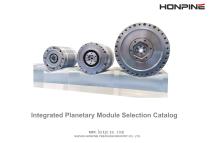
Planetary Robot Joint Actuator
14 Pages
Other Suzhou Honpine Precision Industry Co., Ltd. products
Robot Joint Motor


Related Searches
- Electromotor
- Synchronous motor
- Electric gearmotor
- BLDC motor
- Motor for industrial applications
- 24 V electromotor
- Servo motor
- DC gearmotor
- Ultra high-efficiency motor
- Servo-amplifier
- Performance servo motor
- Coaxial electric gearmotor
- Industrial gearmotor
- 24 V gearmotor
- High-torque motor
- Solid-shaft gearmotor
- Planetary electric gearmotor
- Compact gearmotor
- 48 V motor
- Medical equipment motor
*Prices are pre-tax. They exclude delivery charges and customs duties and do not include additional charges for installation or activation options. Prices are indicative only and may vary by country, with changes to the cost of raw materials and exchange rates.
About DirectIndustry
DirectIndustry is a marketplace that offers B2B players a complete experience, from product sourcing to purchase. DirectIndustry is an entity of VirtualExpo Group.
Are you a buyer?
Are you a supplier?