


Ferrite content measuring instrument TQ-7laboratoryfor harsh environmentswith display


Add to favorites
Compare this product
Characteristics
- Measured value
- ferrite content
- Applications
- laboratory, for harsh environments
- Other characteristics
- with display, continuous
Description
The universal tool designed for local measuring of the ferrite content in metal welds, deposited rust-inhibiting coatings, and in the base metal of workpieces, parts, and finished products made of austenitic and austenitic-ferritic stainless Cr-Ni steels.
- Percentage (%) and ferritic number (FN) scales available in all measurement ranges
- Measurement of ferrite content according to ISO 8249-2000, DIN EN ISO 17655, ANSI/AWS A4.2M/A4.2 standards
- Suitable for laboratory and workshop conditions of nuclear and chemical engineering, shipbuilding, and other industries for quality control of stainless steel weldings
- Wide range of transducers available for different applications
Operational advantages
- Ergonomic housing made of ABS plastic equipped with shockproof rubber pad
- IP54 dust- and moisture-proof housing
- Display of the minimum, maximum, and arithmetic mean values for a set of measurements
- Optional remote transducer (TQ0.7-01 model) for cladding for ultra-high measurement locality
- Non-volatile memory
- USB interface
Operating modes
- Discrete mode: Discrete measurement of ferrite content with displaying of auxiliary information: min/max value, average value, statistics/history.
- Continuous mode: Scanning of the test object with indication of the current value of coating thickness as well as displaying the min/max value.
Delivery set
- Electronic unit with batteries
- TQ2-01 transducer with built-in cable
- TQ0.7-01 super local transducer (optional)
- Carrying bag
- Reference block with preset ferrite content
- Set of reference blocks with certificate (optional)
- Verification certificate
- Operation manual
Technical specifications
Characteristic | Value
--- | ---
Ferrite content measurement range, % | 0.5...20 / 0.5...60 / 0.5...80*
FN measurement range | 0.5…100*
Basic error | less than 5%
Power supply | 2700 mAh batteries (replaceable) or AA batteries
Time of continuous operation, h | 8
Display | color TFT LCD 320Х240
Memory capacity | 100 pages x 100 measurements per page
Weight, kg | 0.3
Electronic unit dimensions, mm | 36х78х159
TQ2-01 transducer dimensions / TQ0.7-01 transducer dimensions | d16х60 / d10х63
Operating temperature range, °C | -10...+40
Max magnetization depth (locality) of TQ2-01 / TQ0.7-01 transducer | 3 / 5.5
Transducer type | magnetic induction
Ferrite measurement method
Ferrite measurement is a vital non-destructive testing (NDT) technique used to determine the amount of ferrite present in austenitic and duplex stainless steels. Ferrite content significantly impacts the mechanical properties, corrosion resistance, and weldability of these materials. The most common method employed for ferrite testing is magnetic induction. This process uses a probe with an exciter coil that generates a low-frequency magnetic field. When placed near a steel sample, this magnetic field is amplified by ferrite grains, and the resulting voltage change is measured to determine the ferrite content.
Maintaining the right balance of ferrite is crucial. If the ferrite content is too low, it can lead to solidification cracking, particularly during welding. On the other hand, excessive ferrite can reduce the material’s corrosion resistance and negatively affect mechanical properties. By assessing ferrite levels, industries can ensure that the material is tough, resistant to cracking, and maintains its intended performance, especially in challenging environments.
Applications of Ferrite Testing
- Welds and cladding: Ensuring that weld seams in stainless steel pipes and tanks have the correct ferrite content to prevent cracking during cooling and operation.
- Pressure vessels and tanks: These large industrial containers, used for storing liquids or gases, require accurate ferrite content to ensure their strength and longevity.
- Heat exchangers: Used in power generation and petrochemical industries, where the integrity of stainless steel components is key to safe and efficient operation.
- Piping systems: Commonly found in power plants, chemical plants, and oil refineries, where ferrite testing helps prevent material failure due to stress or corrosion.
Ferrite testing is particularly beneficial for stainless steel grades like 300 series austenitic stainless steel (e.g., 304/L, 316/L) and duplex stainless steels, where the ferrite percentage directly impacts toughness, ductility, and resistance to corrosion and cracking.
Importance and Benefits of Ferrite Testing
Ferrite testing is quick, affordable, and provides immediate results, making it an essential part of quality control in industries where material failure can result in costly downtime or hazardous situations. By maintaining the correct ferrite content, companies can enhance the performance, safety, and reliability of their stainless steel components, avoiding issues like premature failure, high maintenance costs, or safety risks due to structural weaknesses.
In summary, ferrite testing is a critical NDT method used across a variety of industries to assess and control the material properties of stainless steel, ensuring long-term durability, reliability, and safety.
Key Features / Technical Specifications
- Ferrite content measurement range: 0.5...20 / 0.5...60 / 0.5...80%*
- FN measurement range: 0.5…100*
- Basic error: less than 5%
- Power supply: 2700 mAh batteries (replaceable) or AA batteries
- Continuous operation time: 8 hours
- Display: color TFT LCD 320Х240
- Memory: 100 pages x 100 measurements per page
- Weight: 0.3 kg
- Electronic unit dimensions: 36х78х159 mm
- Transducer dimensions: TQ2-01 d16х60 mm / TQ0.7-01 d10х63 mm
- Operating temperature: -10...+40°C
- Max magnetization depth: TQ2-01: 3 mm / TQ0.7-01: 5.5 mm
- Transducer type: magnetic induction
VIDEO
Catalogs
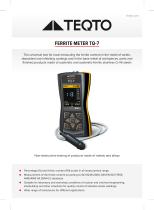
TQ-7 - Ferrite meter
2 Pages
Related Searches
- Measuring device
- Indentation hardness tester
- Digital hardness tester
- Thickness measuring machine
- Handheld thickness gauge
- Manual test kit
- Rockwell indentation hardness tester
- Brinell indentation hardness tester
- Vickers indentation hardness tester
- Automatic indentation hardness tester
- Portable indentation hardness tester
- Metal indentation hardness tester
- Measuring device with display
- Coating thickness gauge
- Laboratory measuring device
- Steel indentation hardness tester
- Fault detector
- Mobile fault detector
- Aluminum indentation hardness tester
- Measurement hardness tester
*Prices are pre-tax. They exclude delivery charges and customs duties and do not include additional charges for installation or activation options. Prices are indicative only and may vary by country, with changes to the cost of raw materials and exchange rates.