


- Company
- Products
- Catalogs
- News & Trends
- Exhibitions
Mechanical torque limiter TG seriesfrictioncompactzero-backlash


Add to favorites
Compare this product
Characteristics
- Operation
- mechanical, friction
- Other characteristics
- compact, zero-backlash
- Torque
Max.: 7,150 Nm
(5,273.569367 ft.lb)Min.: 0.3 Nm
(0.221269 ft.lb)- Diameter
Max.: 70 mm
(2.76 in)Min.: 6 mm
(0.24 in)- Rotational speed
Max.: 1,400 rpm
(8,796.4594 rad.min-1)Min.: 900 rpm
(5,654.8668 rad.min-1)
Description
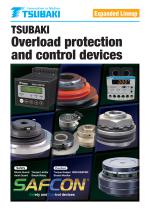
Our lineup includes ball-type Shock Guard, which trip when the ball pops out of the pocket and spins freely when the load exceeds a set value; friction-type Torque Limiter, which slip when a load greater than the friction force is applied; and Torque Keeper and Mini Keeper, slipping clutches and brakes that are suitable for continuous slippage.
Ball type (Shock Guard)
Power is transmitted through the ball.
When the load exceeds the set value, the ball jumps out of the pocket and spins freely (trips), cutting off the power.
Once the overload is removed, it will Auto reset or manually reset, and it also has high repeat tripping accuracy.
Friction type (Torque Limiter, Torque Keeper, Mini Keeper)
It transmits power using friction.
When a load greater than the frictional force is applied, the unit slips and cuts off power.
It will automatically reset once the overload is removed, but it cannot return to the exact trip position. It has a simpler structure and is less expensive than the ball type.
Difference from shear pin
In shear pin protection method, if the load increases and exceeds the strength of the pin, the pin breaks and torque is cut off.
It is inexpensive, but it does not Auto reset, so you will need to replace the pin, and the set torque cannot be adjusted.
Tsubaki's Mechanical protector are capable of Auto reset in both types, reducing maintenance work.
The torque at which power is cut off can be set continuously, allowing adjustment to suit the device.
In the protection method using shear pins, the load increases and exceeds the strength of the pin, the pin breaks, thus shutting off the torque.
VIDEO
Catalogs

Related Searches
- Power transmission belt
- Precision gearbox
- Tsubaki right angle gear reducer
- Compact gearbox
- Solid-shaft gearbox
- Flexible shaft coupling
- Hollow-shaft gearbox
- Tsubaki shaft coupling
- Gear train gearbox
- Transmission gearbox
- Rubber power transmission belt
- Tsubaki transmission chain
- Shaft gearbox
- Helical gear gearbox
- Machine gearbox
- Tsubaki flange coupling
- Tsubaki metal chain
- High-performance gearbox
- Low-noise gearbox
- Flange gearbox
*Prices are pre-tax. They exclude delivery charges and customs duties and do not include additional charges for installation or activation options. Prices are indicative only and may vary by country, with changes to the cost of raw materials and exchange rates.
About DirectIndustry
DirectIndustry is a marketplace that offers B2B players a complete experience, from product sourcing to purchase. DirectIndustry is an entity of VirtualExpo Group.
Are you a buyer?
Are you a supplier?