

- Materials - Tools - Components
- Standard Mechanical Component
- Steel profile
- Welser Profile GmbH


- Company
- Products
- Catalogs
- News & Trends
- Exhibitions
Profile for agricultural applications chrome steelsteelwear-resistant steel

Add to favorites
Compare this product
Characteristics
- Material
- steel, stainless steel, high strength steel, chrome steel, wear-resistant steel
- Configuration
- special
- Applications
- agriculture, for agriculture machines, for agricultural applications
- Other characteristics
- custom-made
- Width
Min.: 10 mm
(0.394 in)Max.: 1,000 mm
(39.37 in)- Height
Min.: 0 mm
(0 in)Max.: 320 mm
(12.598 in)- Length
Min.: 0 mm
(0 in)Max.: 27,000 mm
(1,062.99 in)- Thickness
Min.: 0.3 mm
(0.01 in)Max.: 8.2 mm
(0.32 in)
Description
We supply heavy-duty steel sections for applications in agricultural machinery and livestock farming. Our solutions combine high wear resistance with weight reduction and are designed to withstand dynamic loads in agricultural use. Thanks to modern roll-forming technology, we produce dimensionally accurate, repeatable sections with high dimensional stability, even over long lengths. High-strength materials and optimised wall thicknesses ensure stability whilst reducing weight. Integrated manufacturing steps such as punching, embossing or bending increase efficiency and reduce assembly effort. Our sections are used, amongst other things, in soil cultivation, sowing and fertilising technology, harvesting technology, as well as in livestock housing and machine components.
Catalogs
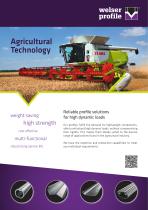
Folder Agriculture
2 Pages
Exhibitions
Meet this supplier at the following exhibition(s):

Metalmadrid 2026
4-05 Nov 2026 Madrid (Spain)

Other Welser Profile GmbH products
Product Solutions


Related Searches
- Welser Profile profile
- Welser Profile metal profile
- Welser Profile industrial profile
- Frame profile
- Welser Profile construction profile
- Welser Profile steel profile
- Round profile
- Welser Profile custom-made profile
- U-shaped profile
- Welser Profile stainless steel profile
- Connecting profile
- Window profile
- Composite profile
- H-shaped profile
- Profile for the automotive industry
- Closed profile
- Galvanised steel profile
- Heavy-duty profile
- Functional profile
- Mounting profile
*Prices are pre-tax. They exclude delivery charges and customs duties and do not include additional charges for installation or activation options. Prices are indicative only and may vary by country, with changes to the cost of raw materials and exchange rates.
About DirectIndustry
DirectIndustry is a marketplace that offers B2B players a complete experience, from product sourcing to purchase. DirectIndustry is an entity of VirtualExpo Group.
Are you a buyer?
Are you a supplier?