

- Metrology - Laboratory
- Metrology and Test Equipment
- Electrical safety tester
- Wuhan UHV Power Technology Co.,Ltd.


- Products
- Catalogs
- News & Trends
- Exhibitions
Network tester UHV-802performancecurrent impulsevoltage

Add to favorites
Compare this product
Characteristics
- Test type
- network, performance, current impulse, voltage, AC, operational, safety, electric, phase, electrical safety, power
- Tested product
- for single- and 3-phase equipment, multi-phase relay, for electrical equipment
- Applications
- for substations, for power systems
- Configuration
- portable
- Other characteristics
- USB, with programable test sequences, PC-controllable, with memory, secondary injection
Description
Product introduction
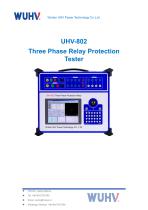
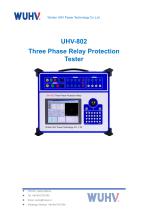
The UHV-802 is a three-phase relay tester designed for secondary current injection testing and relay protection verification. It integrates an industrial control computer running Windows, a 6.4" TFT color display, trackball and optimized panel keyboard for standalone field operation or external PC control.
Key features
Advantages for test engineers
Application scenarios
Product details — electrical outputs
AC current output
Phase current (RMS): 0–40 A
Output precision: 0.2°
3-phase parallel current (RMS): 0–120 A
Long-time phase current rating: 450 VA
Max output power (3 parallel): 900 VA
Max permitted working time (3 parallel): 10 s
Frequency range (fundamental): 0–1000 Hz
Harmonic order: 0–20
DC current output
Output current: 0–±10 A per phase; 0–±30 A (3 parallel)
Output precision: 0.5°
Max output load voltage: 20 V
AC voltage output
Phase voltage (RMS): 0–120 V
Output precision: 0.2°
Line voltage (RMS): 0–240 V
Phase/Line output power: 80 VA / 100 VA
Frequency range (fundamental): 0–1000 Hz
Harmonic order: 0–20
DC voltage output
Phase voltage range: 0–±160 V
Output precision: 0.5°
Line voltage range: 0–±320 V
Phase/Line output power: 70 VA / 140 VA
Switching I/O and time measurement
Switching inputs: 8 channels (dry contact 1–20 mA, 24 V). Potential contact: "0": 0–+6 V; "1": +11 V–+250 V
Switching outputs: 4 pairs (DC: 220 V/0.2 A; AC: 220 V/0.5 A)
Time measurement: range 0.1 ms–9999 s; accuracy 0.1 ms
FAQ (selected)
Technical specifications
The UHV-802 is a three-phase relay tester designed for secondary current injection testing and relay protection verification. It integrates an industrial control computer running Windows, a 6.4" TFT color display, trackball and optimized panel keyboard for standalone field operation or external PC control.
Key features
- Flexible outputs: standard 4-phase voltage and 3-phase current outputs; phase current 0–40 A, three-phase parallel up to 0–120 A; phase voltage 0–120 V, line voltage 0–240 V.
- High-fidelity linear amplifiers (non-switching) for clean waveforms and low distortion across current ranges.
- DSP-controlled host with fast real-time processing, wide frequency range (0–1000 Hz) and high-resolution D/A conversion.
- Dual operation modes: standalone with built-in keyboard/mouse or controlled from an external PC via USB/RS232/Ethernet.
- Integrated adjustable DC auxiliary outputs (110 V and 220 V) and comprehensive I/O including switching inputs/outputs and time-measurement channels.
Advantages for test engineers
- Accurate signal generation and measurement using DSP and high-precision ADC for reliable protection testing.
- Automated test sequences, fault replay and report generation to reduce manual steps and documentation time.
- Portable, single-unit design suited to field commissioning, maintenance and troubleshooting.
- Extensive self-protection functions (thermal, hardware and software diagnostics) to protect equipment and test integrity.
Application scenarios
- Commissioning and factory acceptance testing of protection relays and protection schemes.
- Routine maintenance and calibration of relays in substations, power plants and industrial sites.
- Fault simulation and troubleshooting, including staged fault replay and vector diagram analysis.
Product details — electrical outputs
AC current output
Phase current (RMS): 0–40 A
Output precision: 0.2°
3-phase parallel current (RMS): 0–120 A
Long-time phase current rating: 450 VA
Max output power (3 parallel): 900 VA
Max permitted working time (3 parallel): 10 s
Frequency range (fundamental): 0–1000 Hz
Harmonic order: 0–20
DC current output
Output current: 0–±10 A per phase; 0–±30 A (3 parallel)
Output precision: 0.5°
Max output load voltage: 20 V
AC voltage output
Phase voltage (RMS): 0–120 V
Output precision: 0.2°
Line voltage (RMS): 0–240 V
Phase/Line output power: 80 VA / 100 VA
Frequency range (fundamental): 0–1000 Hz
Harmonic order: 0–20
DC voltage output
Phase voltage range: 0–±160 V
Output precision: 0.5°
Line voltage range: 0–±320 V
Phase/Line output power: 70 VA / 140 VA
Switching I/O and time measurement
Switching inputs: 8 channels (dry contact 1–20 mA, 24 V). Potential contact: "0": 0–+6 V; "1": +11 V–+250 V
Switching outputs: 4 pairs (DC: 220 V/0.2 A; AC: 220 V/0.5 A)
Time measurement: range 0.1 ms–9999 s; accuracy 0.1 ms
FAQ (selected)
- Q: Why perform periodic relay testing? A: To detect aging, parameter drift and ensure correct operation of protection devices.
- Q: What distinguishes microprocessor-based testers? A: DSP/microprocessor control enables higher accuracy, automation and complex fault simulation.
Technical specifications
- Model: UHV-802
- Display: 6.4" TFT true color
- Embedded OS: Windows (English interface)
- Interfaces: USB, RS232, Ethernet 10/100 M
- AC current per phase: 0–40 A; 3-phase parallel: 0–120 A
- AC voltage phase: 0–120 V; line: 0–240 V
- DC outputs: current ±10 A/phase, ±30 A (3 parallel); voltage ±160 V phase, ±320 V line
- Frequency range: 0–1000 Hz; harmonics: 0–20
- Time measurement: 0.1 ms–9999 s; accuracy 0.1 ms
Other Wuhan UHV Power Technology Co.,Ltd. products
Relay Protection Tester


Related Searches
- Measuring device
- Test stand
- Portable testing system
- Digital testing system
- Automatic testing system
- Automatic test stand
- Industrial testing system
- Automatic test equipment
- Voltage testing system
- Portable measuring device
- Benchtop testing system
- Industrial gauge
- Manual test kit
- Test set
- Industrial test rig
- Laboratory testing system
- Tester with LCD screen
- Installation tester
- Insulation testing system
- Industrial test equipment
*Prices are pre-tax. They exclude delivery charges and customs duties and do not include additional charges for installation or activation options. Prices are indicative only and may vary by country, with changes to the cost of raw materials and exchange rates.
About DirectIndustry
DirectIndustry is a marketplace that offers B2B players a complete experience, from product sourcing to purchase. DirectIndustry is an entity of VirtualExpo Group.
Are you a buyer?
Are you a supplier?