

- Metrology - Laboratory
- Metrology and Test Equipment
- Phase sequence tester
- Wuhan UHV Power Technology Co.,Ltd.


- Products
- Catalogs
- News & Trends
- Exhibitions
Power tester UHV-702phase sequenceelectricphase

Add to favorites
Compare this product
Characteristics
- Test type
- power, phase sequence, electric, phase, voltage, safety
- Tested product
- multi-phase relay, for single- and 3-phase equipment, for electrical equipment
- Applications
- for the aerospace industry, railway, for power systems, laboratory
- Configuration
- portable
- Other characteristics
- PC-controllable, with LCD screen
Description
Product overview
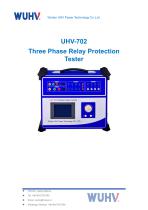
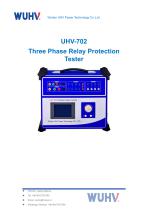
The UHV-702 is a portable three-phase relay protection tester kit designed for on-site verification, calibration and automated protection tests. It features 4-phase voltage and 3-phase current outputs, a 320×240 dot-matrix LCD and an ergonomic rotary controller for standalone operation; connecting to a PC (Windows software, Chinese interface) enables advanced automated sequences, data storage and report printing.
Key features
Technical parameters — AC current output
Technical parameters — DC current output
Technical parameters — AC voltage output
Technical parameters — DC voltage output
Switch quantity and time measurement
Advantages
Application fields
FAQ (summary)
Technical specifications
The UHV-702 is a portable three-phase relay protection tester kit designed for on-site verification, calibration and automated protection tests. It features 4-phase voltage and 3-phase current outputs, a 320×240 dot-matrix LCD and an ergonomic rotary controller for standalone operation; connecting to a PC (Windows software, Chinese interface) enables advanced automated sequences, data storage and report printing.
Key features
- Standard outputs: 4-phase voltage and 3-phase current; single-phase voltage up to 120 V; single-phase current up to 40 A (10 s); three-phase parallel current up to 120 A; configurable fourth-phase Ux (3U0 / sync‑check / user‑defined).
- Standalone operation: large LCD and rotary mouse controller for immediate field verification without a PC.
- Dual modes: standalone and PC-connected operation with Windows software for automated test plans, scanning of protection settings and real-time data logging.
- Advanced test functions: three-phase differential, fast bus transfer, backup auto‑reclose, sync checks, fault playback, vector display and waveform plotting.
- Digital I/O: contact inputs compatible with 0–250 V, auto‑identification, 7 inputs and 2 pairs dry contact outputs; I/O expandable.
- Safety and reliability: optimized cooling, soft‑start, fault self‑diagnosis and automatic lockout.
- Auxiliary DC outputs: dedicated 110 V and 220 V DC outputs for auxiliary supply during tests.
Technical parameters — AC current output
- Output precision: 0.2 class
- Phase current (RMS): 0–40 A
- Three-phase parallel current (RMS): 0–120 A
- Long‑term permissible phase current (RMS): 10 A
- Max phase output power: 450 VA; three‑phase parallel max power: 900 VA (max 10 s)
- Frequency range (fundamental): 0–1000 Hz (online), 0–300 Hz (standalone)
- Harmonics: up to 20th (online), up to 6th (standalone)
Technical parameters — DC current output
- Output precision: 0.5 class
- Output current: 0–±10 A/phase, 0–±30 A (parallel)
- Maximum load voltage: 20 V
Technical parameters — AC voltage output
- Output precision: 0.2 class
- Phase voltage (RMS): 0–120 V
- Line voltage (RMS): 0–240 V
- Phase/line output power: 80 VA / 100 VA
- Frequency range (fundamental): 0–1000 Hz (online), 0–300 Hz (standalone)
Technical parameters — DC voltage output
- Output precision: 0.5 class
- Phase voltage amplitude: 0–±160 V
- Line voltage amplitude: 0–±320 V
- Phase/line output power: 70 VA / 140 VA
Switch quantity and time measurement
- Switching inputs: 8 channels; open contact detection 1–20 mA, 24 V; potential contact access: "0" = 0–+6 V, "1" = +11 V–+250 V
- Switching outputs: 4 pairs (DC: 220 V / 0.2 A; AC: 220 V / 0.5 A)
- Time measurement: range 0.1 ms–9999 s; resolution/accuracy 0.1 ms
Advantages
- Precise outputs suitable for protection calibration
- Comprehensive test functions including automated sequences
- Portable form factor for field use
- Clear local operation with large LCD and rotary controller
- Expandable I/O and PC integration for advanced workflows
Application fields
- Power systems: line protection verification, main transformer differential tests, excitation control testing and fault simulation.
- Manufacturing and utilities: R&D, production QC, calibration and maintenance of protection devices.
- Research and education: laboratory verification and teaching of relay protection principles.
- Special systems: traction, railway and aviation protection testing.
FAQ (summary)
- Use near live equipment: not permitted; connect only after the tested equipment is fully de-energized, verified and grounded.
- Battery life: approx. 4–6 hours continuous when fully charged; use backup battery or external adapter for extended field work.
- Temperature influence: operate mainly within 5 ℃ to 40 ℃; extremes may affect measurements.
- Definition of "fixed value": configured relay protection parameters such as pickup current and time delay that determine device action.
Technical specifications
- Model: UHV-702
- Manufacturer/Brand: Wuhan UHV Power Technology Co.,Ltd.
- Display: 320×240 dot-matrix LCD
- AC current output: phase 0–40 A; three-phase parallel 0–120 A
- AC voltage output: phase 0–120 V; line 0–240 V
- DC outputs: phase 0–±160 V; line 0–±320 V
- Output precision: AC 0.2 class; DC 0.5 class
- Frequency range: online up to 1000 Hz; standalone up to 300 Hz
- Digital I/O: 7 contact inputs (0–250 V compatible), 2 pairs dry contact outputs (expandable)
- Auxiliary DC outputs: 110 V and 220 V
- Time measurement: 0.1 ms–9999 s; accuracy 0.1 ms
Catalogs
Other Wuhan UHV Power Technology Co.,Ltd. products
Relay Protection Tester


Related Searches
- Measuring device
- Test stand
- Portable testing system
- Digital testing system
- Automatic testing system
- Automatic test stand
- Industrial testing system
- Automatic test equipment
- Voltage testing system
- Portable measuring device
- Benchtop testing system
- Industrial gauge
- Manual test kit
- Test set
- Industrial test rig
- Laboratory testing system
- Tester with LCD screen
- Installation tester
- Industrial test equipment
- Insulation testing system
*Prices are pre-tax. They exclude delivery charges and customs duties and do not include additional charges for installation or activation options. Prices are indicative only and may vary by country, with changes to the cost of raw materials and exchange rates.
About DirectIndustry
DirectIndustry is a marketplace that offers B2B players a complete experience, from product sourcing to purchase. DirectIndustry is an entity of VirtualExpo Group.
Are you a buyer?
Are you a supplier?