


- Production Machines
- Other Manufacturing Equipment
- Zhengzhou Yugong Construction Machinery Co., Ltd.
Cold thread rolling YG seriescarbon steelfor metal fabricationfor the construction industry


Add to favorites
Compare this product
Characteristics
- Type
- cold
- Treated material
- carbon steel
- Applications
- for metal fabrication, for the construction industry, for heavy-duty applications, industrial
Description
Product overview
YG Machinery’s automatic thread rolling machine processes rebar from 16 to 40 mm using cold rolling to form threads. Typical output is 30–40 pcs/h (up to 50 pcs/h with an auto-loading rack). Cold rolling increases thread tensile and fatigue strength while reducing onsite processing time and labor.
Application scenarios
Construction Engineering
Rebar connection processing for high-rise and residential projects; one-time forming without open flame.
Bridge & Tunnel Projects
Processes large-diameter rebar (32–40 mm); cold rolling significantly improves thread fatigue strength.
Industrial Manufacturing
Produce mechanical parts and fasteners supporting common rebar grades with high thread precision.
Prefabricated Component Factories
Bulk rebar processing for precast beams and walls; automatic feeding reduces manual intervention.
Core advantages
Core technical highlights
Success summaries
FAQ highlights
Technical specifications
YG Machinery’s automatic thread rolling machine processes rebar from 16 to 40 mm using cold rolling to form threads. Typical output is 30–40 pcs/h (up to 50 pcs/h with an auto-loading rack). Cold rolling increases thread tensile and fatigue strength while reducing onsite processing time and labor.
Application scenarios
Construction Engineering
Rebar connection processing for high-rise and residential projects; one-time forming without open flame.
- Use case: fast onsite rebar threading to accelerate construction schedules.
- Practical tip: pair with rebar couplers to increase joint strength.
Bridge & Tunnel Projects
Processes large-diameter rebar (32–40 mm); cold rolling significantly improves thread fatigue strength.
- Use case: high-strength threaded rebar for heavy infrastructure.
- Practical tip: activate the built-in cooling system to avoid precision loss from high temperatures.
Industrial Manufacturing
Produce mechanical parts and fasteners supporting common rebar grades with high thread precision.
- Use case: bulk production of threaded components and fasteners.
- Practical tip: select hydraulic versions for very high-strength metal processing.
Prefabricated Component Factories
Bulk rebar processing for precast beams and walls; automatic feeding reduces manual intervention.
- Use case: automated, repeatable production of threaded rebar for precast elements.
- Practical tip: enable auto-counting to simplify production capacity tracking.
Core advantages
- High efficiency & automation: integrated auto-feeding, rib stripping and threading enable one operator to run the machine; up to 5× faster than manual methods.
- High precision: thread tolerance ≤ 0.05 mm; consistent diameters meeting major construction standards.
- Durable structure: hardened components (high manganese steel) for long service life under continuous 8-hour operation.
- Flexible adaptation: supports multiple diameters (16–40 mm) with quick die changes; optional extended lengths available.
Core technical highlights
- Cold rolling technology: increases tensile strength and fatigue resistance without heat treatment.
- Automatic PLC-controlled system: reliable rib stripping, stored parameters for repeated production runs.
- Circulating cooling system: reduces temperature and prevents thread deformation; reusable coolant reduces consumable costs.
Success summaries
- US project: Replaced manual machines (8 pcs/h) with the automatic thread rolling machine; single-operator output rose to ~35 pcs/h and thread pass rate improved to ~99.8%, reducing labor and rework.
- Germany factory: Processing 32 mm rebar time reduced from ~3 min to ~90 s; cooling limited thread deformation to ≤ 0.03 mm and doubled daily capacity.
FAQ highlights
- Processing range: standard 16–40 mm; custom extended versions available for longer workpieces.
- Production rate: normally 30–40 pcs/hour; increased with auto-loading accessories.
- Maintenance: rolling dies service life approx. 8,000 pcs; annual maintenance cost typically low relative to equipment price.
Technical specifications
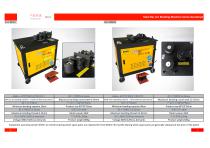
- Models: YGS-40; YGT-40; YGA-40.
- Processing diameter range: 16–40 mm.
- Thread rolling length: YGS-40: 0–80 mm; YGT-40: 0–80 mm; YGA-40: 0–100 mm.
- Power / voltage: YGS-40: 4 kW / 380 V 50 Hz; YGT-40: 4 kW / 380 V 50 Hz; YGA-40: 7.5 kW / 380 V 50 Hz.
- Working efficiency: YGS-40: 15 s/forming; YGT-40: 8 s/forming; YGA-40: one-touch auto forming.
- Machine weight: YGS-40: 320 kg; YGT-40: 350 kg; YGA-40: 400 kg.
- Machine size: YGS-40: 115 × 50 × 106 cm; YGT-40: 110 × 60 × 130 cm; YGA-40: 126 × 70 × 106 cm.
- Type / automation level: Standard type (YGS-40); Upgrade type (YGT-40); Full automatic type (YGA-40).
VIDEO
Catalogs
Other Zhengzhou Yugong Construction Machinery Co., Ltd. products
Steel Machine


Related Searches
- Production machine
- Automatic making machine
- Coating machine
- Bag making machine
- Continuous production machine
- Plastic bag making machine
- Automatic bag making machine
- High-speed production machine
- PLC-controlled making machine
- Paper bag making machine
- Medical production machine
- Paper production machine
- Making machine with touch screen
- High-performance coating machine
- Stone splitting tool
- Continuous coating machine
- Straightening and cutting machine
- Production machine for the food industry
- Automatic straightening and cutting machine
- High-speed bag making machine
*Prices are pre-tax. They exclude delivery charges and customs duties and do not include additional charges for installation or activation options. Prices are indicative only and may vary by country, with changes to the cost of raw materials and exchange rates.
About DirectIndustry
DirectIndustry is a marketplace that offers B2B players a complete experience, from product sourcing to purchase. DirectIndustry is an entity of VirtualExpo Group.
Are you a buyer?
Are you a supplier?