


- Building - Construction
- Construction and Mining Equipment
- Hydraulic rock splitter
- Zhengzhou Yugong Construction Machinery Co., Ltd.
Hydraulic rock splitter YG seriesfor mining applicationsfor controlled demolitionwith built-in air compressor

Add to favorites
Compare this product
Characteristics
- Operation
- hydraulic
- Application domain
- for mining applications, for controlled demolition
- Other characteristics
- with built-in air compressor, vibration-free, controlled, noiseless
Description
Product Overview
A rock splitter attachment for excavators provides a non‑explosive, low‑vibration method to break very hard rock (Mohs >7). The attachment uses the excavator hydraulic system: it drills a hole, inserts wedge elements and applies high lateral tensile force to split rock along its natural grain within seconds. This page covers typical applications, YG model options, operational differences with hydraulic breakers, a project case and maintenance guidance.
Where It Is Used
Model Options (YG Machinery)
How It Works vs Hydraulic Breakers
A rock splitter applies internal expansion (tensile force) by driving wedges outward from a drilled hole to create controlled fractures with near‑zero vibration, minimal dust and no flyrock. Hydraulic breakers use rapid external impact (compressive force) suitable for soft or weathered rock but produce high noise, vibration and chisel wear.
Comparison
Operational Notes & Performance
YG units integrate drill, splitter, feed beam, air compressor and dust collector with wireless remote control. Typical drilling rate in hard granite: 0.7–1.0 m/min. Splitting time after drilling: ≈40 seconds per hole. Compatible with 24–65 t excavators when breaker piping and appropriate hydraulic adapters are fitted.
Overseas Case (Summary)
Maintenance & Wear Items
Technical Specifications
A rock splitter attachment for excavators provides a non‑explosive, low‑vibration method to break very hard rock (Mohs >7). The attachment uses the excavator hydraulic system: it drills a hole, inserts wedge elements and applies high lateral tensile force to split rock along its natural grain within seconds. This page covers typical applications, YG model options, operational differences with hydraulic breakers, a project case and maintenance guidance.
Where It Is Used
- Open‑pit quarries and secondary rock breaking where oversized boulders block crushers.
- Urban foundations, trenching and near‑residential sites where blasting and high vibration are prohibited.
- Tunnelling and slope stabilisation where controlled fracture direction and minimal over‑excavation are required.
Model Options (YG Machinery)
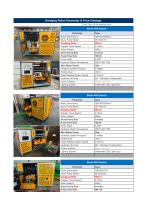
- YG-1000 (24–36 t excavators): 22 kW hydraulic drill; 12,000 tons splitting force; hole diameters Φ89–127 mm; max depth 1000 mm; unit weight ≈4 t; up to 411 m³/day.
- YG-1500 (36–48 t excavators): 30 kW drill; 15,000 tons splitting force; hole Φ135 mm; depth up to 1250 mm; unit weight ≈5 t; up to 672 m³/day.
- YG-2000 (48–65 t excavators): 35 kW drill; 30,000 tons splitting force; hole Φ152 mm; max depth 1500 mm; up to 1080 m³/day.
- YG-3000 (48–65 t heavy class): ultra‑heavy attachment (~8 t); 35 kW drill; hole Φ203 mm; max depth 1800 mm; 360° rotation available for large face excavation.
How It Works vs Hydraulic Breakers
A rock splitter applies internal expansion (tensile force) by driving wedges outward from a drilled hole to create controlled fractures with near‑zero vibration, minimal dust and no flyrock. Hydraulic breakers use rapid external impact (compressive force) suitable for soft or weathered rock but produce high noise, vibration and chisel wear.
Comparison
- Mechanism — Hydraulic breakers: External impact (compressive); Rock splitter: Internal expansion (tensile).
- Best for — Hydraulic breakers: Soft rock, shale, weathered rock; Rock splitter: Hard granite, basalt, dense limestone.
- Noise & vibration — Hydraulic breakers: High; Rock splitter: Low, near‑zero vibration.
- Wear & tear — Hydraulic breakers: High chisel wear and oil overheating; Rock splitter: Low maintenance, wedge greasing and periodic drill bit replacement.
Operational Notes & Performance
YG units integrate drill, splitter, feed beam, air compressor and dust collector with wireless remote control. Typical drilling rate in hard granite: 0.7–1.0 m/min. Splitting time after drilling: ≈40 seconds per hole. Compatible with 24–65 t excavators when breaker piping and appropriate hydraulic adapters are fitted.
Overseas Case (Summary)
- Project: Trenching in Madrid on solid granite adjacent to residences (blasting banned).
- Solution: YG-2000 mounted on a 45 t excavator with onboard 35 kW drill and multi‑stage booster.
- Results: Drilling ~3 minutes and splitting ~40 seconds per hole; daily output ~1,000 m³; fuel consumption reduced by ~35%; silent and dust‑controlled operation meeting environmental limits.
Maintenance & Wear Items
- Main wear parts: drill bits, drill rods and forged alloy wedges.
- Maintenance tips: keep hydraulic oil clean; apply high‑pressure grease to wedge sets daily; keep spare wedge sets and drill bits to avoid downtime.
Technical Specifications
- Brand: YG Machinery.
- Series: YG series (YG-1000, YG-1500, YG-2000, YG-3000).
- Excavator compatibility: 24–65 t (model dependent).
- Drill motor power: 22 kW (YG-1000), 30 kW (YG-1500), 35 kW (YG-2000, YG-3000).
- Splitting force: 12,000 t (YG-1000), 15,000 t (YG-1500), 30,000 t (YG-2000), ultra‑heavy spec (YG-3000).
- Hole diameters: Φ89–127 mm (YG-1000), Φ135 mm (YG-1500), Φ152 mm (YG-2000), Φ203 mm (YG-3000).
- Max splitting depth: 1000 mm, 1250 mm, 1500 mm, 1800 mm (model dependent).
- Unit weight: ≈4 t (YG-1000), ≈5 t (YG-1500), up to ≈8 t (YG-3000).
- Rotation: up to 360° on selected models (e.g., YG-3000).
- Typical drilling speed in hard granite: 0.7–1.0 m/min; splitting: ≈40 s per hole.
- Onboard equipment: drill, splitter, feed beam, air compressor, dust collector; wireless remote control.
- Recommended spares: extra wedge sets, drill bits, drill rods.
Catalogs
Other Zhengzhou Yugong Construction Machinery Co., Ltd. products
Cutting Machine


Related Searches
- Crushing plant
- Drilling rig
- Boom excavator
- Rotary drilling unit
- Crawler hydraulic excavator
- Construction hydraulic excavator
- Hydraulic drilling rig
- Mobile crushing and screening plant
- Mobile drilling rig
- Crawler drilling rig
- Medium hydraulic excavator
- Primary crushing and screening plant
- Wheel compactor
- Stone crushing and screening plant
- Secondary crushing and screening plant
- Mineral material crushing plant
- Rock breaker
- Mini hydraulic excavator
- Multifunction drilling unit
- Civil engineering drilling rig
*Prices are pre-tax. They exclude delivery charges and customs duties and do not include additional charges for installation or activation options. Prices are indicative only and may vary by country, with changes to the cost of raw materials and exchange rates.