|
|
|
|
|
|
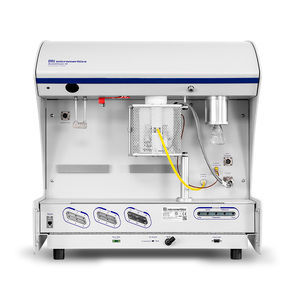
DSC 200 F3 Maia® - Differential Scanning Calorimeter
This newest Differential Scanning Calorimeter development at NETZSCH unites compactness, robustness and simple operation with high detection sensitivity for your preferred application in material quality control and failure analysis, especially in polymer processing.
The DSC 200 F3 Maia® combines the advantages of modern technology, high sensitivity and a robust, easy-to-operate work horse. Using liquid nitrogen, the temperature range extends from -170°C to 600°C. The main features of the DSC 200 F3 Maia® are the newly developed monolithic DSC sensor and a new silver furnace with long-life heating element.
The heat flux sensor of the DSC 200 F3 Maia® combines high stability, improved resolution and fast response time. Laser-guided welding processes for the sensor disk and thermocouple wires yield high sensitivity and robustness.
For routine applications we offer the upgrade with an automatic sample changer (ASC) for up to 20 samples and reference materials, also in different crucible types.
|
|
|
|
|
|
The versatile Premium DSC 204 F1 Phoenix® fascinates with its unique concept: all essential operational components are integrated into the instrument and optional add-ons can be installed anytime on site.
The DSC measuring cell consists of a cylindrical high-conductivity silver block with an embedded heating coil for broad thermal symmetry (3D symmetry) in the sample chamber, the cooling ports for liquid nitrogen or compressed air cooling and a cooling ring for connection of the intracooler (also with simultaneous liquid nitrogen cooling). The gas-tight construction and integrated mass flow controllers for the purge and protective gases allow coupling to an FTIR or MS for gas analysis.
Exchangeable sensors are tailored to their tasks:
With its disk-shaped silver carrier plate and supersensitive thermosensors of nickel-chromium constantan, the Tau-sensor offers a high level of calorimetric sensitivity along with extremely short signal time constants of only 0.6 seconds, which guarantees good separation of overlapping thermal effects.
The µ-sensor stands out for its high level of calorimetric sensitivity, never before achieved with a DSC. For example, it is extremely well suited for pharmaceutical applications with small sample weights.
Important hardware extensions like the automatic sample changer (ASC) for up to 64 sample and reference crucibles, the new UV-extension for photocalorimetry and software features such as BeFlat® for an optimized baseline or the optional temperature modulation of the DSC signal (TM-DSC) make the DSC 204 F1 Phoenix® the most versatile DSC system for R & D, QA, failure analysis and process optimization on the market today.
|
|
Pushing the limits of science – Our hyper-enabled, double-furnace DSC 8500 is truly revealing
We are proud to introduce you to our DSC 8500. This new double-furnace DSC, features our second-generation HyperDSC® technology. Now you can gain unlimited insight into the structure, properties and performance of your materials and gain the best applications capabilities in the industry. And with our newly designed autosampler, you’ll be running samples faster then ever before.
Give you laboratory unlimited potential with our DSC 8500.
|
|
DTA - Differential Thermal Analysis - & DSC - Differential Scanning Calorimetry - measure, respectively, the temperature difference and the heat flow difference between a sample and a reference material (subjected to the same temperature variation in a controlled atmosphere).
DTA detects any change in all categories of materials; DSC determines the temperature and heat of transformation.
SETARAM Instrumentation offers:
- the widest temperature range of all DTA systems (from –150°C to 2400°C°) using high-precision tri-couple probes;
- the most complete choice of DSCs (from Q&C system to the highest sensitivity DSC, and 3D-Sensor Inside DSC).
Properties measured by DTA / DSC include phase changes, glass transition, melting, purity, evaporation, sublimation, crystallization, pyrolysis, heat capacity, polymerization, denaturation / aggregation, compatibility, etc.
|
|
|
|
|
|
The VP-DSC is the most sensitive, easy to use differential scanning calorimeter to study samples in solution. Providing fast, accurate transition midpoint (Tm) determination, the VP-DSC has revolutionized the study of liquid biopharmaceutical formulations by reducing the time and cost of stability testing. In addition, a complete thermodynamic profile is generated to understand the factors that affect conformation and stability.
The VP-DSC is controlled by an intelligent user interface (VPViewer™ software) and data analysis is performed with Origin®, a market-leading data analysis package.
VP-DSC features:
- Active cell volume ~ 0.5 ml.
- Non-reactive Tantalum 61™ cells for excellent chemical resistance.
- Fixed-in-place cells for reproducible ultrasensitive performance with low maintenance.
- Operating temperature range of –10ºC to +130ºC.
- Peltier element for precise temperature control.
- User selectable temperature scan rates (0ºC to 90ºC per hour upscans) and range for application versatility.
- Unparalleled sensitivity and reproducibility (Figure 1).
- Three user selectable response times (US Patent #5,967,659) for maximum performance.
- Allows studies of fast or slow transition processes.
- Self-contained pressurizing system (0-45 psi) for studying solutions above their boiling point.
- Includes ThermoVac® sample preparation and cleaning device.
- Pressure Perturbation Calorimetry accessory available for the determination of partial specific volumes.
|
|
|
|
|
|
Differential Scanning Calorimeters (DSC) measures temperatures and heat flows associated with thermal transitions in a material. Common usage includes investigation, selection, comparison and end-use performance evaluation of materials in research, quality control and production applications. Properties measured by TA Instruments’ DSC Differential Scanning Calorimeters techniques include glass transitions, "cold" crystallization, phase changes, melting, crystallization, product stability, cure / cure kinetics, and oxidative stability.
Tzero Differential Scanning Calorimeters TA Instruments' latest development, Tzero™ DSC Differential Scanning Calorimeters technology, is a revolutionary and fundamentally more accurate way of measuring heat flow. It provides significant improvements in baseline flatness, transition resolution and sensitivity. Tzero™ Differential Scanning Calorimeters technology allows direct measurement of heat capacity, and makes Modulated® DSC experiments both faster and more accurate. Three DSC modules (Q2000, Q200, Q20) are now available, all significantly advance the DSC Differential Scanning Calorimeters technique to levels previously unattainable.
|
|
|
Thanks to its modular design, the DSC1 as part of the METTLER TOLEDO Thermal Analysis Excellence Line is the best choice for manual or automatic operation, from quality assurance and production through to research and development. The DSC utilizes an innovative patented DSC sensor with 120 thermocouples which guarantees unmatched sensitivity.
|
|
|
|
|
|
The VP-Capillary DSC System is the most advanced differential scanning calorimeter for screening multiple samples for thermal transition midpoints (Tm). A fully integrated autosampler enables the analysis of up to 50 samples per day with unattended operation. With its advanced capability, the system has revolutionized the study of liquid biopharmaceutical formulations by reducing the time and cost of stability testing.
With higher throughtput and unattended sample handlng capabilities, the VP-Capillary DSC is a powerful tool in drug discovery programs, service laboratories and laboratories screening large numbers of samples. Whether used to screen multiple excipients for formulations or the binding activity of drug compounds against a target, the system can deliver reliable results quickly with minimal operator time.
The VP-Capillary DSC is controlled by an intelligent user interface (VPViewer™ software) and data analysis is performed with Origin®, a market-leading data analysis package.
|
|
DSC - Differential Scanning Calorimetry - measures the temperature difference and the heat flow difference between a sample and a reference material (subjected to the same temperature variation in a controlled atmosphere).
DSC determines the temperature and heat of transformation.
MICRO DSC III (-20 to 120°)
Thanks to the exclusive "3D-Sensor Inside" technology, the microcalorimeter Micro DSC III offers very high sensitivity detection for the analysis of liquids, gels, powders, solids, etc.
|
|
Model Unitherm 6000 Guarded Hot Plate Thermal Conductivity Measuring System
* -175°C to 550°C, in several ranges
* Guarded hot plate method
* Fully automated operation
* For insulating materials
* 300 mm square samples
* ASTM C177, ISO 8302
|
|
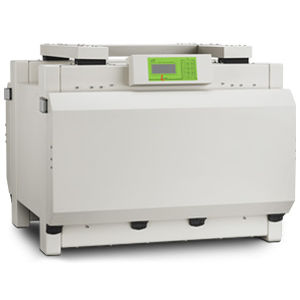
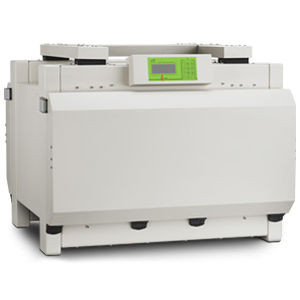
The new GHP 456 Titan® is the ideal tool for researchers and scientists in the field of insulation testing. Based on the well-known, standardized guarded hot plate technique (e.g. ISO 8302, ASTM C 177 or DIN EN 12667), the system features unrivalled performance over an unmatched temperature range.
Combining state-of-the-art technology with the highest quality standards, NETZSCH has designed a robust and easy-to-operate instrument, featuring unparalleled reliability and optimum accuracy over a broad temperature range.
The GHP 456 Titan® works with sheeted individually calibrated PT100 resistance temperature sensors (resolution 1 mK, accuracy in the range of a few 10 mK). Due to special sheeting, the sensors can be used up to 700°C (+ more than 100 K safety range).
The NETZSCH GHP 456 Titan® is the new benchmark in Guarded Hot Plate measurements.
|
|
Numerous physical processes and chemical reactions are influenced by the surrounding gas pressure. In practise it is therefore often necessary to conduct DSC measurements under an increased pressure.
With the high-pressure DSC 204 HP Phoenix®, thermal effects in a sample can be analyzed in the pressure range from vacuum to 15 MPa (150 bar) and at temperatures from -150°C to 600°C, depending on the type of gas.
The sample chamber atmosphere can be static or dynamic. The electronic pressure monitor and control, along with exact regulation of the purge gas flow, provide for excellent accuracy and reproducibility of the measurement results.
The proven CC 200 L for liquid nitrogen cooling is available for the low-temperature range.
The safety of the high-pressure DSC system has been certified through design tests and is guaranteed during operation by the appropriate safety components.
|
|
|
|
|
|
The new DSC 404 F1 Pegasus® by NETZSCH is capable of high precision sample analysis across an extremely broad temperature range from -150°C to 2000°C in a number of applications such as ceramics, metals, plastics, and composites. Unique among high-temperature DSC instruments is the optional temperature-modulated DSC (TM-DSC), which can separate reversible from irreversible energetic effects.
A great variety of both standard and optional features makes the DSC 404 F1 Pegasus® particularly flexible and effective. Various furnaces can be easily interchanged by the user and combined with a swiveling double furnace lifting device. Also, different sample carriers (DSC, DTA), an automatic sample changer (ASC) for up to 20 samples, and plenty of accessories, such as crucibles in numerous shapes and materials, are available.
Its proven vertical format and vacuum-tight construction not only make the DSC 404 F1 Pegasus® easy to operate and very robust, but also enable the implementation of measurements under pure gas atmospheres, which is particularly important for samples sensitive to oxidation. The various DSC sensors are characterized by optimal sensitivity, short response times and high reproducibility.
As with all NETZSCH instruments, this excellent product is complemented by expert application support and first-rate service.
|
|
SETSYS Evolution: High Performance Thermal Analyzers (ambient to 2400°C): DTA, DSC, TGA, simultaneous TGA-DTA/DSC, TMA, coupling to gas analyzers
Widest temperature range (ambient / 2400°C) on the market
Modularity: the different modules DTA, DSC, TGA, TMA can be adapted interchangeably around the same structure
Measurement performance: satisfy unique resolution, precision and sensitivity criteria
SETSYS Evolution is today the state-of-the-art in research-grade thermal analyzers.
It includes:
-SETSYS Evolution DTA (up to 2400°C), DSC (up to 1600°C)
-SETSYS Evolution TGA
-SETSYS Evolution simultaneous TGA-DTA/DSC-EGA
-SETSYS Evolution TMA
|
|
|
|
|
|
TCT 426 - Thermal Conductivity Tester: furnace/hot-wire method
The TCT 426 works according to the hot wire method and is especially designed for the investigation of refractory rock. The measuring cross, parallel wire, and T(R) methods can be used in the instrument. The TCT 426 is indispensable for the efficient use of energy in industrial kiln engineering with refractories.
The hot-wire method is an absolute method for direct determination of the thermal conductivity, based on the measurement of the temperature increase of a linear heat source/hot wire (cross-wire technique) or at a specific distance from a linear heat source (parallel-wire technique).
The hot wire and thermocouple are embedded between two test pieces, which make up the actual test assembly. The time-dependent temperature increase after the heating current is switched on is a measure of the thermal conductivity of the material being tested.
Another variation, the so-called "Platinum Resistance Thermometer Technique" or "T(R) Technique", is described in ASTM-C 1113. Here an integral temperature measurement is carried out over the entire length of the hot wire; i.e. the hot wire is both heat source and temperature sensor at the same time.
The TCT 426 thermal conductivity tester enables the use of all three of the methods described in easily interchangeable, pre-wired measuring frames.
|
|
Model FL2000 Thermal Properties Analyzer
* High Speed Xenon Discharge (HSXD) pulse source
* Operating range from RT to 330°C
* Automated operation and easy to use
* Rugged, reliable, modular design
* Specimens up to 25mm Dia. or Sq.
* Fast testing times and high specimen throughput
* Up to four specimen (indexed) system
* Specific heat capacity determination
* Thermal conductivity measurement
* Usable with wide range of materials
* ASTM E-1461
* Thermal interface module option
|
|
Model FL3000 Thermal Properties Analyzer
* Bench-top system
* Xenon flash
* -150 to 200°C, RT to 1100°C range
* Multiple sample capability
* Specific heat capacity
* Thermal conductivity determination
* Large sample capability (32 mm dia.)
* Tests highly conductive materials
* ASTM E-1461
|
|
Model FlashLine 5000 Thermal Properties Analyzer
* Laser flash system
* Modular furnaces from -150°C to 200°C and RT to 1600°C through 2800°C
* Air or inert gas purge after evacuation
* Up to 4 samples (indexed) system
* 12.7 mm Dia. sample
* Thermal diffusivity, specific heat capacity, thermal conductivity determination
* ASTM E-1461
|
|
|
|
|
|
LFA 457 MicroFlash® - Laser Flash Apparatus
The NETZSCH LFA 457 MicroFlash® complies with the latest technology for modern laser flash systems. The table-top instrument allows measurements from -125°C to 1100°C using two different user-exchangeable furnaces.
The innovative infrared sensor technology employed in the system enables measurement of the temperature increase on the back surface of the sample, even at temperatures of -125°C.
The instrument can be used for small and large sample sizes of up to 25.4 mm diameter and, with the integrated sample changer, measurements can be run on several samples at the same time.
The vacuum-tight design enables tests under defined atmospheres.
The vertical arrangement of the sample holder, furnace and detector simplifies sample placement and, at the same time, guarantees an optimum signal-to-noise ratio of the detector signal.
The LFA 457 MicroFlash® is the most up-to-date and versatile LFA system for research and development and for all applications involving characterization of standard and high-performance materials in automobile manufacturing, aeronautics, astronautics and energy technology.
|
|
|
|
|
|
The main advantage of light-curing systems is their fast reaction time. Monomer solutions which are mostly free of solvents can be cured within only a few seconds and already at low temperatures. A combination of thermal and light curing reactions is often applied to dual cure adhesives or paints.
The NETZSCH Photo-DSC 204 F1 Phoenix® works in the temperature range from
-100°C to 200°C. The instrument has a vacuum-tight measuring cell and the purge gas control is regulated by a mass flow controller (MFC).
For our Photo-DSC 204 F1 Phoenix®, most standard industry or laboratory lamps for cationic or radically curing material systems can be used. For the analysis of adhesives, we recommend the DELOLUX04, from the DELO company.
The modified automatic lid-lifting device of the DSC 204 F1 Phoenix® guarantees a defined distance between the two light conductors and the sample and reference.
This achieves high reproducibility of measurement results.
For your normal DSC analyses above 200°C, a retrofit of the standard lid-lifting device is possible, or the manual lid can also be used without problems.
For high sample throughput or for repeat measurements, use of our Automatic Sample Changer (ASC) for up to 64 samples is recommended.
|
|
|
|
|
|
STA 449 F1 Jupiter® – Simultaneous TG-DSC
Fascinating Flexibility in Thermal Analysis
The new STA 449 F1 Jupiter® combines unlimited configuration flexibility and unmatched performance in just one instruments.
● Thermal stability, decomposition behavior, composition, phase transitions, melting processes to be analyzed comprehensively and quickly
● Easily to use top-loading system with exceptionally precise balance resolution (25 ng resolution at a weighing range of 5g) and highest long-term stability
● Interchangeable sensors for DSC measurements with highest sensitivity and best reproducibility for reaction/transition temperatures and enthalpies as well as for measurements of specific heat
● A variety of optional system enhancements for ideal system adaption to user-defined applications
● Various furnaces, easily interchangeable by the user, available (optional a swiveling double hoisting device for two furnaces)
● Pluggable sample carriers (TG, TG-DSC, TG-DTA, etc.)
● Automatic Sample Changer (ASC) for up to 20 samples
● Automatic evacuation and refilling (Autovac)
● Plenty of accessories, e.g. sample crucibles in the most varied of forms and materials
● Unique for STA: temperature-modulated DSC (TM-DSC)
By supplementary MS-and/or FTIR-coupling even more comprehensive analyzes are possible.
All these features make the new developed STA 449 F1 Jupiter® to the ideal tool for thermal analysis of materials in the fields of research, developments and quality assurance.
|
|
Fascinating Flexibility in Thermal Analysis
DSC 404 F3 Pegasus® - High-Temperature DSC
The new DSC 404 F3 Pegasus® offers a high flexibility for all DSC and DTA applications in quality control and product development. Furnaces and DSC/DTA sensors are available for a broad temperature range (-150...2000°C). Numerous upgrade possibilities allow adaption of this cost-effective system to sophisticated applications.
The DSC 404 F3 Pegasus® is part of the economical NETZSCH F3-product line, which is specially tailored to the requirements of comparative material characterization and quality control.
The DSC 404 F3 Pegasus® can be operated from -150°C to 2000°C with various DTA and DSC sensors that are easily exchangeable by the user and various furnace types.
The sample chamber can be purged with inert or oxidizing gases in order to remove gases evolved from the sample.
The measuring system is vacuum tight (10-2mbar).
|
|
Model FireLine 1000 Thermal Conductivity Measuring System
* RT to 1000°C
* Fire protective materials & insulation
* 150 mm square samples
* Slug calorimeter method
* ASTM E-2584-07
|
|
Model Unitherm 2022 Thermal Conductivity Measurement Instrument
* -20°C to 300°C
* Guarded Heat Flow Meter
* Fully computerized operation
* 2'' dia. sample
* Solids, pastes, liquids
* Filled polymers
* ASTM E1530
|
|
Model QuickLine -10 Thermal Conductivity Meter
* Ambient temperature operation
* Guarded heat flow meter
* Manual or computerized operation
* 2 inch dia. sample
* Solids, pastes, liquids
* Filled polymers
* ASTM E1530
|
|
|
|
|
|
The QuickLine™-50 instrument is a device specifically developed for measuring interface thermal resistance.
Heat transport across gaps is most frequently improved by the addition of a layer of conductive material that fills the crevices in between, and with that thermally bridges the gap. Heat transfer is then governed by the thermal conductivity of the material, the thickness of the layer, and the two interfaces at the boundaries of the layer. For most engineering applications it is extremely difficult to model this combination from its components, as exact figures for the boundary resistances are usually not known. Further aggravating this is the effect varying surface conditions can bring to the interface. For this reason it is becoming general practice to measure the combination that closely replicates actual use, and determine experimentally the interface impedance of the filler and the two interfaces combined.
* Thermal Interface Materials
* Fast Test Times
* RT to 150°C
* Variable (controlled) Loading
* Easy to use
|
|
|
|
|
|
TG 209 F3 Tarsus - Thermo-Microbalance
Together with the DSC 200 F3 Maia®, the new thermo-microbalance, TG 209 F3 Tarsus, represents a cost-effective overall concept, tailored not only to the quality assurance of polymers, but also to routine applications in the fields of organic chemistry, pharmaceuticals, cosmetics and food.
This new basic instrument for thermogravimetric measurements offers already a resolution of 0.1 µg. The TG 209 F3 Tarsus operates between room temperature and 1000°C with freely selectable heating rates from 0.001 K/min up to 100 K/min. The accurate sample temperature is detected by a thermocouple in direct contact with the sample crucible. Through the reliable vertical construction with sample carrier lift, the thermo-balance as a top-loader, is easy and safe to use, with no hang-down wires or exposed fragile parts.
The calculated DTA-signal c-DTA® (option) not only is ideal for temperature calibration. During sample measurements it yields important information regarding endothermal processes (e.g. vaporization with mass loss or melting without mass loss) as well as exothermal reactions.
For the TG 209 F3 Tarsus we offer an automatic sample changer (ASC) for up to 20 samples also in different crucible types.
|
|
|
|
|
|
Automatic ashing and drying systems prepASH® 340 Series
prepASH 340 series
... is the latest in the new generation of thermo-gravimetric analysis instruments.
It determines moisture and ash values automatically and produces up to 80% savings in workload and costs. The prepASH provides higher precision and reproducibility of the results through considerable improvements of manual procedures. This is an instrument where no technology transfer data loss occurs and where the entire process is monitored and recorded from start to finish.
In one working cycle, up to 29 specimens and a reference pan are ashed fully automatically in accordance with the latest quality guidelines, monitored and recorded within a wide temperature range of 50° to 1000°C.
prepASH representing the highest level of fully automatic thermo-gravimetric analysis operating at temperatures of up to 1000º C.
Built-in high performance analytical balance 0.0001 g.
Massive reduction in the work-load through the simultaneous evaluation of the moisture and ash content of up to 29 samples in one cycle without desiccator.
Over 36 hours analysis time available.
Selectable atmosphere (N2, O2, Air), exhaust option for measure sulphate-ash.
Display 5.7“ VGA colour touch screen keyboard.
Remote Monitoring on PC via Network.
Various communication ports: Ethernet, USB (PC, Printer).
Printout: Graphics, Tables, Methods and Statistics.
Measurements meet the requirements of DIN, ASTM, ICC and others.
Error free reports conform to GLP guidelines.
|
|
Thermogravimetry (TGA) measures weight changes in a material (subjected to temperature variation in a controlled atmosphere).
All SETARAM Instrumentation's balances satisfy the highest accuracy and stability criteria.
Properties measured by thermogravimetry (TGA) include corrosion, pyrolysis, adsorption / desorption, loss of solvent, oxidation / reduction, hydration / dehydration, decomposition, carbon black, etc,.
SETARAM Instrumentation offers several systems:
SETSYS Evolution, High Performance and modular Thermogravimetric Analyzer (ambient to 2400°C)
LABSYS, easy-to-use Thermogravimetric Analyzer (ambient to 1600°C)
96 LINE, large volume and high temperature Thermogravimetric Analyzer (ambient to 2100°C)
|
|
|
Thermogravimetric Analysis (TGA) measures weight changes in a material as a function of temperature (or time) under a controlled atmosphere. Its principal uses include measurement of a material's thermal stability and composition. Thermogravimetric Analysis instruments are routinely used in all phases of research, quality control and production operations. TA Instruments offers the Q5000IR, Q500, Q50, and simultaneous DSC / TGA (Q600) to meet the various needs of the researcher, quality control analyst and academic instructor.
|
|
|
|