|
|
Trelawny Pneumatic Needle Scalers provide a thorough and effective means of removing coatings, corrosion and other accumulated materials. These scalers will work on almost any surface, especially irregular surfaces that are otherwise hard to prepare.
Trelawny needle scalers, when converted to chisel scalers, can commonly be used for applications such as chipping, weld dressing and brick/stone cleaning.
|
|
|
|
|
|
6 Cuft Contractor Blast Machines
High-performance blast cleaning system removes corrosion, mill scale, and coatings from most surfaces. Produces a uniform surface texture, and creates a surface profile to increase bonding for coatings. See related literature for additional applications. Machine holds 6 cubic feet of abrasive for up to 30 minutes of continuous blasting at 100 psi with standard No. 6 nozzle (3/8-inch orifice).
Requirements for Operation
These items are required but not included with this equipment:
- Clean, dry, compressed air of sufficient volume to maintain desired pressure at the nozzle. Refer to Air Consumption Chart in Blast Off 2 booklet (publication stock no. 09294).
- Maximum working pressure 150 psi
- Minimum pressure 30 psi needed to operate OSHA-required remote control valves
- NIOSH-approved, type CE, supplied-air respirator.
- Grade D breathing-air supply as defined by Compressed Gas Association Commodity Specification: G-7.1 (Refer to www.cganet.com).
- Abrasive blast media specifically marketed for abrasive blasting and appropriate for your application.
- Appropriate blast suit, work boots, hearing and eye protection.
Description of Operation
The operator controls blasting from a remote control handle at the nozzle. Pressing the handle starts blasting; releasing it stops blasting. The blast machine contains abrasive and meters it into the compressed air stream.
|
|
Available types:
Mod SM - SMS
Softclean
X series
Mod SC - SCX
Mod CM - CMX
Micrajet
Complete sandblasting equipments
Modular Sanders
Each Modular sandblasting machine is equipped with a dual pneumatic or electric remote control on request. This device enables the operator, from where he is workimg, to start and stop the machine and carry out the output unblock of abrasive when it, due to moisture, is not regular. Each machine is supplied equipped with: sieve, solid rubber wheels, device for remote control to start/stop consisting of alluminium handle-valve complete with security, locking system and 20 m. of sheated hose (or cable) to avoid eventual accidental starting and it is prearranged for applying the Air-hydro-sand-blasting kit Mod.
|
|
Fully automatic sand blasting jet plant for turbine blades, the movement is accomplished with the robot.
|
|
|
|
|
|
The operating scope of this high performance blasting system “Roboblaster” with one arm robot comprises deburring, surface finishing, as well as shotpeening of impact sensitive components of various dimensions. Every user of shotblasting technology that is using or planning a certain degree of automation in his company, should think about having a system like this with robo-handling. The Roboblaster® system comprises definition of the size, the performance and the technical parameters of the robot to be used, as well as determination of the design of transport systems. The Roboblaster® is tailored to suit the needs to the needs of the customer. The system comprises definition of the size, the performance and the technical parameters of the robot to be used, as well as determination of the design of transport systems. The Roboblaster concept has been implemented a number of ways. One example is the deburring and surface-finishing of cylinder heads made of aluminium diecastings for a car manufacturer. The sealing system, with patent pending, is a Roboblaster specialty. The robot places its docking plate on the shot-blasting machine aperture and seals it. This ensures shorter cycle times and less wear, without any mechanical locking mechanisms.
|
|
Because of their characteristics the rotary-table shotblasting machines can easily be incorporated in diversified machining, adapting to the treatment of various parts of different shape and type. Positioned on the moving table the articles are uniformly covered with a wide jet of shot launched by centrifugation by one or more turbines.
Our production range covers from a minimum table diameter of 500 mm to a maximum of 2400 mm. On the same principle we produce a 3-table satellite machine, called "T3/100", with tables of 1000 mm each, suitable for delicate articles and large-scale production.
|
|
The rotating table shot-blasting machines are the most simple, versatile and economic solution to the surface treatment needs.
The parts are loaded on the rotating table: their lateral and top surfaces are subject to the shots thrown by the turbines.
The table diameter can vary from 500 to 2500mm, with a load capacity up to 1500 Kg.
The machine does not require a pit, and is supplied complete with a self-cleaning dry cartridges dust collector.
|
|
When it is difficult, even impossible, to hang the parts to be treated, or even when they are too fragile to be treated in bulk and finally when the production remains weak, the part can be treated while being exposed on a s3eance table which is exposed to the sheaf of the turbine.
This exposure often requires a reversal of the part to expose all the faces.
Our standard range of shot-blasting machines with s3eance table RT goes from tables of diameter 1000 to 2500, for heights useful of parts going from 600 to 1200 and functioning with 1 to 3 turbines.
|
|
International Surface Preparation offers a wide variety of wheel blast equipment in several configurations. Table wheel blast machines are one of the most versatile.
Table wheel blast machines have a table that rotates beneath a blast wheel, or series of blast wheels within a cabinet enclosure. Table machines process a batch at a time. Occasionally parts may require a two step blast cycle - once the first step is completed the parts may need to be re-oriented on the table to allow for complete coverage from the blast wheel.
These machines are well suited for parts that are fragile and part on part impingement is unacceptable. Table systems also are good candidates for parts that are large or do not lend themselves to tumbling.
Standard table blast machines range from 48" diameter table size up to 84". Table wheel blast models bigger than 84" diameter are available should your process require a larger machine.
|
|
|
|
|
|
The Aerolyte Bicarbonator Pressure Blast Cabinet is designed specifically for use with sodium bicarbonate media for degreasing, cleaning, and paint stripping. Soda media is non-toxic, nonhazardous, and soft, making it ideal for delicate substrates; and it is water-soluble simplifying the process of residual media removal and disposal.
Safety
- Door interlock system interrupts blasting when either door is opened
- Optional time-delay locking system keeps doors locked for predetermined time
- Double-wall, insulated doors reduce exterior noise
- Industrial-quality lift-off hinges allow easy door removal
- Full-opening doors maximize work chamber capacity and ease loading large parts
- Light fixture (dual 15-watt fluorescent lights) gives bright illumination and stays cool
Productivity
- Unique air logic system maximizes air and media flow for blasting
- ASME-code pressure vessel, 0.5 cuft capacity, with 1/2” piping
- Industrial-quality, coupled two-braid blast hose and tungsten carbide nozzle
- Reverse-pulse cartridge dust collector immediately evacuates spent media and ensures optimal visibility for blasting; traps 99.7% of dust down to 0.5 micron
- Air-activated ball valve keeps blast machine under pressure to maintain efficient work flow when frequent start/stop is necessary.
Convenience
- Tilt-out window allows tool-free glass changes in minutes
- Easy-to-reach pressure regulator, gauge, and electric switch
- Built-in air gun conveniently located inside allows part blow-off inside cabinet
|
|
Standard jet plant with extendable turntable, for the crane loading. Plant is equipped with a four-wheel pistol movement and turntable drive.
|
|
|
|
|
|
SMALL AND MEDIUM-SIZED SAND-BLASTING
mod.S11
- Work cabin dimensions: LxDxH in mm: 1100 x 1100 x 1100
- Outer dimensions LxDxH in mm: 2650 x 1265 x 1940
mod.S14
- Work cabin dimensions: LxDxH in mm: 1400 x 1400 x 1400
- Outer dimensions LxDxH in mm: 3250 x 1565 x 2340
mod.S16
- Work cabin dimensions: LxDxH in mm: 1600 x 1600 x 1600
- Outer dimensions LxDxH in mm: 3650 x 1765 x 2650
CHARACTERISTICS
- Cube shape of cabin allows optimum maneuverability
- Cyclone for grit separation and recovery.
- Front door for quick loading/unloading parts
- Side door for loading/loading heavy parts
- Machine can operate with pressurized or vacuum systems
OPTIONAL ACCESSORIES
- Filtering cabinet
- Manual rotary table
- Automatic rotary table
- External table support
- Automatic linear drive of shot-peening gun
- Operator interface PLC
- Cyclone for management of several guns (max 10)
- Wearproof inside coating
TECHNOLOGY
These models have been designed to treat different materials and pieces that are to undergo aesthetic finishing processes (to create a satin finish or antique effect), cleaning to eliminate welding oxides and make surface even and surface preparation for later coatings. These plants’ special characteristic is that they are designed to work both with vacuum or pressurized systems and with all types of abrasive grits, such as corundum (aluminum oxide), cast iron, steel, plastic, and balls in glass, ceramic or steel.
|
|
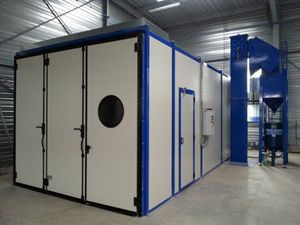
Dry sand blast cleaning room to projection of the type "overpressure" high output with generator and separate dust extractor with cartouches.
Cabin of great volume (1300 X 750 X 850 mm)
Broad door for the passage of the parts to be treated on the right. A plate on swivelling arm or rails facilitates the loading of the heavy parts.
The generating unit dust extractor allows a sorting, a ventilation and a projection of the abrasive of high efficiency and thus ensures a production 20% higher than the concurrent machines.
|
|
|
|
|
|
Blasting Range - Pressurized Blasting Cabinet
With the possibility of employing a wide range of abrasive materials such as, for example: carbon steel grit, stainless steel, aluminum oxide, sand, glass micro spheres etc., this equipment is appropriate for medium to heavy works in the surface preparation for the application of coatings or cleaning of parts, matting, removal of old paint, lamination scale, forgery, foundry, deoxidization, decoration, engraving, shot peening etc.
The CMV pressurized cabinets have a pressure vessel designed to operate with pressure of up to 6.5 Bar (94 PSI), built according to ASME standard, revision 2001, section VIII, division I, and meet the most important international safety standards such as, for example, the 97/23/EC and the Brazilian NR-13. The pressure vessel is welded by the submerged arc process by qualified welders, and all equipment is hydrostatically tested at a pressure of 9.8 Bar (141PSI). The blasters are also equipped with the following original accessories: pressure regulator, manometer, inspection window, air intake valve piloted by the pedal valve, pop-up valve built in polyurethane with a semi-spherical shape that insures better sealing, an air dosing spherical valve, a depressurizing valve, also piloted by the pedal valve, a centrifugal moisture separator, an abrasive material dosing valve with a calibrated hole, which foregoes the need for adjustment, with a very low maintenance cost, an anti-static blasting hose and a venturi type blasting nozzle in tungsten dicarbide.
|
|
Blast cabinets are the workhorse of the abrasive blasting world. They are an economical, versatile piece of equipment that can be used for many different shapes and sizes of work, as well as a multitude of different abrasives and applications.
Cabinets can first be separated into suction and pressure systems:
-Suction systems utilize the venturi principle to deliver the abrasive to the blast gun via suction (hence the name) where it is combined with your compressed air source and propelled against the work piece.
- Pressure systems use a pressurized vessel to contain the abrasive. In these systems the abrasive is metered into the compressed air stream at the pot, and travels the length of the blast hose and out of the nozzle under pressure.
|
|
Blast cabinets are operated from the exterior. During blasting, spent blast media is recovered by an efficient reclaiming system and recycled. Dust, fine particles and debris are carefully separated from reusable blast media.
Blast Cabinets are available in various sizes with internal working dimensions from 920 mm
to 1500 mm.
The viewing window is slightly angled for operator convenience.
Blasting is initiated and stopped by means of a foot-operated valve.
|
|
|
|
|
|
The Clemco Power Gun is a suctionblast tool designed for dry abrasive blasting where the air supply is limited or the job is small. The tool is lightweight and compact and ideal where setting up a conventional pressure blast machine would be awkward or inconvenient. The Power Gun can be used with all common media to clean or etch metal, clean masonry, etch glass, and other durable surfaces.
Description of Operation
The tool simply connects to compressed-air and abrasive sources. The unique suction lance installed on the abrasive hose is partially submerged into a bag of media or connected to the optional media hopper. Blasting begins when the operator depresses a lever on the gun. The tool operates on the principle of induction, where vacuum is created by the compressed air rushing past the point where the abrasive hose attaches to the gun. The vacuum draws abrasive through the hose into the gun, where it mixes with compressed air. The air-abrasive mix exits the gun and strikes the surface to be blasted.
|
|
COMPACT SAND-BLASTING
mod.SD9
- Work cabin dimensions: LxDxH in mm: 900 x 620 x 650
- Outer dimensions: LxDxH mm: 1295 x 650 x 1520
mod.SD12
- Work cabin dimensions: LxDxH in mm: 1200 x 1000 x 850
- Outer dimensions: LxDxH mm: 1592 x 1025 x 1700
CHARACTERISTICS
- Compact
- Integrated self-cleaning cartridge filter
- High-efficiency system of grit separation and recovery
- Grit flow control device
OPTIONAL ACCESSORIES
- Manual fixed rotary table
- Automatic fixed rotary table
- Manual mobile rotary table (only SD12)
- Tumbler unit
- Wearproof inside coating
TECHNOLOGY
These machines use the vacuum shot system and is fitted with an air filtration system built into the cabin, with cleaning of the cartridge by countercurrent air flow.
In addition, research by safety engineers has aimed to guarantee worker health and protection of the external environment.
|
|
A range of blasting machine of simple and economic building site associated with a permanent stock of all the wearing parts and protection equipements of the personnel.
From 1.348
|
|
-Vacuum SANDBLASTERS
-High-pressure SANDBLASTERS
-SPECIAL high-pressure or vacuum SANBLASTERS
The production of standard sandblasters - shot peening machines is completed by job production, according to customers' requirements (from large-sized sandblasting booths for several operators to PLCcontrolled satellite automatic plants).
|
|
KUFRA - AUTOMATIC SAND BLASTING MACHINES WITH PLC AND STEPPED MOVEMENT OF THE GLASS PLATE
Different height models: 1.300 mm - 1.600 mm - 1.800 mm (open top) - 2.000 mm (closed). Solid and epoxy-painted frame. Max thickness of the glass plate 40mm. 2 automatic guns and one manual gun. Effective recycling and filtration system provides minimum consumption of the abrasive media. PLC for a simple and fast programmation. CE brand.
|
|
|
|
|
|
COMPLETE SANDBLASTING EQUIPMENTS
COMPLETE SANDBLASTING EQUIPMENT MOD. 8-EM2 consisting of:
•Sandblasting machine mod. Micrajet 8 complete with m.4 blast hose and nozzle ø 3 mm.
•Air extension of m.10 air hose to connect compressor to blasting machine
•Nozzle ø 4 mm.
•Complete hood mod. RC4 and 1 spare parts set
•Kg.100 abrasive and abrasive fill measurer of litres 2
•Trailer-mounted Electro-compressor voltage 220 Volts mono-phase 2,2 KW
The complete blasting equipment mod. 8-EM2 is particularly suitable for the use in places or flats, provided with a 3 kw 220 volts mono-phase household meter, because, using the nozzle Ø mm.3, allows of blasting at a constant pressure between 0,05 and 4 bar, with a working autonomy from 5 to 15 min. about, therefore, allowing of carrying out the following superficial treatments:
•Blasting of metallic structures with calamine, rust and/or old paint
•Cleaning and restoration of relining brick, stone particulars , marble and granit removing old paintings, dirt, smog , calcareous deposits, graffito and cleaning of wood particulars removing dirt and smog deposits.
•Restoration of epoch cars, maintenance and / or cleaning of naval and nautical particulars.
•Cleaning of moulds, welds and copper, brass, aluminium, stainless steel handworks.
•Execution of indelible written on every kind of surface ( glass, marble, wood , plastic or abs ecc.)
It is also available the COMPLETE SANDBLASTING EQUIPMENT MOD. 8VR-EM2. Part.n 48056050 It is supplied with all components of mod. 8-EM2 except for mod. Micrajet. The model of supplied Micrajet in the complete equipment MOD. 8VR-EM2 is Micrajet Mod. 8VR.
|
|
Tumble blasters
Viking’s rubber belt blasters are ideal for high speed processing of parts than can be gently tumbled. Available in rubber belt or steel belt styles. Available in 4 different sizes.
|
|
|
|
|
|
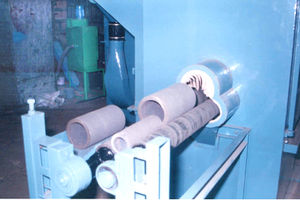
Unlike other hollow bodies tubes and pipes can be processed horizontally because abrasive and compressed air may escape at the rear end.
That is why our Problast PowerPacks with closed-circuit system are the ideal equipment to blastclean, descale and activate the insides of tubes and pipes.
There are two different blasting methods:
1. Blow-through method
In the easiest case, such as the blasting of coils, a blast nozzle is connected to the forward end and a recovery hose to the rear end of the tube.
When straight tubes are to be processed the rear end of the tube is led to a recovery box where the abrasive is collected and recycled.
2. Lance method
For larger tube diameters special blast nozzles are fitted to a lance which is inserted in the tube:
The rear end of the pipe is positioned in an abrasive recovery box.
A blast lance is inserted cleaning the pipe while it retracts.
Either the pipe, the lance or the blast head is rotated.
Multi-nozzle blast heads are available for high-production needs.
|
|
Finally a machine of good quality at price moderated, in conformity with the European standards!
The technique and the equipment of Eco Air 1000 will be appropriate to you. Its innovating design will hold all your attention.
|
|
SA 1000 S6
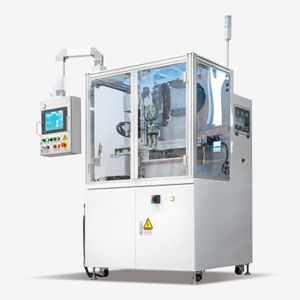
Satellite sandblast systems with freely scalable and rotatable satellites for individual tool processing.
|
|
|
|