|
|
|
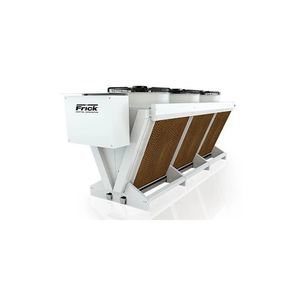
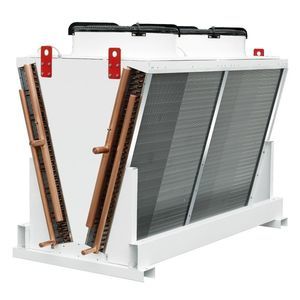
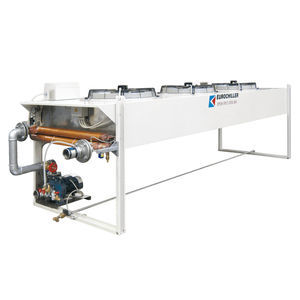
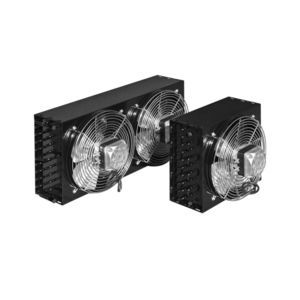
This type of device condenses a refrigerant with the outside air. The fluid comes from the compressor of a refrigeration circuit, circulates inside the bank of tubes, initially cools, then condenses before it leaves in the liquid state. In certain circumstances, the condenser can be designed to ensure supercooling of this fluid.
|
|
Air cooled condensers :
• MA 3 > 14 kW
• WA 7 > 198 kW
• ECA 21 > 876 kW
• CHV 32 > 745 kW
Centrifugal fan condensers :
• CCT 4 > 138 kW
• CCM 41 > 532 kW
|
|
|
|
|
|
To meet changing market expectations, Heatcraft Europe (trade name FRIGA BOHN and HK Refrigeration) has introduced:
NEOSTAR, a new range of high-performance, air condenser units sub-divided into two distinct lines Silence and Power
Using state-of-the-art production methods, efficient and reliable components and a simple and practical selection tool*, the NEOSTAR range offers all the advantages you are looking for. Of course, as is the case for all heat-exchanger products proposed by Heatcraft, the performance ratings of the NEOSTAR range are certified by Eurovent in terms of noise level, power and energy consumption. For this reason, the NEOSTAR range has been accorded the "E-Solution" label.
• Energy efficiency
• Reduced size
• Ultra-silent version
• Fin efficiency
NEOSTAR Silence, a combination of efficiency and silence offering perfect integration in an urban environment (reduced noise level) as well as energy saving (low rotation speeds)
NEOSTAR Power, power at the service of performance
Equipped with a new fin type, NEOSTAR Power is both extremely compact and highly efficient.
|
|
Air heat exchangers
Alfa Laval’s range of air coolers includes
* air condensers
* dry coolers
* unit coolers
for commercial as well as industrial cooling, air-conditioning and refrigeration. They feature excellent heat transfer with minimized fluid volume and low power consumption.
The range of air-cooled condensers is designed for air-conditioning and refrigeration duties. Dry coolers are used for heavy-duty applications and the range of unit coolers is suitable for direct cooling of rooms.
|
|
|
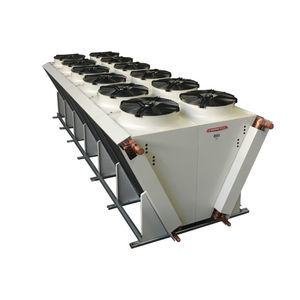
THERMOKEY presents “Turbo-J”, an innovative series of “V” type (double coil) condensers. Designed to be used with all environment friendly refrigerants with capacities ranging from 95 to 1897 kW (ENV 327 Norm), this series is based on a modular design with a RAL 7035 oven painted galvanized steel housing. The units can use up to sixteen 900 mm fans with 8 different sound power levels in single or double fan row.
|
|
|
|
|
|
|
The XLP2 is a traditional axial fan forced draft evaporative condenser that by design minimizes the energy consumption of the entire system by providing lower condensing temperatures. Owners save money while conserving natural resources and reducing environmental impact. The XLP2 product line provides heat rejection at the lowest possible energy input, low maintenance requirements, low installed cost, easy installation and reliable year-round operation. Specifically the XLP2 product line has standard high efficiency, low horsepower axial fans driven by premium efficient, inverter- duty fan motors. The top section self-aligns with the bottom section on all four sides to significantly reduce the time required to rig the XLP2 unit Large 30” x 42” access doors are standard that allow the interior of the unit to be easily accessed for adjusting the float valve, cleaning of the strainer, or flushing of the basin. A large hinged internal partition door and an external door step are standard on all side air inlet units. Water distribution branch removal system requires no tools. The cold water basin is sloped to eliminate stagnant water and reduce biological growth. Fan motors are mounted in the horizontal position on an adjustable base; to aid belt tensioning and changing the base is easily adjusted by turning one large nut. Various materials are available to meet the corrosion resistance and budgetary requirements of any budget: G-235 hot-dip galvanized steel is standard with options of Thermosetting Hybrid Polymer, TripleGuardTM, and Type 304 SS corrosion protection. XLP2 evaporators are designed to meet the requirements of the 2006 International Building Code.
|
|
One of the most important fibers, polyamide 6, is produced by polymerization of caprolactam. Large quantities of extraction effluents are produced in this process. The effluents are cleaned in evaporation plants: the valuable substance is recovered, waste products are minimized, and existing energies from the caprolactam production can be used.
Moreover, evaporation plants are used in this process as sump evaporators for distillation plants.
The particular features of GEA Wiegand plants are:
Economic conception in order to minimize the caprolactam losses
Long operating periods thanks to an optimum temperature
Many years of experience in the application of mechanical vapor recompressors
|
|
GEA Wiegand designs and constructs complex plant systems for the treatment of effluent and the recovery of solvent. The concepts of the different operating processes mainly focus on high degrees of purity, the energetic situation and low residual product quantities.
For the treatment of industrial effluent, our process engineers develop concepts for plant systems that are especially designed for the relevant effluent problem on the basis of a detailed analysis of the current situation.
|
|
Steep and wash water that contain a high proportion of valuable nutrients are produced during the processing of corn, potatoes and rice. For recovering these nutrients, steep and wash water are concentrated in evaporation plants, namely corn steep water to 50 % TS, wash water from the production of wheat starch to 20 - 30 % TS and potato starch effluent up to 60 - 70 % TS.
5-effect falling film evaporation plant for monosodium glutamate heated by thermal vapour recompressor, evaporation rate: 25,000 kg/hr
|
|
GEA Wiegand designs and constructs complex plant systems for the treatment of effluent and the recovery of solvent. The concepts of the different operating processes mainly focus on high degrees of purity, the energetic situation and low residual product quantities.
For the treatment of industrial effluent, our process engineers develop concepts for plant systems that are especially designed for the relevant effluent problem on the basis of a detailed analysis of the current situation.
|
|
|
|
|
|
For the production of fruit juice, fruit and vegetable juice is concentrated from stone, pomacious and soft fruit from approx. 11 % TS to approx. 72 % TS or citrus juice is concentrated from 10 % TS to 60 - 70 % TS. Normally evaporation plants are used for this.
Before or during the evaporation process, volatile aroma substances are extracted from thin juice. These aroma substances are removed and added to the fruit juice later on for intensifying the typical fruit flavor.
The concentration of fruit and vegetable juice means:
the possibility of compensating differences in quantity and quality of different vintage.
the possibility of compensating fluctuations in price in years of cheap and expensive fruit (large and small harvest)
the possibility of storing 6 or 7 times as much harvest in the existing tank space available
considerably less requirements on the storage process
reduction of investment costs, because the apparatures for the production of concentrate are cheaper and involve lower manufacturing costs than the storage tanks that would be necessary otherwise.
simpler and cheaper transportation, because weight and volume of the juice are reduced to a fraction.
|
|
|
|
|
|
For the production of starch conversion products, the starch molecules are either entirely or partially broken down into their basic constituents by hydrolysis, i.e. by catalytic action of acids and enzymes in an aqueous suspension.
Dextrose
pure D-glucose, a final product that cannot be hydrolytically decomposed any further.
Glucose syrup (starch syrup)
contains D-glucose, maltose, isomaltose and high molecular sugar and it is produced by prematurely stopped hydrolysis. The decomposition degree of this product ranges from 20 to 65 DE. The DE value (dextrose equivalent) indicates the degree of conversion. It refers to the content of D-glucose relative to the total dry substance.
Maltodextrine
a starch decomposition product of less than 20 DE and more than 3 DE.
Maltose syrup
consists of approx. 72 % maltose, 18 % glucose, 10 % iso-maltose. It is produced by enzyme conversion of starch of different origin.
Isoglucose syrup
partially isomerized glucose juice (FCS = high fructose corn syrup).
Typical composition:
D-glucose 53 %
D-fructose 42 %
oligo-saccharide 5 %
The indexes 42, 55 or 70 indicate different fructose contents.
D-sorbitol
reduction product of D-glucose (starting material for vitamin C synthesis).
D-mannitol
reduction product of D-glucose.
|
|
|
|
|
|
When product-sensitive and energy-saving applications are involved, the EVAPplus plate falling film evaporators are exactly the right choice. State-of-the art technology ensures high-efficiency concentration of juice from sugar beet and cane. The special feature of EVAPplus is the combination of tube and plate evaporators. The plates are arranged in such a way that two separate flow channels result: a tubular channel with 6 or 9 mm diameter for the juice and a corrugated channel for the condensing steam or
vapour. The plate packs are fully welded without the need for gaskets.
Retrofitting Robert-type evaporators
The advantages of the EVAPplus can also be used to achieve greater efficiency by retrofitting existing Robert evaporators. In most cases no changes are necessary to buildings, foundations or the static design of the plant. The calandria from the old Robert evaporator is simply removed and replaced with an EVAPplus plate pack and the respective distributor. With minimum expenditure the heating surface area and the system efficiency is considerably increased.
Simple to clean
The EVAPplus can be easily and quickly cleaned to maintain its maximum performance. Evaporators used for processing beet sugar juices are cleaned at the end of each campaign. When processing cane sugar juice, a sensible cleaning cycle is every one to two weeks.
Outstanding features
- High density of heating surface (170 m²/m³ or 240 m²/m³)
- Outstanding overall heat transfer values
- Low temperature differences
- Short residence time of the of the juice in each effect
- Low juice colour formation
|
|
|
Gelatin is a high-value natural product which is recovered from animal substances. After a chemical pretreatment, the initial product is extracted in hot water. The gelatine solution recovered in this way is then filtered, concentrated, sterilized, and finally dried. Both plate evaporators and tube evaporators are used for the concentration.
|
|
API Schmidt-Brettens' evaporization systems with SIGMASTAR® climbing-film plate evaporators are used in the food industry, in the organic and chemical industry and for wastewater treatment.
The unique construction of the SIGMASTAR® evaporization plates makes it possible to apply SIGMASTAR® in a number of different evaporization processes. With problem products (e.g. viscous streams, slurries, and liquids with fouling tendencies) which cannot be processed with falling film evaporators, the SIGMASTAR® evaporizer performs especially smoothly and successfully.
|
|
|
|
|
|
In the food industry, in the organic and chemical industry, and for wastewater treatment.
Some advantages of the rising-film SIGMASTAR®.
Superior product distribution due to the thermo-siphon principle. As product boils and rises in the tube, fresh product automatically rises to refill the tube. This distribution technique operates independently of the feed rate, allows a high degree of flexibility and the possibility of turn down.
Very short residence time; the product is in the SIGMASTAR® for less than a second. This is due to the short flow distance and the high product film velocity. This feature guarantees a gentle treatment of the product.
Low pressure losses across the tubes, a benefit of the short tube length.
High vapour velocity in the rising film, which allows the processor to achieve high concentrations and viscosity.
Clearly defined product flow path. There is no chance of local over-concentration.
High heat transfer co-efficients are obtained even when the feed temperature is lower than the boiling temperature.
Compared to other evaporizer systems less expensive for high grade materials of construction.
Easy assembly and dismantling. A change in the size of the heat exchange surface by varying the number of heat exchange plates makes it possible to create more compact systems.
|
|
|
|
|
|
APV PLATE EVAPORATORS
During the plate evaporation process, liquid is pumped between thin plates with the heating medium on the mating surfaces. The product is then evaporated with the vapour generated forming a high velocity core. This expansion in volume causes a high-velocity, thin film on the heat exchange surface providing efficient heat transfer.
Plate evaporators should be considered for applications that have:
* Capacities up to 27,000 kg/h water removal
* A need for future expansion
* Limited head space
* A particle size smaller than 600 Micron
APV Product Range:
* Rising/falling film plate evaporators
The original plate type evaporator.
* Falling film plate evaporator
Combining all the advantages of the original Rising/Falling Film Plate Evaporator with the added benefits of even shorter product residence time and larger capacities.
* Paravap
The APV Paravap is specially designed to process high solids concentrates or those having non-Newtonian viscosity characteristics.
* Paraflash
For products which tend to crystallize during concentration or those that contain a high percentage of suspended solids.
APV Plate Evaporators Features/benefits:
* Improved product quality.
* Higher product concentration.
* Low liquid holdup.
* Easily cleaned.
* Flexible capacity.
* Low installation costs.
|
|
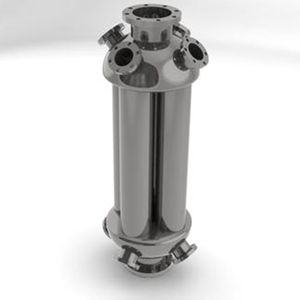
This is one possible realisation of a plate evaporator. In this case it is a kettle-type evaporator with extend shell.
Other types of two phase units are possible such as condensator, desuperheater or Dephlegmator.
We are able ot adjust the design to your needs, feel free to contact us. We are looking forward to fulfill your demands.
|
|
|
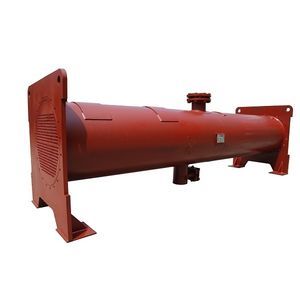
The THERMOKEY shell and tube condensers are designed using the best technical solutions, for applications in the fields of air conditioning and refrigeration. The capacity range, in nominal conditions, is between 10 kW and 1700 kW with just three shell lengths. To allow a rapid and clear choice of the product, a table with the identification codes has been prepared, in which a series of variable standards and any particular requests are drawn up. The shell and tube is made of high performance tubes of special copper, finned externally and grooved internally for a low fauling factor. Thanks to the combination of the two effects, refrigerant side and water-flow side, the condensers are reduced in size and weight compared to those that use traditional tubes, for the same capacity. All the products are made to function with tap water, well water or, on request, sea water.
|
|
THERMOKEY shell and tube evaporators are designed to provide its clients with the best solutions available in air-conditioning and in refrigeration.
Different models with range capacities from 20 kW to 1700 kW at nominal working conditions, with a number of independent circuits which can vary from 1 to 4. In order to provide a fast and clear description of the product, a specific order code table has been prepared. This table provides a whole series of standard variables and special requirements.
|
|
|
The THERMOKEY shell and tube condensers are designed using the best technical solutions, for applications in the fields of air conditioning and refrigeration. The capacity range, in nominal conditions, is between 10 kW and 1700 kW with just three shell lengths. To allow a rapid and clear choice of the product, a table with the identification codes has been prepared, in which a series of variable standards and any particular requests are drawn up. The shell and tube is made of high performance tubes of special copper, finned externally and grooved internally for a low fauling factor. Thanks to the combination of the two effects, refrigerant side and water-flow side, the condensers are reduced in size and weight compared to those that use traditional tubes, for the same capacity. All the products are made to function with tap water, well water or, on request, sea water.
|
|
THERMOKEY shell and tube evaporators are designed to provide its clients with the best solutions available in air-conditioning and in refrigeration.
Different models with range capacities from 20 kW to 1700 kW at nominal working conditions, with a number of independent circuits which can vary from 1 to 4. In order to provide a fast and clear description of the product, a specific order code table has been prepared. This table provides a whole series of standard variables and special requirements
|
|
| ... products without technical information |
| |
|
|