|
|
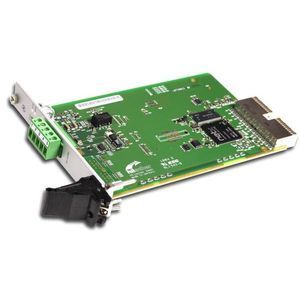
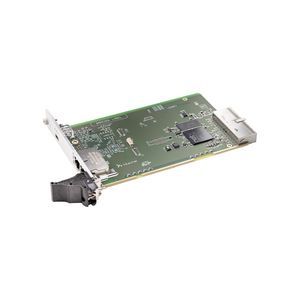
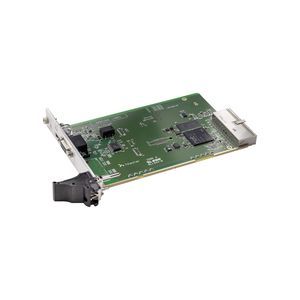
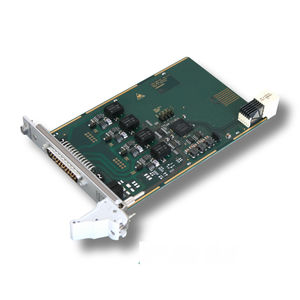
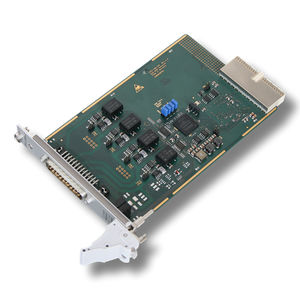
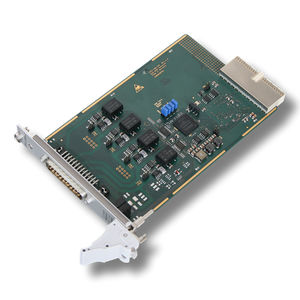
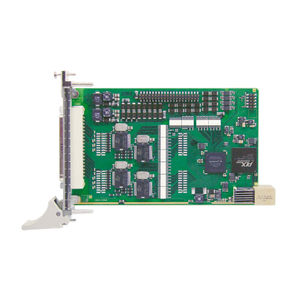
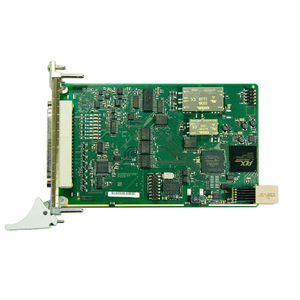
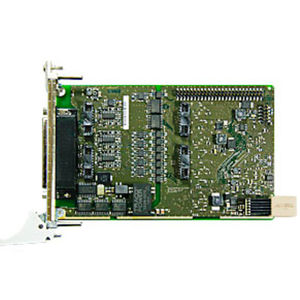
ADDI-DATA offers interference-free boards for the CompactPCI bus for the industrial measurement, control and automation. The measurement boards are available with 6U or 3U bracket.
- Digital I/O, 24 V
- Analog I/O, multifunction boards
- multifunction counter board: incremental counter, SSI synchronous serial interface, counter/timer, pulse acquisition, frequency , pulse width , period duration, velocity measurement, PWM, BiSS-Master, digital inputs and outputs, ...
- Communication board
- Motion control boards
Protective measures:
- Optical isolation from 500 V to 1000 V
- Separation between analog and digital signals
- Protection against short-circuits, overtemperature and overvoltage
- Input and output filters
- Industry-standard SUB-D connectors
Free drivers for standard operating systems and programming samples.
In preparation: Open Source real-time PAC system in CompactPCI format
|
|
6U CompactPCI Boards
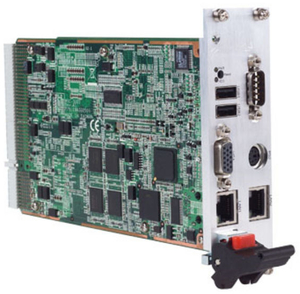
Full line of 6U CompactPCI products supporting PICMG 2.16, IPMI, Hotswap, TPM, System Management. For more information on CompactPCI integrated systems, please click here systems
A complete overview provides Kontron's CompactPCI Product Guide.
|
|
Today, the PC assumes a key position in automation technology. Together with a real-time operating system, e.g. Windows® NT, it creates an ideal hardware platform for control and visualisation of process data. By using so called SoftPLCs the PC penetrates into application areas that have been the domain of classical programmable controllers.
Fieldbus systems with remote input and output modules are used for the data transfer between the PC and the automation equipment. We offer special interface cards since the PC does not feature a direct link to the fieldbus.These intelligent cards manage the entire data transfer. Only useful data are passed onto the user applications.
|
|
|
NAI offers a variety of PCI-based COTS and Custom Boards, specifically designed for the rugged-Military and Commercial Aerospace markets. Our DSP-based designs offer unusually high function density, high resolution and accuracy, and low power consumption. Standard features include extensive diagnostics, background Built-In-Test (BIT), auto-ranging of signal inputs, self-calibration, galvanic isolation, and field programmable parameters. A Windows 9x+/PNP Software Support Kit (SSK) with board-specific library (DLL) is supplied to facilitate applications development.
|
|
16 Channel 12-Bit Analog Input Board
16 (8 optional) channels
Resolution 12-bit
Basic accuracy of 1 LSB
Input voltage range 0..5V, 0...10V, 5V, 10V
|
|
Boards for PC-based systems
SERCOS II boards are available for all standard bus systems including PCI, ISA, PC/104 and PMC (PCI Mezzanine Card). They support 2,4,8 and 16 MBit/s transfer speed and are based on the SERCON816 controller which succeeded the predecessor SERCON 410B.
Some boards offer dual-interfaces on a single PCB. Those two separate SERCOS interfaces can be synced via a SYNC –connector.
The first world-wide available SERCOS III board, a dual-ring PCI model, is already released.
Board for embedded platforms
In addition to boards for PC-based systems a SERCOS has been developed for use on embedded platforms. It is very compact and comes with a 16bit parallel bus. It can be easily integrated into application-specific hardware designs.
|
|
The 8011 digital I/O interface provides 8 optically isolated inputs and 8 Form C relay outputs. The inputs protect the PC and other sensitive equipment from spikes and ground loop current that can be generated in industrial environments, while the outputs provide higher current capabilities (up to 2A) and are optimized for 24V operation. Form C relays can be wired for either normally open or normally closed operation.
If your application requires RoHS compliance, order the 8011-RoHS.
Sealevel's SeaI/O Classic software drivers and utilities make installation and operation easy using Windows 98, ME, NT, 2000, XP and Vista operating systems.
Get a jumpstart on your digital I/O development with The Digital I/O Handbook that will provide helpful information that you will use again and again. Check out Chapter 1 for an overview of logic principles.
|
|
* 16 bit A/D converter board
* 8 synchronous channels with seperate A/D
* Maximum sampling rate 3 MS/s on 8 channels
* Extremely high dynamic range
* Up to 256 MSample memory
* 8 input ranges between ±50 mV and ±10 V
* Continuous FIFO mode
* Automatic offset calibration
* Selectable single-ended or differential inputs
* Synchronisation to multi-board system possible
* 32 Bit CompactPCI 6U interface
* Compatible with 3,3V and 5V PCI I/O-Voltage
The MC.46xx series allows recording of two, four or eight channels with sampling rates of 200 kS/s up to 3 MS/s. These cards offer outstanding A/D features both in resolution and spees for CompactPCI. They are available in several versions and different speed grades making it possible for the user to find an individual solution. The installed memory of up to 256 MSample can be used for fast data recording or sustained data streaming. The enhanced FIFO engine is capable of streaming even 8 channels with 3 MS/s sustained to memory or hard disk.
|
|
|
|
|
|
* Universal digital I/O
* 32 bit data width at 125 MS/s
* configured for input and output
* 110 Ohm termination software selectable
* 3,3V and 5V TTL tolerant I/O lines
* Up to 512 MByte on-board memory
* continuous FIFO transfer possible
* Pattern edge pulsewidth trigger
* internal synchronisation with analog cards possible
* 32 Bit CompactPCI 6U interface
* Compatible with 3,3V and 5V PCI I/O-Voltage
The MC.70xx series of fast digital I/O boards offer a resolution between 16 bit and 64 bit with a maximum sampling rate of 125 MS/s (60 MS/s). Every 16 bit / 32 bit of the board could be separately programmed for input or output. The on-board memory of up to 512 MByte could be completely used for recording or replaying digital data. Alternatively the MC.70xx could be used in FIFO mode. Then data is transferred on-line to PC memory or hard disk. The internal standard synchronisation bus allows synchronisation of several MC.xxxx boards. Therefore the MC.70xx board could be used as an enlargement to analogue boards.
|
|
|
|
|
|
DF PROFI II PCI/PCIe/CPCI/PC104+
High performance PROFIBUS DP/DPV1 interface
The DF PROFI II is a high performant PROFIBUS DP/DPV1 board of the newest generation and is available as PCI, PCIe, CompactPCI and PC104+ board. The DF PROFI II PCI interface supports 5V and 3.3V 32 Bit PCI slots, so it can be used in server pcs and workstations without problems. Beside the standard DP/DPV1 PROFIBUS services the board implements useful additional options.
The implemented hardware watchdog allows the electrical switch off of the PROFIBUS interface, that allows the board to be used in redundant DP Master concepts with 2 pc systems.
The process image contains except I/O data and status information a relative time stamp with millisecond resolution.
The DF PROFI II board needs for the data exchange of the process image only round about 1 ms with common I/O data sizes up to 3 Kbytes and stores the PROFIBUS configuration data in a failsafe flash memory.
For the compilation of the PROFIBUS configuration a very powerful and comfortable tool is available. The DF PROFI II board supports beside the popular operating systems Windows 2000/XP and Linux (SUSE, Redhat, Fedora) real-time operating systems like LINUX RT and LabVIEW RT.
|
|
|
The P635 is a single-width, 3U, PXI bus module with eight frequency measurement channels. This counter module can be used to monitor a variety of pulse sources. Moreover, its unique circuitry allows the monitoring of a wide range of frequencies without changing any module settings. TTL inputs are provided as well as differential input circuits, with filtering and hysteresis to provide high noise immunity. The switching threshold is programmable. The input voltage should be at least twice the threshold voltage for noise immunity. AC or DC coupling of the differential inputs is programmable on a per-channel basis.
|
|
| ... products without technical information |
| |
The 8011 digital I/O interface provides 8 optically isolated inputs and 8 Form C relay outputs. The inputs protect the PC and other sensitive equipment from spikes and ground loop current that can be generated in industrial environments, while the outputs provide higher current capabilities (up to 2A) and are optimized for 24V operation. Form C relays can be wired for either normally open or normally closed operation.
If your application requires RoHS compliance, order the 8011-RoHS.
Sealevel's SeaI/O Classic software drivers and utilities make installation and operation easy using Windows 98, ME, NT, 2000, XP and Vista operating systems.
Get a jumpstart on your digital I/O development with The Digital I/O Handbook that will provide helpful information that you will use again and again. Check out Chapter 1 for an overview of logic principles.
|
|
|
|
|
|
* Universal digital I/O
* 32 bit data width at 125 MS/s
* configured for input and output
* 110 Ohm termination software selectable
* 3,3V and 5V TTL tolerant I/O lines
* Up to 512 MByte on-board memory
* continuous FIFO transfer possible
* Pattern edge pulsewidth trigger
* internal synchronisation with analog cards possible
* 32 Bit CompactPCI 6U interface
* Compatible with 3,3V and 5V PCI I/O-Voltage
The MC.70xx series of fast digital I/O boards offer a resolution between 16 bit and 64 bit with a maximum sampling rate of 125 MS/s (60 MS/s). Every 16 bit / 32 bit of the board could be separately programmed for input or output. The on-board memory of up to 512 MByte could be completely used for recording or replaying digital data. Alternatively the MC.70xx could be used in FIFO mode. Then data is transferred on-line to PC memory or hard disk. The internal standard synchronisation bus allows synchronisation of several MC.xxxx boards. Therefore the MC.70xx board could be used as an enlargement to analogue boards.
|
|
|
Galil offers a complete line of single and multi-axis controllers for stepper and servo motors. Interfaces include PCI, ISA, PC/104, cPCI, VME, USB, RS232 and Ethernet. Modes of motion include point-to-point positioning, jogging, linear and circular interpolation, contouring, ecam and electronic gearing. Also programmable I/O for interface to external sensors.
|
|
|
|