


{{product.productLabel}} {{product.model}}
{{#if product.featureValues}}{{product.productPrice.formattedPrice}} {{#if product.productPrice.priceType === "PRICE_RANGE" }} - {{product.productPrice.formattedPriceMax}} {{/if}}
{{#each product.specData:i}}
{{name}}: {{value}}
{{#i!=(product.specData.length-1)}}
{{/end}}
{{/each}}
{{{product.idpText}}}
{{product.productLabel}} {{product.model}}
{{#if product.featureValues}}{{product.productPrice.formattedPrice}} {{#if product.productPrice.priceType === "PRICE_RANGE" }} - {{product.productPrice.formattedPriceMax}} {{/if}}
{{#each product.specData:i}}
{{name}}: {{value}}
{{#i!=(product.specData.length-1)}}
{{/end}}
{{/each}}
{{{product.idpText}}}


... and simulation we have optimized the design and performance of the accumulator. Parker Olaer bladder accumulators are suitable for use in more than 35 countries (all hydraulic accumulators ...

... installation and operation of the accumulators in any hydraulic system. Parker Olaer have developed very sophisticated simulation software to optimize sizing recommendations for hydraulic ...
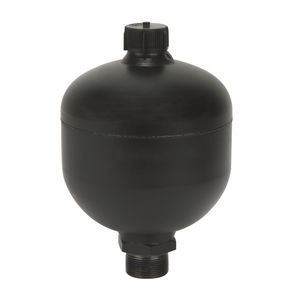

F9.601 Hydraulic accumulators F9.601 Hydraulic accumulators Nominal volume 13 – 750 cm³ max. operating pressure 250 – 500 bar hydraulic fluid: ...
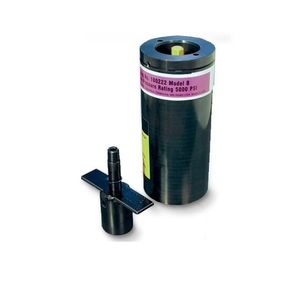

... piston type accumulators allowing them to be mounted in any orientation. This type of accumulator has a wider operating range at any one charge pressure than any other type of accumulator. ...
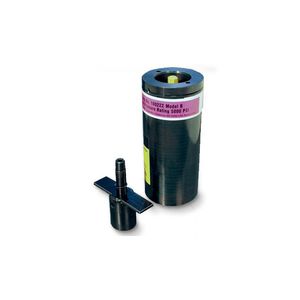

SPX accumulators have been developed for storing small supply of pressurized oil. They are suitable for palletized workholding systems or other such systems with temporary disconnection of supply pressure. The nitrogen-charged ...
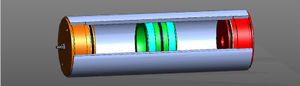

Ligon Hydraulic Cylinder Group manufactures piston type accumulators in a wide range of different bore sizes and lengths for several industries such as oil, mining and road construction. Designed for ...
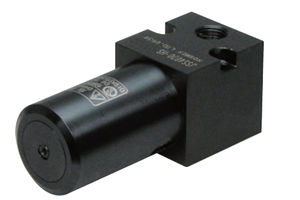

This is a spring-type accumulator that absorbs pressure variation caused by changes in the circuit temperature of jigs that have been disconnected from the hydraulic pressure source.
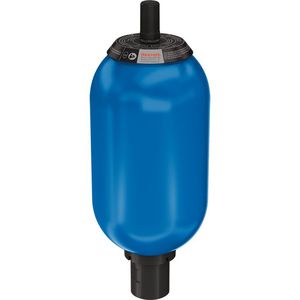

Bladder-type accumulators are used for energy storage, shock and vibration absorption, and leakage oil or volume compensation in hydraulic systems. With the design and monitored production in accordance ...
Bosch Rexroth - Mobile Hydraulics and Electronics


Complete mounted accumulator station on a console consisting of a bladder-type accumulator, accumulator shut-off block and pressure gauge with red marking Accumulator ...
Bosch Rexroth Hägglunds Products and Solutions


Diaphragm accumulators are a type of hydraulic accumulator. A diaphragm separates the compressible gas cushion from the hydraulic fluid. The diaphragm accumulator ...
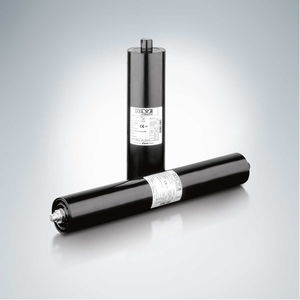
Piston type accumulators are a type of hydraulic accumulator. A freely moving piston separates the compressible gas cushion from the hydraulic fluid. The piston type ...
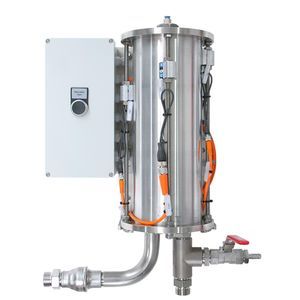

The ViscoTec hydraulic accumulator offers the simplest solution for achieving smooth production that is not disrupted by container changes. The accumulator is usually integrated in the ...
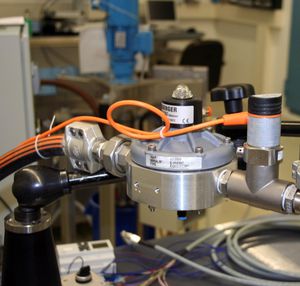
The ViscoTec hydraulic accumulator offers the simplest solution for achieving smooth production that is not disrupted by container changes. The accumulator is usually integrated in the ...

Since liquids are not easily compressible, they cannot be used to accumulate energy directly. Hydraulic accumulators make it possible to store liquids under pressure.
ApplicationsApplications are numerous; accumulators are present in every type of industrial facility.
TechnologiesThe operating principle is based upon Boyle's law (pressure times volume = a constant) and on the compressibility difference between liquids and gases.
The accumulator's bladder is filled with nitrogen and closed off by a filling valve. The bladder then fills the accumulator's interior. Introduction of a pressurized liquid compresses the nitrogen. As gas volume decreases, pressure increases and the pressurized liquid accumulates.
In the opposite case, the accumulator empties if the pressure on the liquid side drops below that of the bladder.
The volume and operating pressure of the accumulator should suit the task it is meant to perform.
- Energy transmitted by a stored liquid
- Process is reversible
- Maintains required pressure
Please specify:
Help us improve:
remaining