


{{product.productLabel}} {{product.model}}
{{#if product.featureValues}}{{product.productPrice.formattedPrice}} {{#if product.productPrice.priceType === "PRICE_RANGE" }} - {{product.productPrice.formattedPriceMax}} {{/if}}
{{#each product.specData:i}}
{{name}}: {{value}}
{{#i!=(product.specData.length-1)}}
{{/end}}
{{/each}}
{{{product.idpText}}}
{{product.productLabel}} {{product.model}}
{{#if product.featureValues}}{{product.productPrice.formattedPrice}} {{#if product.productPrice.priceType === "PRICE_RANGE" }} - {{product.productPrice.formattedPriceMax}} {{/if}}
{{#each product.specData:i}}
{{name}}: {{value}}
{{#i!=(product.specData.length-1)}}
{{/end}}
{{/each}}
{{{product.idpText}}}


Torque: 0.018 Nm - 56.5 Nm
Rotational speed: 8,000 rpm - 30,000 rpm
Power: 0 W - 14,000 W
... Hysteresis Brake Dynamometers (HD Series) are versatile and ideal for testing in the low to medium power range (maximum 14 kW intermittent duty). With a Hysteresis Braking system, the ...
MAGTROL

Torque: 0.3 Nm - 560 Nm
Rotational speed: 2,390 rpm - 15,915 rpm
Power: 500 W - 140,000 W
... Eddy-Current Brake Dynamometers (WB Series) are ideal for applications requiring high speeds and also when operating in the middle to high power range. Eddy-Current Brakes provide increasing torque as the speed increases, ...
MAGTROL

Torque: 6.2 Nm - 28 Nm
Rotational speed: 12,000 rpm - 25,000 rpm
Power: 3,000 W - 6,000 W
... the production line, at incoming inspection or in the R&D lab. As with all Magtrol Hysteresis Dynamometers, engine loading is provided by Magtrol’s Hysteresis Brake which provides: torque independent ...
MAGTROL
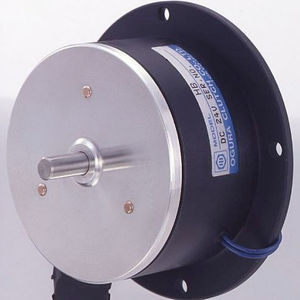

Torque: 0.0367 ft.lb - 0.741 ft.lb
Rotational speed: 3,000 rpm
Power: 7 W - 18 W
... Hysteresis brake for industrial application. Torque is independent of slip speed and can be easily controlled by varying the current. Since there is no frictional contact between the magnets, the units have an extremely ...
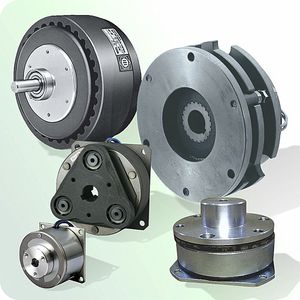

Torque: 0.05 Nm - 3,200 Nm
... A range of electromagnetic brakes with torque range from 0.05 to 3200 Nm / 0.4 in-lbs. to 2360 ft-lbs. Including multiple disc, mag-particle, hysteresis, spring applied and permanent magnet models. Electromagnetic brakes ...
jbj Techniques Limited
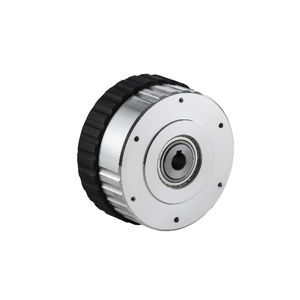

Torque: 2 Nm
Rotational speed: 0 rpm - 1,000 rpm
Power: 20 W
... New: our adjustable hysteresis brake PMB-2. The special thing about this very compact brake is that the torque can be adjusted manually using the wheel on the outer diameter both when stationary and when ...
Kern Antriebstechnik GmbH
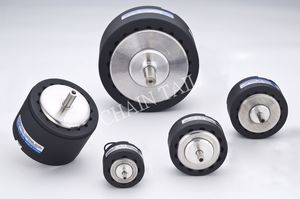

Torque: 0.02 Nm - 1.75 Nm
... Chain Tail hysteresis clutch and brake operates on the principles of hysteresis to bring accurate and smooth torque. A magnetic air gap without magnetic particles or friction components produces torque. ...
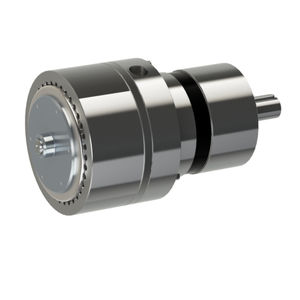

Torque: 0.0226 Nm - 0.0791 Nm
... These brakes utilize an electric hysteresis brake paired with an integral gearbox. Ideal for applications that require high torque at a low speed. Available in a variety of gear ratios depending on torque ...
Magnetic Technologies
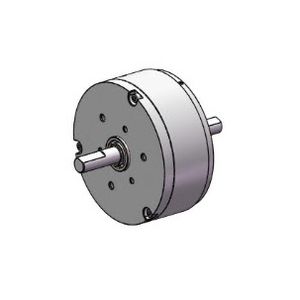

Torque: 0.02 Nm - 15 Nm
Dongguan Weizheng Electromechanical Technology Co., Ltd.
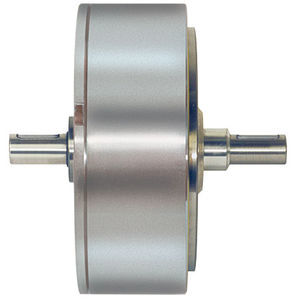

Torque: 0.024 Nm - 30,200 Nm
Power: 5 W - 4,800 W
... Hysteresis Brakes Current Controlled - Standard with shaft on both sides For complete technical data and dimensions, the >Data Sheet (PDF) can be downloaded. Likewise, 3D drawings in IGS or STEP can be downloaded. After ...
mobac


Torque: 0.25 Nm
... With the BRAKE-BWA, Nanotec offers an electrically operated spring loaded brake with an extremely compact design for use as a static holding brake. It can be mounted directly to motors with a shaft diameter ...
the best suppliers