

- Metrology - Laboratory
- Laboratory Equipment
- Sample preparation scratching tool
- ERICHSEN GmbH & Co. KG

- Company
- Products
- Catalogs
- News & Trends
- Exhibitions
Sample preparation scratching tool Model 426

Add to favorites
Compare this product
Characteristics
- Options
- for sample preparation
Description
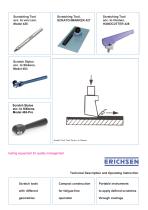
The Scratching Tool acc. to van Laar is a ball-shaped hard metal pin with a tip diameter of 0.5 mm is mounted stably in a ballpoint pen-shaped holder made of anodised hard aluminium. The special handy design of the instrument guaranties a stable appliance during the scratching operation. The spherical point was submitted to the following endurance test: A cylinder of 100 mm dia. (4) free-cutting steel chucked in a lathe was scratched by a scratch needle at a surface speed of 20 cm/s (8) and a pressure of 50 N (11 lbs). No damage of the spherical point did occur after a run of 18000 cm (600 ft). It proved that at least 2000 scratches of 90 mm (3.1/2) length each can be made without a failure.
Purpose and application
Scratching-in of the St. Andrews cross into test panels is a well-known preparation for short-term and endurance corrosion tests, enabling the examination of the protection of the coating against rusting of the substrate underneath the coating (underrusting). The Sratching Tool acc. to van Laar is a handy universal tool: for producing accurately defined incisions on the surface of the coating in preparation of forced corrosion tests, such as salt spray, continuous or intermittent immersion, accelerated weathering, gas corrosion and humidtiy tests.
Principle of the test
For producing a specified incision in the protective coating, the test panels are scratched with the scratching needle at the beginning of the corrosion test and again at regular time intervals. These scratches are made horizontally, one above the other, the first at the bottom on the shorter side of the panel. By this method it is easy to study the progression of the underrusting. More or less strain will have to be exerted according to the thickness and hardness of the coating in order to reach the substrate with certainty and to produce a slight deformation of the metal. For drawing a clean scratch should be about 10 cm/s (4).
Purpose and application
Scratching-in of the St. Andrews cross into test panels is a well-known preparation for short-term and endurance corrosion tests, enabling the examination of the protection of the coating against rusting of the substrate underneath the coating (underrusting). The Sratching Tool acc. to van Laar is a handy universal tool: for producing accurately defined incisions on the surface of the coating in preparation of forced corrosion tests, such as salt spray, continuous or intermittent immersion, accelerated weathering, gas corrosion and humidtiy tests.
Principle of the test
For producing a specified incision in the protective coating, the test panels are scratched with the scratching needle at the beginning of the corrosion test and again at regular time intervals. These scratches are made horizontally, one above the other, the first at the bottom on the shorter side of the panel. By this method it is easy to study the progression of the underrusting. More or less strain will have to be exerted according to the thickness and hardness of the coating in order to reach the substrate with certainty and to produce a slight deformation of the metal. For drawing a clean scratch should be about 10 cm/s (4).
Other ERICHSEN GmbH & Co. KG products
Sample preparation


Related Searches
- Laboratory shaker
- Digital laboratory shaker
- Benchtop laboratory shaker
- Coating machine
- Stainless steel laboratory shaker
- Liquid laboratory shaker
- Variable-speed laboratory shaker
- High-speed laboratory shaker
- Rotary laboratory shaker
- Coating machine for pharmaceutical applications
- Laboratory shaker with LCD display
- Laboratory coating machine
- Motorized laboratory stirrer
- Video microscope
- Optical video microscope
- Inspection video microscope
- Paper coating machine
- LED illumination video microscope
- ERICHSEN scratching tool
- USB video microscope
*Prices are pre-tax. They exclude delivery charges and customs duties and do not include additional charges for installation or activation options. Prices are indicative only and may vary by country, with changes to the cost of raw materials and exchange rates.