



- Company
- Products
- Catalogs
- News & Trends
- Exhibitions
Manual disconnector GW6motorizedhigh-voltage3-pole

Add to favorites
Compare this product
Characteristics
- Type
- manual, motorized
- Voltage level
- high-voltage
- Number of poles
- 3-pole
- Electrical characteristics
- AC, grounding, three-phase
- Construction
- horizontal
- Assembly
- overhead
- Applications
- industrial, for railway applications, for photovoltaic applications
- Other characteristics
- outdoor, blade, semi-pantograph
- Certifications
- IEC
- Primary current
3,150 A, 4,000 A, 5,000 A
- VAC
Min.: 126 kV
Max.: 550 kV
Description
·IEC 62271, ANSI/IEEE Std C37, NEMA
·ISO 9001, KEMA, CESI, CE, TUV, UL, ASTA
·Seismic design, ETGI-1.020, IEEE Std 693, NCh2369
·Structural design, ASTM A325, ANSI/AISC 360, AWS D1.1
·High altitude correction per IEC 62271 & IEEE C37, ~ 5000m
·Copper and silver moving contact
·Insulator double row ball bearings
·Adjustable open and close position stops
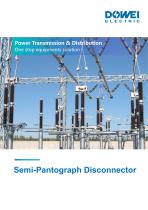
Semi-Pantograph Disconnector (Semi-Pantograph Isolator) is a high-voltage disconnector used in air-insulated substations (AIS) to provide visible electrical isolation of transmission equipment. It combines features of a conventional disconnector and a pantograph mechanism, making it particularly suitable for substations with restricted space or where equipment is mounted at different elevations.
Unlike a full pantograph disconnector, only one side uses a pantograph linkage, while the opposite side remains fixed. This reduces mechanical complexity while retaining many of the space-saving benefits.
Working Principle
The semi-pantograph disconnector uses a movable pantograph arm that extends or retracts to make or break contact with a fixed terminal.
·Closed position: The pantograph mechanism extends upward or outward, and the movable contact engages the fixed contact to complete the electrical circuit.
·Open position: The pantograph retracts, creating a clearly visible air gap that safely isolates the equipment.
Like all disconnectors, it must not be used to interrupt load current or fault current. The associated circuit breaker must first open the circuit.
Normal Operating Sequence
1.Open the circuit breaker.
2.Confirm the circuit is de-energized.
3.Open the semi-pantograph disconnector.
4.Close the earthing switch if maintenance is required.
Main Components
·Fixed contact assembly
·Pantograph movable arm
·Conducting links
·Post insulators
·Operating mechanism (motor-operated or manual)
·Mechanical linkage
·Base frame
·Position indicator
·Auxiliary switches
Features
·Pantograph mechanism on one side only.
·Reduced space requirements compared with conventional disconnectors.
·Accommodates connections at different heights.
·Provides a visible isolation gap.
·High mechanical reliability.
·Suitable for remote and local operation.
·Designed for outdoor air-insulated substations.
Typical Voltage Ratings
·72.5 kV Distribution and sub-transmission
·145 kV High-voltage substations
·220 kV Transmission substations
·330 kV Extra-high-voltage systems
·400 kV EHV substations
·500–765 kV Bulk power transmission
Advantages
·Requires less installation space than many conventional designs.
·Simpler than a full pantograph disconnector.
·Easily connects equipment at different elevations.
·High dielectric performance.
·Reliable mechanical operation with long service life.
·Ideal for compact substation layouts.
Limitations
·Cannot interrupt load current or fault current.
·More mechanically complex than center-break disconnectors.
·Higher initial cost than standard disconnector designs.
·Requires periodic inspection and lubrication of the pantograph linkage.
Applications
Semi-pantograph disconnectors are commonly used for:
·Compact air-insulated substations (AIS)
·High-voltage and extra-high-voltage substations
·Transformer isolation
·Circuit breaker isolation
·Busbar switching
·Connections between equipment at different heights
·Substations where horizontal space is limited
The Semi-Pantograph Disconnector offers a practical compromise between traditional disconnectors and full pantograph designs. It provides visible isolation, compact installation, and the ability to connect equipment at different elevations, making it a popular choice for modern high-voltage and extra-high-voltage air-insulated substations where efficient use of space is important.
·ISO 9001, KEMA, CESI, CE, TUV, UL, ASTA
·Seismic design, ETGI-1.020, IEEE Std 693, NCh2369
·Structural design, ASTM A325, ANSI/AISC 360, AWS D1.1
·High altitude correction per IEC 62271 & IEEE C37, ~ 5000m
·Copper and silver moving contact
·Insulator double row ball bearings
·Adjustable open and close position stops
Semi-Pantograph Disconnector (Semi-Pantograph Isolator) is a high-voltage disconnector used in air-insulated substations (AIS) to provide visible electrical isolation of transmission equipment. It combines features of a conventional disconnector and a pantograph mechanism, making it particularly suitable for substations with restricted space or where equipment is mounted at different elevations.
Unlike a full pantograph disconnector, only one side uses a pantograph linkage, while the opposite side remains fixed. This reduces mechanical complexity while retaining many of the space-saving benefits.
Working Principle
The semi-pantograph disconnector uses a movable pantograph arm that extends or retracts to make or break contact with a fixed terminal.
·Closed position: The pantograph mechanism extends upward or outward, and the movable contact engages the fixed contact to complete the electrical circuit.
·Open position: The pantograph retracts, creating a clearly visible air gap that safely isolates the equipment.
Like all disconnectors, it must not be used to interrupt load current or fault current. The associated circuit breaker must first open the circuit.
Normal Operating Sequence
1.Open the circuit breaker.
2.Confirm the circuit is de-energized.
3.Open the semi-pantograph disconnector.
4.Close the earthing switch if maintenance is required.
Main Components
·Fixed contact assembly
·Pantograph movable arm
·Conducting links
·Post insulators
·Operating mechanism (motor-operated or manual)
·Mechanical linkage
·Base frame
·Position indicator
·Auxiliary switches
Features
·Pantograph mechanism on one side only.
·Reduced space requirements compared with conventional disconnectors.
·Accommodates connections at different heights.
·Provides a visible isolation gap.
·High mechanical reliability.
·Suitable for remote and local operation.
·Designed for outdoor air-insulated substations.
Typical Voltage Ratings
·72.5 kV Distribution and sub-transmission
·145 kV High-voltage substations
·220 kV Transmission substations
·330 kV Extra-high-voltage systems
·400 kV EHV substations
·500–765 kV Bulk power transmission
Advantages
·Requires less installation space than many conventional designs.
·Simpler than a full pantograph disconnector.
·Easily connects equipment at different elevations.
·High dielectric performance.
·Reliable mechanical operation with long service life.
·Ideal for compact substation layouts.
Limitations
·Cannot interrupt load current or fault current.
·More mechanically complex than center-break disconnectors.
·Higher initial cost than standard disconnector designs.
·Requires periodic inspection and lubrication of the pantograph linkage.
Applications
Semi-pantograph disconnectors are commonly used for:
·Compact air-insulated substations (AIS)
·High-voltage and extra-high-voltage substations
·Transformer isolation
·Circuit breaker isolation
·Busbar switching
·Connections between equipment at different heights
·Substations where horizontal space is limited
The Semi-Pantograph Disconnector offers a practical compromise between traditional disconnectors and full pantograph designs. It provides visible isolation, compact installation, and the ability to connect equipment at different elevations, making it a popular choice for modern high-voltage and extra-high-voltage air-insulated substations where efficient use of space is important.
Catalogs
Other Dowei Electric products
Disconnector


Related Searches
- Surge protector
- Circuit breaker
- Isolator switch
- Power supply surge protector
- Class II surge arrester
- Multipole isolator switch
- Varistor surge protector
- Surge protector with fault indication
- 3-pole isolator switch
- Current circuit breaker
- Voltage circuit breaker
- Single-phase surge protector
- Single-pole circuit breaker
- Distribution circuit breaker
- Electrical installation surge protector
- Anti-surge surge protector
- MOV surge protector
- Class I surge protector
- AC isolator switch
- Single-pole surge protector
*Prices are pre-tax. They exclude delivery charges and customs duties and do not include additional charges for installation or activation options. Prices are indicative only and may vary by country, with changes to the cost of raw materials and exchange rates.
About DirectIndustry
DirectIndustry is a marketplace that offers B2B players a complete experience, from product sourcing to purchase. DirectIndustry is an entity of VirtualExpo Group.
Are you a buyer?
Are you a supplier?