



Polystyrene compactor EPSstationaryscrew

Add to favorites
Compare this product
Characteristics
- Type of waste
- for polystyrene
- Mobility
- stationary
- Type
- screw
Description
Overview
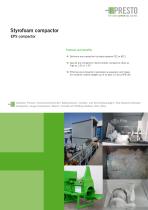
PRESTO's SPN system compacts large volumes of styrofoam (EPS) by combining a pre-crushing stage with an auger compactor. The solution is designed for processing bulky EPS waste streams and optimizing material feed into the compaction unit.
Operation
The feed system uses an MZ 3 or PZZ cardboard feeding crusher to pre-crush and homogenize the material before it enters a special pre-compaction channel. This prevents re-expansion and ensures the material is pressed continuously into the coupled PRESTO container.
Performance
When processing styrofoam (EPS) the system reaches a compaction ratio of approximately 1:25 to 1:30 and achieves a container content weight from at least 3.5 tons (SPB 30), reducing volume significantly for transport.
Benefits
The high compaction ratio lowers transportation costs and reduces the number of truck runs compared to transporting loose EPS in open containers, improving logistics efficiency and storage space utilization.
Documentation
Brochure EPS compactor (PDF) available on request.
Technical specifications
PRESTO's SPN system compacts large volumes of styrofoam (EPS) by combining a pre-crushing stage with an auger compactor. The solution is designed for processing bulky EPS waste streams and optimizing material feed into the compaction unit.
Operation
The feed system uses an MZ 3 or PZZ cardboard feeding crusher to pre-crush and homogenize the material before it enters a special pre-compaction channel. This prevents re-expansion and ensures the material is pressed continuously into the coupled PRESTO container.
Performance
When processing styrofoam (EPS) the system reaches a compaction ratio of approximately 1:25 to 1:30 and achieves a container content weight from at least 3.5 tons (SPB 30), reducing volume significantly for transport.
Benefits
The high compaction ratio lowers transportation costs and reduces the number of truck runs compared to transporting loose EPS in open containers, improving logistics efficiency and storage space utilization.
Documentation
Brochure EPS compactor (PDF) available on request.
Technical specifications
- Compaction ratio: 1:25 to 1:30
- Minimum container content weight: at least 3.5 tons (SPB 30)
- Recommended pre-crushers/feeding: MZ 3 or PZZ cardboard feeding crusher
- Compactor type: SPN auger compactor with special pre-compaction channel
- Material processed: Styrofoam (EPS)
- Primary benefit: major reduction of transport volume and costs
Catalogs
Other Presto products
more PRESTO products


Related Searches
- Baler
- Primary shredding machine
- Two shaft shredder
- Waste container
- Horizontal baler
- Automatic baler
- Cardboard baler
- Trash compactor
- Plastic shredder machine
- Paper baling press
- Plastic baler
- Cardboard shredder
- Compact baler
- Metal waste container
- Tire shredder
- Stationary trash compactor
- Hydraulic baler
- High-density baler
- Mixed trash compactor
- Mobile waste compactor
*Prices are pre-tax. They exclude delivery charges and customs duties and do not include additional charges for installation or activation options. Prices are indicative only and may vary by country, with changes to the cost of raw materials and exchange rates.
About DirectIndustry
DirectIndustry is a marketplace that offers B2B players a complete experience, from product sourcing to purchase. DirectIndustry is an entity of VirtualExpo Group.
Are you a buyer?
Are you a supplier?