



Analysis software package Peakintelligence™data analysisfor chromatographymachine learning

Add to favorites
Compare this product
Characteristics
- Function
- analysis, data analysis, for chromatography, machine learning
- Applications
- laboratory, for mass spectrometry, GC/MS
- Type
- artificial intelligence, AI-assisted, AI
- Deployment mode
- plug-in
Description
Overview
Peakintelligence™ for GCMS is an optional peak-processing software for LabSolutions Insight™ that implements AI-trained peak integration algorithms to accelerate GC/MS/MS quantitative workflows. The algorithms reproduce integration decisions comparable to experienced users without manual parameter tuning and can reliably detect low-concentration peaks. Patent pending. Developed by Shimadzu in cooperation with the Osaka University Shimadzu Omics Innovation Research Laboratories.
Key Features
Applications
Shortening the time for pesticide peak processing with Peakintelligence™ for GCMS — 2023-06-21
Efficient Peak Integration for Analyzing Residual Pesticides in Foods Using Peakintelligence™ LC/MS Peak Processing Software — 2022-06-02
Videos
Downloads
Technical specifications
Peakintelligence™ for GCMS is an optional peak-processing software for LabSolutions Insight™ that implements AI-trained peak integration algorithms to accelerate GC/MS/MS quantitative workflows. The algorithms reproduce integration decisions comparable to experienced users without manual parameter tuning and can reliably detect low-concentration peaks. Patent pending. Developed by Shimadzu in cooperation with the Osaka University Shimadzu Omics Innovation Research Laboratories.
Key Features
- Parameter-free AI peak integration
- Handles complex chromatograms with minimal user intervention
- Reduces manual peak integration time in metabolite and residue pesticide workflows
- Reliable detection of low-concentration samples
- Integration within LabSolutions Insight™ environments and compatibility with GCMS-TQ workflows
Applications
Shortening the time for pesticide peak processing with Peakintelligence™ for GCMS — 2023-06-21
Efficient Peak Integration for Analyzing Residual Pesticides in Foods Using Peakintelligence™ LC/MS Peak Processing Software — 2022-06-02
Videos
- A New Algorithm for Peak Integration — Peakintelligence (explains development from thousands of real chromatograms and parameter‑free operation)
Downloads
- Peakintelligence™ for GCMS - Peak Integration Software for LabSolutions Insight™ (brochure) [PDF / 508.79KB]
Technical specifications
- Product type: Peak processing optional software for LabSolutions Insight™
- Denomination: Peakintelligence™ for GCMS
- Core functionality: AI-based peak integration algorithms
- Operation: Parameter-free for typical peak integration tasks; no manual parameter configuration required
- Performance: Detects low-concentration samples and processes complex chromatograms
- Intended workflows: GC/MS/MS quantitative processing, metabolite data analysis, residual pesticides analysis
- Development: Shimadzu in cooperation with Osaka University Shimadzu Omics Innovation Research Laboratories
- Intellectual property: Patent pending
- Note: For Research Use Only. Not for use in diagnostic procedures.
Catalogs
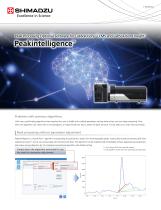
Peakintelligence
2 Pages
LCMS-TQ RX Series
16 Pages
Exhibitions
Meet this supplier at the following exhibition(s):

Other Shimadzu France products
Gas chromatograph - mass spectrometry


Related Searches
- Management software solution
- Shimadzu analysis software
- Real-time software solution
- Industrial software solution
- Measurement software
- Visualization software solution
- Quality software
- Reporting software solution
- EDM software
- 2D software
- Data acquisition software
- Data management software solution
- Calculation software
- Data analysis software solution
- Calibration software
- Control software
- Laboratory software
- Software module
- Software suite
- Diagnostic software
*Prices are pre-tax. They exclude delivery charges and customs duties and do not include additional charges for installation or activation options. Prices are indicative only and may vary by country, with changes to the cost of raw materials and exchange rates.