


{{product.productLabel}} {{product.model}}
{{#if product.featureValues}}{{product.productPrice.formattedPrice}} {{#if product.productPrice.priceType === "PRICE_RANGE" }} - {{product.productPrice.formattedPriceMax}} {{/if}}
{{#each product.specData:i}}
{{name}}: {{value}}
{{#i!=(product.specData.length-1)}}
{{/end}}
{{/each}}
{{{product.idpText}}}
{{product.productLabel}} {{product.model}}
{{#if product.featureValues}}{{product.productPrice.formattedPrice}} {{#if product.productPrice.priceType === "PRICE_RANGE" }} - {{product.productPrice.formattedPriceMax}} {{/if}}
{{#each product.specData:i}}
{{name}}: {{value}}
{{#i!=(product.specData.length-1)}}
{{/end}}
{{/each}}
{{{product.idpText}}}


... Profile Advantage Metal Detector Safeline's most advanced food metal detector, which delivers up to 50 percent improved sensitivity when inspecting wet, hot, chilled, cooling, or metal ...
METTLER TOLEDO

... Next generation industrial metal detector delivers high sensitivity with ease of use to deliver affordable quality control. Suitable for dry or wet product inspection. - Affordable Quality Control: Entry level model ...
METTLER TOLEDO

... Metal Detector M33R Next generation industrial metal detector offers a step-change in performance and very high sensitivity. Suitable for dry or deep frozen products inspection. - ...
METTLER TOLEDO
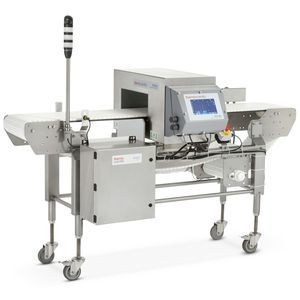

... Sentinel™ family of metal detectors delivers high-sensitivity detection of ferrous, non‑ferrous and stainless steel contaminants for food, beverage and other product lines. Using Multiscan™ and Selectscan™ ...
Thermo Fisher Scientific
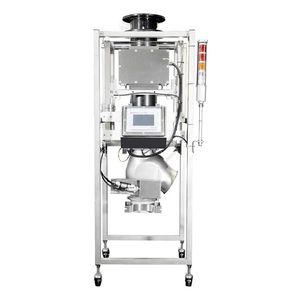
... drop-through metal detector designed for granular and powdered products, cosmetics, chemicals and other free-fall applications. Multiscan technology and selectable apertures improve the probability of detecting ferrous, ...
Thermo Fisher Scientific
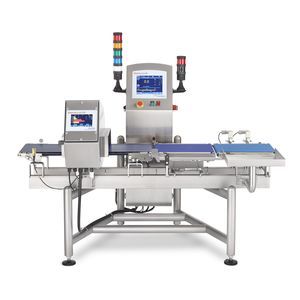
... li>Integrated system option: metal detector mounted on weighframe or on external infeed conveyor
Thermo Fisher Scientific


... Features Protected from dust and water to IP65 standards.Hygienic design with the entire system washable. Suitable for use in HACCP program. Automatic sensitivity setting function. Easy operation with 7 inch color touch panel. Variable belt ...
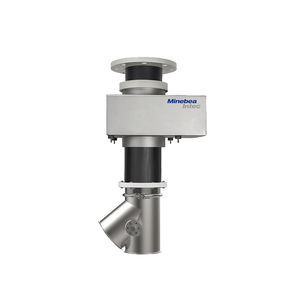

... Freefall metal detector Mitus® The Mitus® free-fall metal detection system guarantees the reliable inspection and removal of metallic foreign objects from food products of all kinds ...
Minebea Intec GmbH
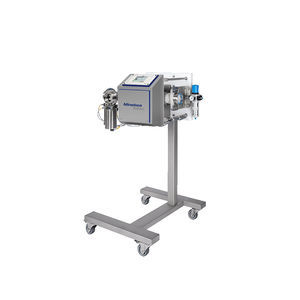
... Metal detector Mitus® Pipeline The Mitus® Pipeline metal detector is equipped with innovative MiWave technology to ensure maximum product sensitivity. It features an intuitive touchscreen ...
Minebea Intec GmbH
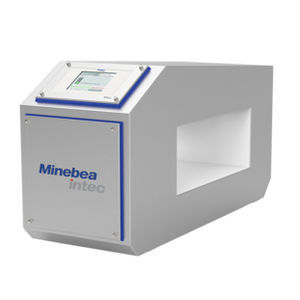
... Metal detector Mitus® The new Mitus metal detection system is an inspection solution with the highest precision in detecting foreign objects in all applications where this is required. Using flexible ...
Minebea Intec GmbH


... copper ore, aluminum ore and other ores to protect the belt and equipment in following up procedure. Magnetic separator can just remove ferrous metal, but not non-ferrous metal like manganese steel. While ...


... addition to its rugged construction, the Xtreme Metal Detector offers easy-to-use set up, operation and reporting from a large, well-designed graphical interface. Setup and Operation While the Xtreme Metal ...
ERIEZ
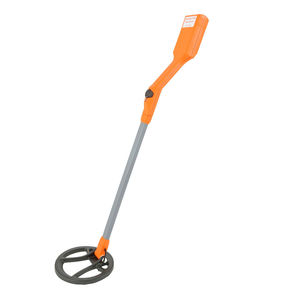

... manhole covers, the Elcometer P500 Metal Box Locator can also be used as a general metal detector. The Elcometer P500 is straight forward to use and very rugged making it a popular choice in the market. Detecting ...


... High-end tunnel detector with integrated evaluation electronics for assembly in conveyor belts. Metal detectors of the METRON 07 CI type are used in a wide range of applications. They represent the ...
Mesutronic GmbH

... High-end metal separator for examining bulk materials in free fall. Metal separators of the QUICKTRON 07 RH type are used for the examination of powders and granulates in free-fall lines. They are available in nominal ...
Mesutronic GmbH

... Mobile metal detector for connection to a vacuum filler. Metal detectors of the MEATLINE 07 series are connected to the outlet of vacuum fillers in sausage production. Mechanical connections ...
Mesutronic GmbH


... surface metals, moisture or fluctuations in temperature. One button operation makes it easier to use the device; continuous readjustment is not necessary. Specific electronics reduce faulty readings due to crown caps, beverage cans or ...
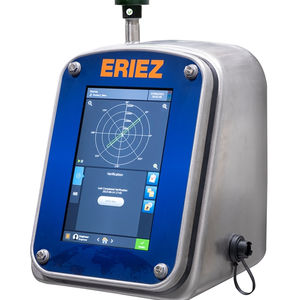

... Reliable and easy-to-use, X8 Metal Detectors from Eriez detect small ferrous, nonferrous, and stainless steel metal contaminants. In its base package, the X8 offers an easy-to-use touchscreen ...
Eriez Magnetics Europe Limited
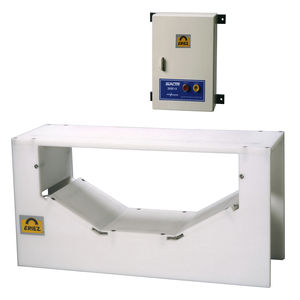
... excellent for detecting tramp metal in burden depths greater than 14 inches (356 mm). The The transmitter/receiver coil combination is excellent for mineralized materials and also for use when nothing smaller than a certain size metal ...
Eriez Magnetics Europe Limited

... MetAlarm Model VC Metal Detector offers an all-in-one unit including search coil and metal-free section. It is supplied with a Model 3500 control connected to the search coil that is integrated into the ...
Eriez Magnetics Europe Limited
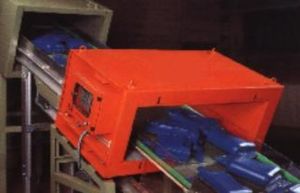

... This is a metal detector manufactured by Neue Herbold Maschinen-u. Anlagenbau GmbH is designed for detecting and protecting the reduction of sizes in a production system. This reduction of size is due to the metal ...
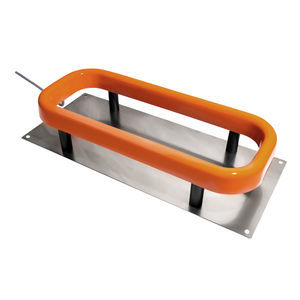

... Detector coil, width 950 mm For monitoring conveyed material on transport and conveyor belts Coil for metal detector system for the protection of cutters, grinders, rollers ...
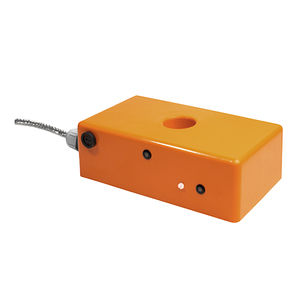
... Robust design with plastic housing Fixed cable connection Sensitivity adjustable ...
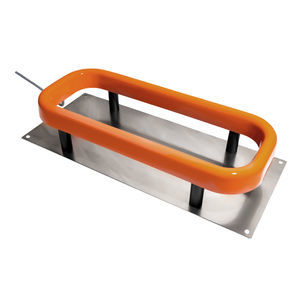
... Detector coil, width 650 mm For monitoring conveyed material on transport and conveyor belts Coil for metal detector system for the protection of cutters, grinders, rollers ...
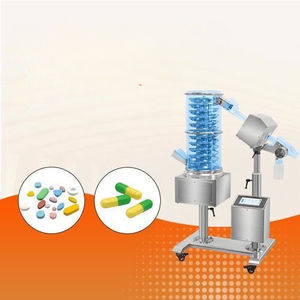

... high-sensitivity metal detection in one inline machine to optimize production flow and quality control.
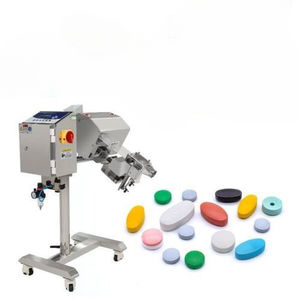
... salty or conductive products) can mask small
metal signals; advanced multi-frequency
detectors help overcome this
Main Features
- Detects ferrous, non-ferrous and stainless
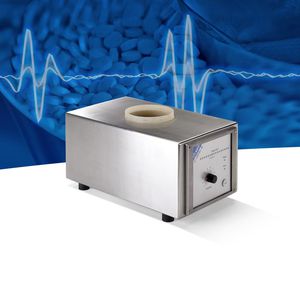

... Free Fall
Metal
Detector for Bulk Materials
■ automatic system adaptation to operation requirements
■ user-friendly operation
■ easy integration into existing conveyor systems
■
metal ...

... ARGUS 3 – Tunnel Metal Detector System with Dividable Aperture
■ automatic system adaptation to operation requirements
■ user-friendly operation
■ easy installation including retrofitting
■ ...

... ARGUS 5 – Single Plate Metal Detector System
■ automatic system adaptation to operation requirements
■ user-friendly operation
■ easy installation including retrofitting
■ ...
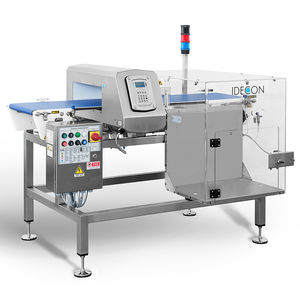

... Fulfilling requirements about contaminant metal detection, Idecon offers last-generation metal detectors assuring the utmost accuracy with any product size, in any surrounding environment and application ...


... speed digital signal processing devices and intelligent algorithm to improve detection precision and stability; Detection of metal impurities such as iron, stainless steel, copper, aluminimn, lead, etc; LED screen display, CH and EN ...

... Automatic detection, automatic induction, flexible sensitivity degree adjustment; High sensitivity, high anti-interference ability; Optional alarm mode: sound effect and light alarming; Optional double head design for double detection; Count fuction ...


... parameters of a detector are protected by a password. The possibility to enter 30 different settings for products. Clear and simple-to use multi-level menus. Simple assembly, disassembly and cleaning. Casing from quality ...
MDR d.o.o.

... equipment. Customization to the customer’s needs. The highest performance in detecting magnetic and non-magnetic metals. Fast and safe ejection of the contaminated product. Minimum number of false detections (due to ...
MDR d.o.o.

... parameters of a detector are protected by a password. The possibility to enter 30 different settings for products. Clear and simple-to use multi-level menus. Simple assembly, disassembly and cleaning. Casing from quality ...
MDR d.o.o.
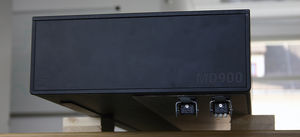

... The MD900 is an inductive metal detector for use in garbage sorting. It consists of a high-frequency field generator and a series of probes running transversely to the treadmill, which analyzes the product stream in a ...


... SD3P-30 Type For inspection of small products, such as confectionery bags ...
SYSTEM SQUARE Inc.
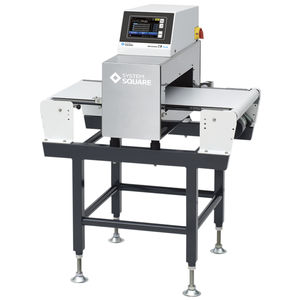
... SD3P-45 Type For inspection of products packed in larger trays ...
SYSTEM SQUARE Inc.
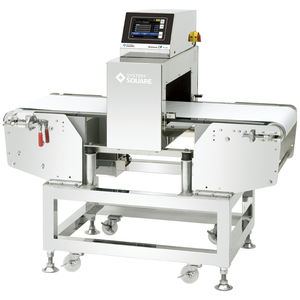
... SD3P-45B Type For inspection of large bag products and large box products, such as grain ...
SYSTEM SQUARE Inc.
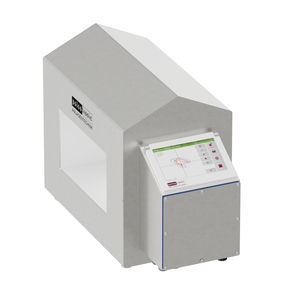

... These tunnel detectors are used wherever the highest requirements for detection performance and reliability are needed. Depending on the application, there are different evaluation electronics to choose from for operation, meaning that ...
Pulsotronic-Anlagentechnik GmbH


... The GA-52Cx Locator detects the magnetic field of iron and steel objects, with unmatched sensitivity. Only two Controls! Designed for one-hand operations, the On/Off-Sensitivity and Volume controls are located on the underside of the cover. This provides ...
Radiodetection


... Due to their stainless steel housing metal face sensors are ideal for applications in aggressive media, oils or acids, and in alkaline fluids. The sensor field permeats the stainless steel sensor front ...
Pulsotronic
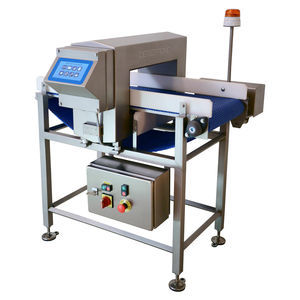

... Detectronic 607-TD is an industrial metal detector for product inspection and contamination control. It integrates an advanced detection system and a long-life mechanical design, built on Detectronic's 33 years of experience ...
Detectronic
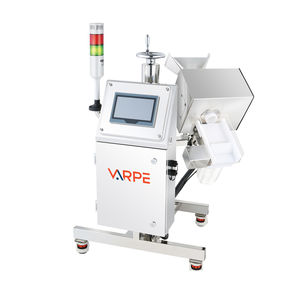

... The pharmaceutical grade metal detector is the most sensitive system among the products in the metal detector range. Offering unrivalled accuracy in the detection of metal ...
Varpe Control de Peso, S.A.


... product. When a metal is detected a signalling device or a reject unit can be activated, or a signal is sent to the process control system. The closed design of the INTUITY metal detector offers the ...
Sesotec GmbH

Metal detectors are used on packaging lines and conveyors to detect the presence of undesirable metallic objects. They can take the form of large machines or portable devices.
ApplicationsThese devices are used in the food and pharmaceutical industries to ensure the absence of metallic contaminants from the products. In the lumber industry they are used to detect nails, shrapnel and other metal bits before wood is sawed. The textile industry uses them to remove any needles that might remain from fabric or garment manufacture. Other uses include the handling of bulk products.
TechnologiesLarge detectors are designed to be integrated into horizontal conveyor systems, fill chutes and packaging lines. They can be used with liquid or solid products. Some include a separator or a checkweighing function. They can be adapted to different flow speeds and their sensitivity is adjustable. They can detect all types of metal, including magnetic and nonmagnetic, ferrous and nonferrous, and high-resistivity stainless steel.
Portable models are used with headphones or a speaker. An audio signal indicates the presence of metal.
Metal detectors are characterized by maximum acceptable line speed, sensitivity, immunity to interference and response time.
the best suppliers