|
|
|
|
|
|
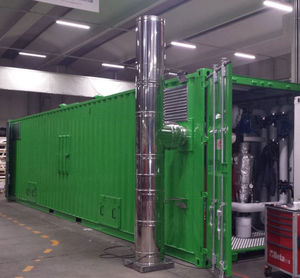
This continuous-rated 30-kW grid parallel model can be fueled with digester or landfill gas with methane content as low as 35%. They are commonly arrayed with Cain or other heat exchangers to serve both renewable power and thermal loads.
Hundreds operate worldwide, including 12 that provide LFG-fueled power and heat to a school near Chicago, a site named "Project of the Year" by the landfill methane division of the US EPA.
Without any exhaust treatment, C30 emissions are much lower than flaring. ISO 9001:2000 certified Capstone Turbine is the world's leading microturbine manufacturer, with more than 3,000 units worldwide. The installed fleet has amassed more than 8 million hours of documented operation.
Capstone invented microturbines and is the world’s only USA incorporated, USA owned and operated manufacturer.
These inverter-based systems have just one moving part: a turbine shaft supported by patented air bearings. The system has no pumps and needs no radiator, gearbox or other mechanical subsystems. Needs no lubricants, coolants or other hazardous fluids. UL1741, CA Rule 21 and NY PSC interconnect precertified, UL2200, etc.
Scalable from kilowatts to >1 MW without any paralleling switchgear or other external hardware (built-in arraying via computer cables).
|
|
|
|
|
|
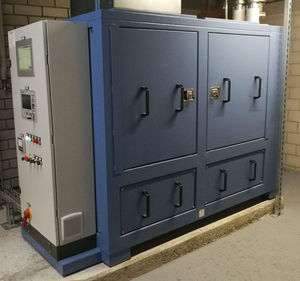
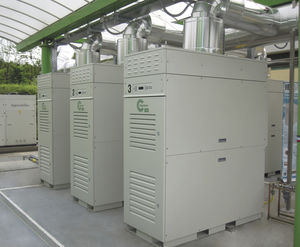
Clean, quiet microturbines cut energy costs every day at businesses and public facilities. This natural gas fueled continuous-rated 60-kWe model with 115-kWth integrated heat recovery delivers 80% efficiency measured at end-user power and thermal loads. Grid-parallel only or grid/stand-alone/grid autoswitching.
Without any exhaust treatment chemical or devices, the C60’s full-load NOx emissions per megawatt-hour are 1/20th those of the average US utility power plant, according to US EPA figures.
ISO 9001:2000 certified Capstone Turbine is the world's leading microturbine manufacturer, with more than 3,000 systems worldwide. The installed fleet has amassed more than 8 million hours of documented operation.
Capstone invented microturbines and is the world’s only USA incorporated, USA owned and operated manufacturer.
These inverter-based systems have just one moving part: a shaft supported by patented air bearings. The system has no pumps and needs no radiator, gearbox or other mechanical subsystems. Needs no lubricants, coolants or other hazardous fluids. UL1741, CA Rule 21 and NY PSC interconnect precertified, UL2200, etc.
Scalable from kilowatts to >1 MW without any paralleling switchgear or other external hardware (built-in arraying via computer cables).
|
|
VHP9500 Power Generation
The 16 cylinder VHP 9500, with continuous rating of 1175 kWe at 50 Hz and 1400 kWe at 60 Hz, is suitable for prime power, cogeneration, peak shaving and standby power applications.
VHP 12 Cylinder Power Generation
Reliable 12 cylinder VHP ® generator sets, rated at 475-1100 kWe at 50 Hz (1000 rpm) continuous duty to 1200 kWe at 60 Hz (1200 rpm) intermittent duty, are ideal for remote sites.
VHP3604/VHP3600 Power Generation
VHP ® generator sets are an industry standard for continuous power applications. Six cylinder models rated at 315-540 kWe at 50 Hz and 360-600 kWe at 60 Hz.
|
|
Microturbines
The efficient Ingersoll Rand microturbine generates environmentally
friendly, cost-effective thermal and electrical energy for a wide range
of environmental, commercial and industrial businesses, as well as
for public utilities, for reduced energy costs and emissions.
Fuel Conditioning Systems
Our unique fuel conditioning system with patented deep chill dryer
technology is designed to transform low-pressure landfill or digester
gas containing moisture, siloxanes and other contaminants into dry,
clean, pressure-regulated gaseous fuel that meets the gas turbine's
requirements. With a demand-based fuel supply strategy for reduced
power use and no carbon beds to replace, Ingersoll Rand fuel
conditioning will provide years or trouble-free and low cost microturbine
operation.
|
|
Our 4-100 MW combined heat and power (CHP) plants incorporate both power and heat generation. The system for heat generation, producing either low-pressure steam, hot water or both, trigeneration, etc. is optimized for the customer%u2019s needs and requirements.
The total plant efficiencies rise to even above 90%. Our CHP plants can run on various natural gas and liquid fuel qualities, also liquid biofuels, while maintaining low emissions and high efficiency.
Modular design
The modular design of our CHP plants enables fast-track delivery anywhere in the world.
Prefabricated, functionally pretested modules guarantee consistent quality and performance and make on-site installation simply a matter of assembling and connecting the modules.
|
|
|
For the co-generation system of diesel engines, those engines are diverted to industrial use which have abundant actual achievements proofed in the field of regularly used ship engines under severe using conditions for a long time. Although full operation during one year is possible, a maintenance of about once a year is necessary.
|
|
WINTER 2003
LIPA purchases an additional 45 fuel cell systems for installation across Long Island. Twenty-five of the
5kW fuel cell systems will be installed at LIPA’s West Babylon Fuel Cell Demonstration Site, which currently
contains fuel cell systems feeding directly into the Long Island electrical grid. The remaining 20 systems
will generate on-site heat and power for single or multi-family residential sites, for the first time in LIPA’s
service territory.
Plug Power and LIPA continue to work together to gain information and experience to propel the evolution of
fuel cell technology as a source of power, while keeping very specific environmental concerns at the forefront.
|
|
|
In the 2MW electrical power range, the OPRA package produces the highest thermal power which makes it ideal for co and tri-generation applications.
|
|
|
|
|
|
Trigeneration is the conversion of a fuel into three useful energy products: electricity, hot water or steam, and chilled water. A trigeneration system is a cogeneration system extended with an absorption chiller that uses some of the heat to produce chilled water for air-conditioning of buildings and building complexes.
With a Wärtsilä trigeneration power plant you will reach the same output with notably less fuel input compared to separate power and heat generation.
Wärtsilä power plants have ready-made solutions for trigeneration which can easily be adapted to different market and customer requirements and delivered within tight time schedules.
Benefits
The trigeneration system makes utilization of the engine CHP plant highly efficient throughout the annual seasons and through changes in the local climate. The plant can flexibly run at high total efficiencies, producing heat and cooling for airport terminals, office and building complexes, housing areas, etc., and can interchange smoothly between supplying heating and/or cooling. At the same time it supplies the needed electrical power.
|
|
|
|
|
|
CAMPOFRÍO ALIMENTACIÓN S.A. is a leading international company within the food sector. It produces meat products which, for the production process, requires significant amounts of heat, in the form of steam and hot water, industrial cooling and electrical energy.
In 1996, with the purpose of reducing energy costs on the production processes and equipping the company with flexible installations in order to meet both present and future energy needs in a secure and efficient manner, GUASCOR ENERGIA went into a joint venture with Campofrío in order to construct and operate a Trigeneration plant - producing heat, cold and electrical energy - .
The Trigeneration plant operates 24 hours per day, seven days per week with a total of 8,700 hours of operation annually.
The installation incorporates four turbo-charged gas engines, each one rated at 3 MW, with a total installed power of 12 MW.
To cover the cold demand on the production process, the trigeneration plant is fitted with an ammonia - water absorption machine, which runs off saturated steam obtained from the heat recovered from the engines' exhaust gases.
|
|
| ... products without technical information |
| |
|
|