


{{product.productLabel}} {{product.model}}
{{#if product.featureValues}}{{product.productPrice.formattedPrice}} {{#if product.productPrice.priceType === "PRICE_RANGE" }} - {{product.productPrice.formattedPriceMax}} {{/if}}
{{#each product.specData:i}}
{{name}}: {{value}}
{{#i!=(product.specData.length-1)}}
{{/end}}
{{/each}}
{{{product.idpText}}}
{{product.productLabel}} {{product.model}}
{{#if product.featureValues}}{{product.productPrice.formattedPrice}} {{#if product.productPrice.priceType === "PRICE_RANGE" }} - {{product.productPrice.formattedPriceMax}} {{/if}}
{{#each product.specData:i}}
{{name}}: {{value}}
{{#i!=(product.specData.length-1)}}
{{/end}}
{{/each}}
{{{product.idpText}}}


Measuring range: 0.4 mm - 8 mm
Linearity: 0.1 % - 0.25 %
Measuring rate: 20 Hz - 20,000 Hz
... Non-contact, inductive displacement sensors from Micro-Epsilon operate according to the eddy current measuring principle. Unlike conventional, inductive displacement sensors, they measure ...
MICRO-EPSILON
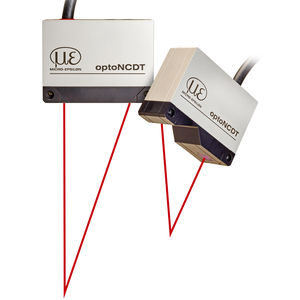
Measuring range: 10 mm - 200 mm
Linearity: 0.02 % - 0.04 %
Measuring rate: 0.3 kHz - 150 kHz
... optoNCDT 5500 laser sensors set new standards in high-precision laser distance measurement. With submicron precision and an impressive measuring rate up to 150 kHz, the sensors are perfect for dynamic measurements of ...
MICRO-EPSILON
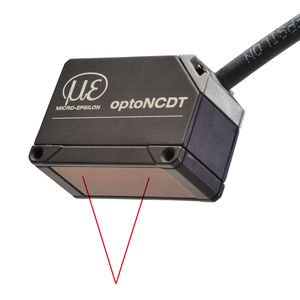
Measuring range: 100, 25, 50 mm
Linearity: 0.1 % - 0.24 %
Measuring rate: 0.3 kHz - 4 kHz
... The optoNCDT 1320 laser triangulation sensor provides the ideal entry-level sensor for precise measurement of displacement, distance and position. The controller is integrated in the housing which considerably ...
MICRO-EPSILON
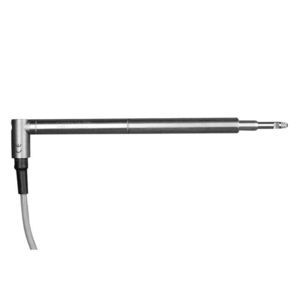

Measuring range: 10 mm - 500 mm
Linearity: 0.2 %
Measuring rate: 4.8 kHz
... Overview
The WA-T is an inductive
displacement
transducer designed for industrial
displacement measurement in harsh environments. It is supplied by HBK and offered in configurable variants to ...
Hottinger Brüel & Kjaer
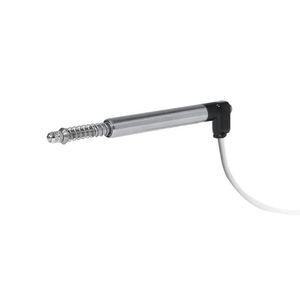
Measuring range: 10, 2, 5 mm
Linearity: 0.2 %
... Product overview
WI inductive
displacement
transducers for high-precision industrial measurement. Inductive sensing technology with low-wear construction and economical variants, including mini probe configurations ...
Hottinger Brüel & Kjaer
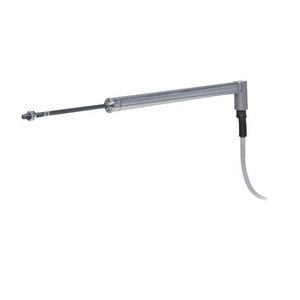
Measuring range: 2 mm - 500 mm
Linearity: 0.2 %
Measuring rate: 4.8 kHz
... Product overview
WA-L is an inductive
displacement
sensor for industrial applications. It provides multiple measuring ranges up to 500 mm and an extensive set of configuration options to adapt mechanical interfaces, ...
Hottinger Brüel & Kjaer
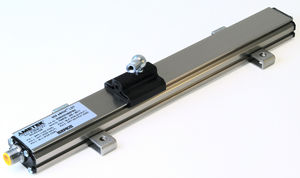

... Linear Displacement Transducer (LDT) is an accurate, programmable zero and span, auto-tuning, non-contact linear position sensor in an economical, low-profile package. The sensor utilizes ...
AMETEK Factory Automation
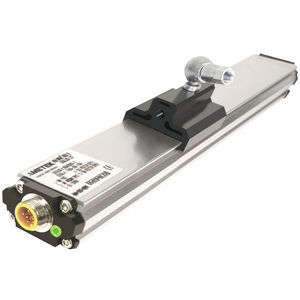
... Linear Displacement Transducer (LDT) is an accurate, programmable zero and span, non-contact linear position sensor in an economical, low profile package. The Brik is a self-contained unit and does not ...
AMETEK Factory Automation
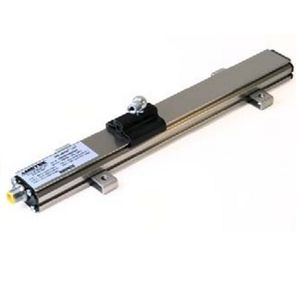
... Brik Linear Displacement Transducer (LDT) is an accurate, programmable zero and span, non-contact linear position sensor in an economical, low profile package. The Brik is a self-contained unit and does ...
AMETEK Factory Automation
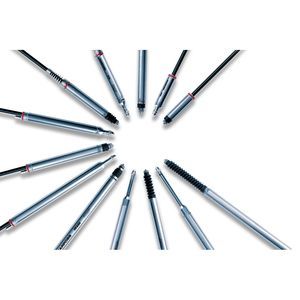

Measuring range: 1, 10 mm
Ambient temperature: -10 °C - 65 °C
... levels in any application. The compact shape, measurement precision, sturdy design, ease of clamping make this type of sensors the basic element for creating customised solutions. Red Crown2 is a line of measurement pencil probes ...
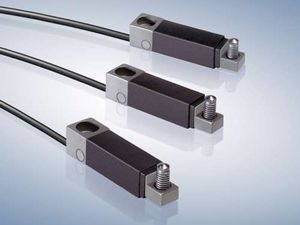
Measuring range: 200 µm
... The A124 miniature measuring cell is a universal measuring instrument, suitable for all applications with limited space. Thanks to its small size it is ideal for highly customisable multi-dimensional measuring applications. Its compact size, ease of ...
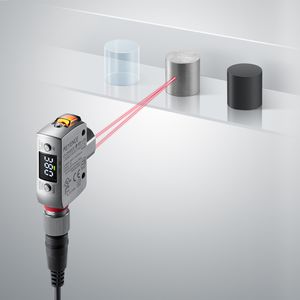

Measuring range: 25 mm - 500 mm
Measuring rate: 1,000 Hz
Power consumption: 0.18 W - 0.45 W
... calibrating this sensor is straightforward and quick. A highly visible indicator and a 7-segment display make this sensor very easy to use. Distinguishing a Target From a Background Using the Distance and Received ...
Keyence


Measuring range: 40 mm - 450 mm
... For high precision laser CMOS sensor with separate amplifier see E3NC-S. -Stable measurement for objects with any surface -Best in class performance for accuracy and speed -Compact size for quick mounting -Increased ...


Measuring range: 1.25 m - 10 m
... Modular wire draw encoder in miniature design The slim design of the EcoLine family is ideal for applications with limited space. Its modularity makes it suitable for a large selection of measuring lengths, interfaces and encoders. Due to the into ...


Measuring range: 0 mm - 100 mm
Measuring rate: 4.8 kHz
... Inductive Displacement Measurements in a Compact Design; Nominal (Rated) Measuring Range up to 100 mm The technologically sophisticated and proven displacement transducers of the WA-T series in the ...
HBM Test and Measurement


Measuring range: 2 mm
... Inductive probe Millimar 1340 Compatibility: Mahr 1340 Vacuum lifter Measuring force (N): 0,75 N Package contains: test certificate, instruction manual • Only for use in conjunction with the Millimar C 1240 M compact length measuring instrument, • ...
MAHR


... Rely on our sensors to pick up on the varying needs of your vehicles steering system. SASA Steering Sensor Precision is never in question with our SASA sensor. Detecting the absolute position and speed ...
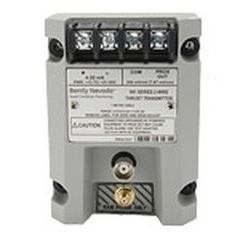

Measuring range: 0.25 mm - 1.65 mm
... centrifugal air compressors or small pumps, motors, or fans who prefer to provide a simple 4 to 20 mA proportional axial displacement (thrust) signal as the input to their machinery control system. The transmitter is a 2-wire, loop-powered ...
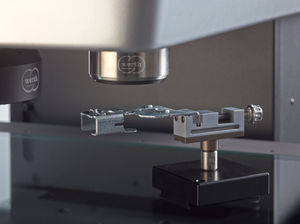

Measuring range: 0.3 mm - 3 mm
... mould and roughness can be measured. • Measurement of sensitive and elastic workpieces • Large measuring ranges of the sensor allow fast scanning without moving the device axes to the workpiece surface and thus even shorter measuring ...
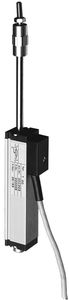

Measuring range: 25 mm - 150 mm
Measuring rate: 10 Hz - 18 Hz
... Displacement Tracer FWA xxx T • Displacement transducers are suitable for direct, accurate measurement of displacements in automatic control and metrology. • The pickup of the displacement ...


Measuring range: 0 mm - 25 mm
... Inductive displacement sensors of this series measure linear displacements and indirectly all mechanical values convertible into displacements by additional equipment (i.e. tension and ...
burster präzisionsmesstechnik gmbh & co kg

Measuring range: 0 mm - 250 mm
... Potentiometric displacement sensor - 8709 Potentiometric displacement sensors are used for direct, precise measurement of mechanical displacements. The mechanical parts ...
burster präzisionsmesstechnik gmbh & co kg

Measuring range: 0 mm - 2,000 mm
... chassis -Metering strokes Displacement sensors model 8718, using a resistance track made of conductive plastic material, are suitable for direct, accurate and absolute measurements of displacements ...
burster präzisionsmesstechnik gmbh & co kg


Measuring range: 2,000 mm
Ambient temperature: -40 °C - 105 °C
... The absolute position transducer can be used directly in-cylinder and thus enables a compact and cost-effective position measurement. The sensor consists of a stainless steel flange welded to a pressure tight rod and ...


Measuring range: 15,000 mm
Linearity: 0.1 %
... Sensor mechanism for incremental and absolute encoders Protection class depends on encoder Synchro and clamping flange assembly Specifications Output - Only mechanics Resolution depending on measurement range - 2,000 mm = ...
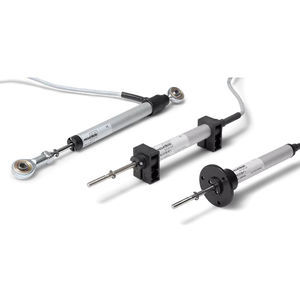

Measuring range: 25 mm - 250 mm
... Rugged, compact, IP60 rated displacement sensor with front guided pushrod and three mounting options for 25 to 250 mm strokes Compact displacement sensor For harsh environments - IP60 ...
MEGATRON Elektronik GmbH & Co. KG
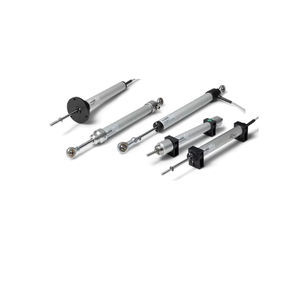
Measuring range: 10 mm - 300 mm
... Rugged IP60/IP67 displacement sensor with front-guided pushrod, available in three mounting options and measuring lengths from 10 to 300 mm For harsh environments - protection up to IP67 Mounting by ball joint, bracket ...
MEGATRON Elektronik GmbH & Co. KG

Measuring range: 15 mm - 100 mm
... mechanical detection of linear motion is achieved by a front guided push rod. The displacement sensor can be used as a probe or with a guided push rod. Potentiometric displacement measurement is performed ...
MEGATRON Elektronik GmbH & Co. KG


Measuring range: 1 mm
... LVDT Gauge Probe | Narrow Body Displacement Transducer - A6J •6mm diameter LVDT displacement transducer (gauge probe) •± 1mm displacement transducer ...
SOLARTRON METROLOGY

Measuring range: 10, 2.5, 5, 1 mm
... 0.05 µm repeatability •Tip force of 0.7N •IP65 Sealing •Spring and Pneumatic options The G-Type of analogue DC/DC displacement probes are based on the LVDT sensing principle and features a high accuracy and long life linear ball ...
SOLARTRON METROLOGY

Measuring range: 2.5 mm - 150 mm
... output The S series displacement sensor is the culminationation of many years experience gained from a history of excellent displacement sensors coupled with attention to detail market ...
SOLARTRON METROLOGY

Supply voltage: 0 V - 5 V
Ambient temperature: -30 °C - 125 °C
... R15M Multi-turn Contactless Magnetic POT. -Absolute multi-turn version -Magnetic rotary sensor -Pocket size -Bushing mount -Housing diameter Φ15mm -Effective electrical angle:Any angle within 1080° General Mechanical Specifications -Mechanical ...
SENTOP by Shanghai Sibo M&E Co., Ltd.

Supply voltage: 15 V - 30 V
Ambient temperature: -30 °C - 85 °C
... R22M Multi-turn Contactless Magnetic POT. Absolute multi-turn version Magnetic rotary sensor (Hall effect) High protection degree Anti-interference Bushing mount Gerneral Mechanical Specifications - Mechanical angle: ...
SENTOP by Shanghai Sibo M&E Co., Ltd.

Supply voltage: 0 V - 5 V
Ambient temperature: -30 °C - 85 °C
... WLH22D 1-turn Contactless Magnetic POT. Characteristics: ★ Magnetic rotary sensor ★ Low cost version ★ Plastic housing case ★ Bushing mount ★ Solder pads General Mechanical Spécifications - Mechanical angle - 360°(Endless) Mass ...
SENTOP by Shanghai Sibo M&E Co., Ltd.
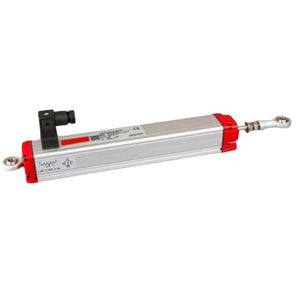

Measuring range: 50 mm - 600 mm
Linearity: 0.05 % - 0.5 %
Supply voltage: 0 V - 28 V
... Presentation
- LS08 potentiometric linear sensor for rod displacement measurement.
- Measuring range: 0 to 50 … 0 to 600 mm.
- Output: analog proportional signal (resistance variation).
Detailed ...
Instrumentys
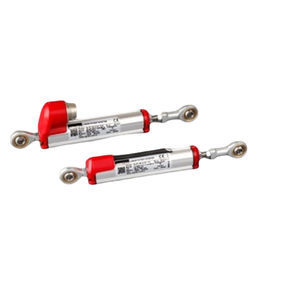
Measuring range: 0 cm - 40 cm
Linearity: 0.1, 0.2, 0.5, 0.05 %
Supply voltage: 0 V - 28 V
... Description
Potentiometric linear
displacement
sensor LS07. Compact anodized aluminium body with stainless steel rod. Uses potentiometric principle (resistance variation) to measure rod travel and provide an ...
Instrumentys
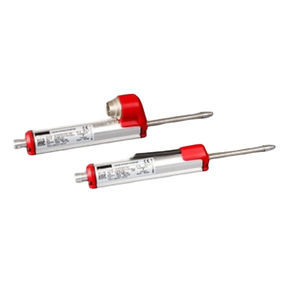
Measuring range: 1 cm - 10 cm
Linearity: 0 % - 0.5 %
Ambient temperature: -20 °C - 80 °C
... br>
Description
The LS05
displacement probe is a linear position
sensor using potentiometric technology (resistance variation) to measure rod travel and provide a proportional analog signal. The
sensor ...
Instrumentys
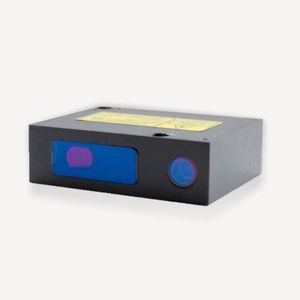

Measuring range: 2 mm - 1,250 mm
Linearity: 0.05, 0.1 %
Measuring rate: 9.4 kHz
... The sensors are intended for non-contact measuring and checking of position, displacement, dimensions, surface profile, deformation, vibrations, sorting and sensing of technological objects as well as for measuring levels ...
RIFTEK EUROPE

Measuring range: 10 mm - 500 mm
Linearity: 0.05, 0.1 %
Measuring rate: 9.4 kHz
... The sensors are intended for non-contact measuring and checking of position, displacement, dimensions, surface profile, deformation, vibrations, sorting and sensing of technological objects as well as for measuring levels ...
RIFTEK EUROPE

Measuring range: 2 mm - 1,250 mm
Linearity: 0.1 %
Measuring rate: 160 kHz
... The sensors are intended for non-contact measuring and checking of position, displacement, dimensions, surface profile, deformation, vibrations, sorting and sensing of technological objects as well as for measuring levels ...
RIFTEK EUROPE
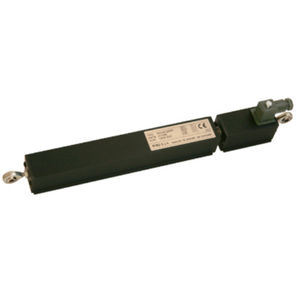

Measuring range: 60 mm - 990 mm
Measuring rate: 100 kHz
Supply voltage: 5 V - 24 V
... PD and PE models of transducers provide excellent services in applications that require measuring/controlling of linear displacement and determining thickness in industrial machinery. The devices are equipped with high reading resolutions ...


Measuring range: 1 m - 4 m
... against water and contamination. The sensor can be easily cleaned using a high-pressure jet without suffering any damage. To achieve maximum performance, the customer can choose the ideal type of housing for the sensor ...
WayCon Positionsmesstechnik GmbH

Measuring range: 2 mm - 200 mm
... LVDTs are displacement sensors that operate according to the inductive measuring principle. The position sensors measure precisely by means of a non-spring-loaded push rod on the measured object. The ...
WayCon Positionsmesstechnik GmbH

Measuring range: 25 mm - 500 mm
... The LVDT series LVPH by WayCon is developed for use in hydraulic cylinders. The inductive sensors measure reliably at a pressure of up to 350 bar. Measurement range - 25 mm, 50 mm, 100 mm, 150 mm, 200 mm, 500 mm Linearity max. - ±0.1 ...
WayCon Positionsmesstechnik GmbH


Measuring range: 50 mm - 1,250 mm
Linearity: 0.1 %
Supply voltage: 6.5 V - 30 V
... Analog linear draw wire sensors are suitable for motion control and position measurement. The drum is coupled to a potentiometer which converts the linear mechanical movement into a resistive value proportional to the movement of the ...
AK Industries

Measuring range: 0 mm - 6,000 mm
... potentiometer displacement sensors are suitable for motion control and position measurement. This potentiometer is coupled to the drum, so the mechanical movement is converted into a resistance value according to the ...
AK Industries
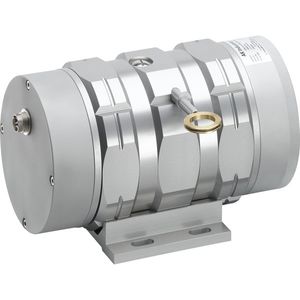
Measuring range: 0 mm - 10,000 mm
Linearity: 0 % - 0.2 %
... potentiometer displacement sensors are suitable for motion control and position measurement. This potentiometer is coupled to the drum, so the mechanical movement is converted into a resistance value according to the ...
AK Industries


Measuring range: 5 m
... CET5 is a robust, high-performance, wire cable pull transducer with CANopen output, designed for industrial applications and featuring high quality and durability. Excellent repeatability, high IP rating, shock and vibration resistance and electromagnetic ...
TSM SENSORS SRL

Measuring range: 5 m
... CET.5000 is a robust, high-performance, wire cable pull transducer with relay output, designed for industrial applications and featuring high quality and durability. Excellent repeatability, high IP rating, shock and vibration resistance and electromagnetic ...
TSM SENSORS SRL

Measuring range: 5 m
... CET5 is a robust, high-performance, wire cable pull transducer with analog output, designed for industrial applications and featuring high quality and durability. Excellent repeatability, high IP rating, shock and vibration resistance and electromagnetic ...
TSM SENSORS SRL
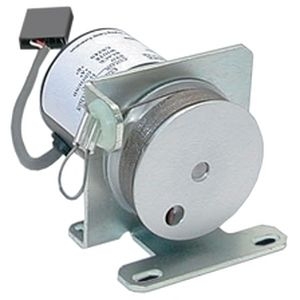
A displacement sensor is a measuring device which can determine the position of a target within a range of possibilities.
ApplicationsThese instruments measure dimensions and control motion in machine tools and welding robots. They also can be used to monitor liquid fill levels.
TechnologiesOptical and laser models use triangulation to measure distance and can operate at long range. Eddy current sensors are used with conductive materials. They measure at close range and at the micrometer scale. Capacitive models offer similar characteristics, but are used for different materials.
LVDT versions use a magnetic core sliding within coils, which alters their electrical behavior. There are also RVDT models. Confocal chromatic sensors split light into distinct wavelengths focused at different distances. A spectrometer detects the most precisely focused wavelength, measuring at the nanometer scale.
Cable and belt models use a measurement drum. The cable or belt attached to the target is extended and retracted. The magnetostrictive sensor uses a magnet sliding on a shaft. Magnetic track versions detect polarity shifts on a displacement scale.
Choice will depend on the sensor's precision and resolution, its range and the characteristics of its operational environment (temperature, humidity, vibrations).
the best suppliers