


{{product.productLabel}} {{product.model}}
{{#if product.featureValues}}{{product.productPrice.formattedPrice}} {{#if product.productPrice.priceType === "PRICE_RANGE" }} - {{product.productPrice.formattedPriceMax}} {{/if}}
{{#each product.specData:i}}
{{name}}: {{value}}
{{#i!=(product.specData.length-1)}}
{{/end}}
{{/each}}
{{{product.idpText}}}
{{product.productLabel}} {{product.model}}
{{#if product.featureValues}}{{product.productPrice.formattedPrice}} {{#if product.productPrice.priceType === "PRICE_RANGE" }} - {{product.productPrice.formattedPriceMax}} {{/if}}
{{#each product.specData:i}}
{{name}}: {{value}}
{{#i!=(product.specData.length-1)}}
{{/end}}
{{/each}}
{{{product.idpText}}}
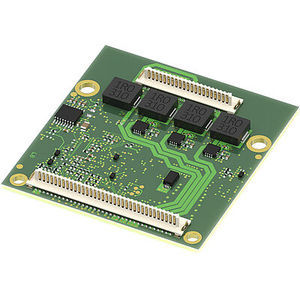

Input voltage: 6 V - 36 V
Output voltage: 0 V - 36 V
Current: 6 A
... A motion controller with even more possibilities: With the new MC 3606 B motion controllers, the selection and commissioning of drive systems is now even simpler. With the compact MC 3602/06 B, DC- motors, ...
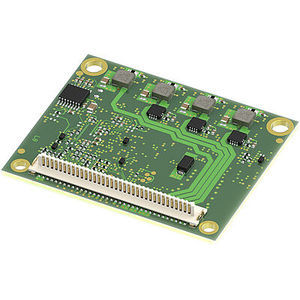
Input voltage: 6 V - 36 V
Output voltage: 0 V - 36 V
Current: 2 A
... A motion controller with even more possibilities: With the new MC 3602 B motion controllers, the selection and commissioning of drive systems is now even simpler. With the compact MC 3602/06 B, DC- motors, ...


Input voltage: 24 V
Output voltage: 24 V
Current: 0.5 A - 3.6 A
... 2-phase/5-phase stepper motor driver CVD Series Features: Compact and lightweight Low vibration For 2- or 5-phase stepper motors Control: I/O, clock input, Modbus RTU Input ...

Input voltage: 24, 48 V
Current: 0.4 A - 3.7 A
... AZ Series mini driver - DC Input The AZ Series now includes a mini driver option. Compatible with battery power operation for use in a wider range of applications. The mini driver allows for smaller and more power-efficient devices. ...
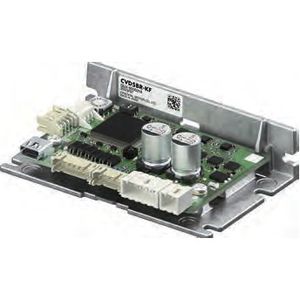
Input voltage: 24 V
Output voltage: 24 V
... Driver for 5-Phase Stepper Motors CVD Series Fully Closed-Loop Control Type Features: Enables High Positioning Accuracy Reference: Actual Measurement Data For 5-Phase Stepper Motors Control: ...
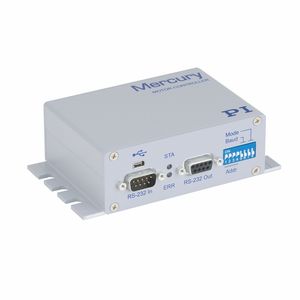

Input voltage: 24 V - 48 V
Output voltage: 0 V - 48 V
Current: 2.5 A
... Operating voltage up to 48 V Closed-loop operation of 2-phase stepper motors Support for external sensors Daisy chain networking Mercury Step controller for 2-phase stepper motors 1 ...


Output voltage: 8 V - 34 V
Current: 1.1 A
... TMCM-343 is a compact and versatile triple axis 2-phase stepper motor controller and driver module. It provides a complete motion control solution at a very small size for embedded applications. ...
Analog Devices

Input voltage: 100 V - 240 V
Current: 0.35, 0.75 A
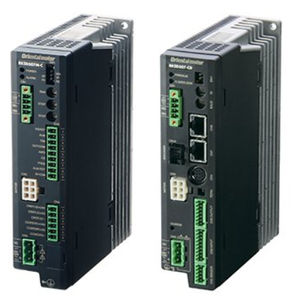
... ion and save energy, the stepper motor and driver losses have been substantially reduced allowing to be operated for longer hours at high speed, which is not possible with conventional stepper motors ...
ORIENTAL MOTOR


... DC, Brushless, Servo, Variable Reluctance, and Stepper Motor Drivers ON Semiconductor supplies a variety of dc motor control devices. ...


Input voltage: 24 V - 48 V
Current: 6.5 A
... PWM constant current bipolar micro-stepping drive Support EtherCAT communication protocol, suppor t control mode PP, PV, HM, PT Optically isolated inputs Motor short circuit protection, under-voltage protection, over-voltage ...
Jiangsu DINGS' Intelligent Control Technology

Input voltage: 24 V - 36 V
Current: 0.4 A - 3 A
... power : DC 24V - 36V 2. Output rated current (peak value) : 0.4 - 3A 3. PWM constant current bipolar micro-stepping drive 4. Support EtherCAT communication protocol, support control mode PP, PV, HM, CSP, CSV 5. Optically ...
Jiangsu DINGS' Intelligent Control Technology

Input voltage: 36, 24, 18 V
Current: 0.3, 2.2 A
... Pulse input type of Open Loop Step Motor Drive Microstep resolution can be set through DIP switch setting Output current can be set through DIP switch setting Protection alarm output Smooth filtering, Soft-Start function implementation ...
Jiangsu DINGS' Intelligent Control Technology

Input voltage: 9 V - 36 V
Output voltage: 9 V - 36 V
Current: 4 A
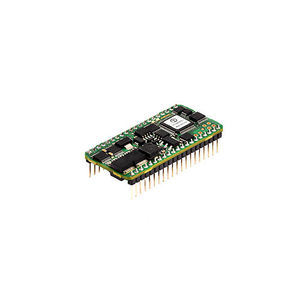
... programmable motor controller • For brushless, DC brush and step motors • For soldering / plugging in with pin headers with a pitch of 2.54 mm • Size (L x W x H): 55 x 26.4 x 13.1 ...
Technosoft
Input voltage: 11 V - 80 V
Output voltage: 11 V - 80 V
Current: 100 A
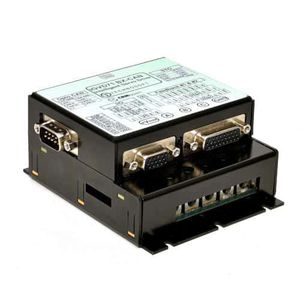
... • Intelligent, compact and freely programmable motor controller • Supports various feedback options including Sin / Cos and absolute encoders • STO inputs with safety integrity level SIL3/Cat3/PLe • Closed-frame design, ...
Technosoft
Input voltage: 9 V - 36 V
Output voltage: 9 V - 36 V
Current: 2 A
... in the smallest of spaces. • Motor types: • Brushless DC motors (BLDC, PMSM motors) • Brushed DC motors (DC motors) ...
Technosoft


Input voltage: 12 V - 24 V
Current: 2 A
... brushless DC motor controller for floor fan ceiling fan table fan Low voltage 3 phase brushless DC motor controller for floor fan ceiling fan table ...
Shenzhen Power Motor Industrial Co., Ltd.

Input voltage: 24 V
Output voltage: 24 V
Current: 5 A
... SCR speed regulation, etc in the field of dc motors and ac series motors. Power Motor has its own unique understanding and solutions for EMC solutions in motor control ...
Shenzhen Power Motor Industrial Co., Ltd.

Input voltage: 24 V
Output voltage: 24 V
Current: 5 A
... brushless DC motor controller for cordless vacuum cleaner / medical sputum aspirator / climbing equipment Low voltage single phase brushless DC motor ...
Shenzhen Power Motor Industrial Co., Ltd.


... and enable input available. It will work with almost any type of high-torque stepper motors and can be mounted on a plane surface. • OEM low-price driver for Stepper Motors • Dimensions ...
JVL A/S
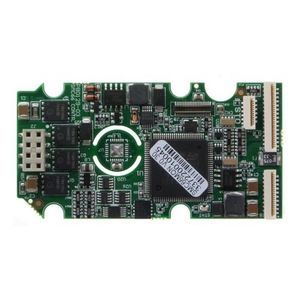
Input voltage: 24 V
Output voltage: 24 V
Current: 6 A
... Stepper motor controller 0-6Amp RMS, PLC build in with 8IOA and RS422. Optional Profinet, EtherCAT, EthernetIP, Powerlink, MOSBUS TCP, Bluetooth, WLAN, Zigbii, SSI or CANopen. A Stepper ...
JVL A/S

Input voltage: 24 V
Output voltage: 24 V
Current: 6 A
... Stepper motor controller 0-6Amp RMS, PLC build in with 8IOA and RS422. Optional Profinet, EtherCAT, EthernetIP, Powerlink, MOSBUS TCP, Bluetooth, WLAN, Zigbii, SSI or CANopen. A Stepper ...
JVL A/S


Input voltage: 12 V - 24 V
... The SDC2 Control System allows to drive SmarAct Piezo stages in a stepper motor like fashion. The Step-Direction Control System SDC2 is a lowlevel control system which allows to drive ...


Input voltage: 20 V - 30 V
Current: 0.3 A - 3 A
... EZD-1136 Controller – Compact and efficient Control your stepper motors with precision using the EZD-1136 controller. Designed for demanding environments, it combines reliability, ease ...
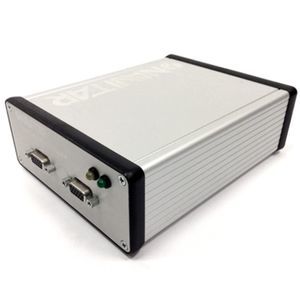

... All Navitar Zoom 6000 and 12X motorized systems can be ordered with a fully integrated control system, featuring single or dual axis control via serial RS-232 or USB. Software includes Demo Application User Interface GUI for simple ...

Output voltage: 100 V - 240 V
... Indexer, Point-to-Point, PVT Camming, Gearing Position, Velocity, Torque Command Interface CANopen ASCII Discrete I/O Stepper commands ±10V position/velocity/torque PWM velocity/torque Master encoder Communications CANopen/Devicenet RS-232 ...
Output voltage: 20 V - 75 V
... -Point, PVT Camming, Gearing Position, Velocity, Torque Command Interface CANopen, Devicenet ASCII, discrete I/O Stepper commands -±10V position/velocity/torque -PWM velocity/torque -Master encoder Communications CANopen/Devicenet RS- ...

Output voltage: 18 V - 80 V
Current: 3.5 A
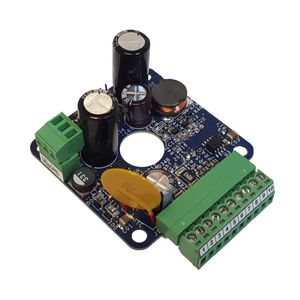
... directly to a size 23 motor and supports a center pass-through hole for motor shaft of dual-shaft or linear actuator motors. Features: Micro-Step resolution from full to 1/256 microsteps Bi-polar chopper ...
Output voltage: 10 V - 50 V
Current: 2.5 A
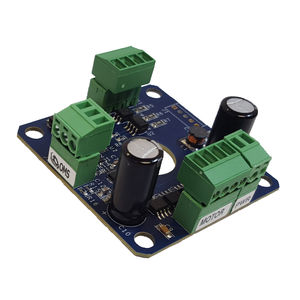
... The OMD23b is new and improved model of the original OMD23-2, an Microstepping motor drive for bipolar stepper motors. This new version, like the previous version, is capable of microstepping from full ...

Output voltage: 12 V - 80 V
Current: 7 A
... second to the step motor and an output current from 0.1 to 7 amps, operating from a supply voltage of 12 to 80 VDC. The MD125 is designed to run hybrid PM step motors rated from 0.1 to 14 amps per phase. When used with ...

Input voltage: 100 V - 240 V
Current: 2 A
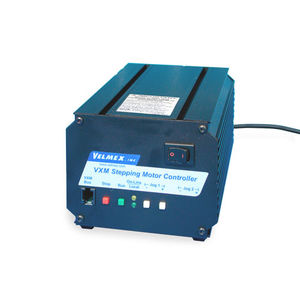
... 2-phase, unipolar stepper motor controller has the capability to drive and control precise movements, multi-axis and velocity. Velmex's VXM Controller System is capable ...
VELMEX, Inc.

Input voltage: 100 V - 240 V
Current: 2 A
... 2-phase, unipolar stepper motor controller has the capability to drive and control precise movements, multi-axis and velocity. Velmex's VXM Controller System is capable ...
VELMEX, Inc.
Input voltage: 100 V - 240 V
Current: 2 A
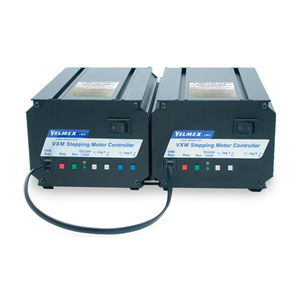
... 2-phase, unipolar stepper motor controller has the capability to drive and control precise movements, multi-axis and velocity. Velmex's VXM Controller System is capable ...
VELMEX, Inc.


Input voltage: 5 V
... ~700nm full step size Operates up to 3 axes Plain text ASCII commands for easy integration Drivers for many operating systems Every full step has 64 micro steps Special wave forms for smooth movement Specifications Power Supply 5 VDC via USB-interface ...


Current: 5, 7, 10 A
... Stepnet TP2 is a dual-axis, high-performance, DC-powered drive for position and velocity control of stepper motors via CANopen. Using advanced FPGA technology, the TP2 provides a significant reduction ...
Copley Controls


Input voltage: 24 V
Current: 0.5 A - 4 A
... Specifications: Bipolar 2-Phase Stepping Driver High Power Model F2BFD400P100 Basic Model F2BED200P100 Input voltage : 24 VDC (+/-10%) Current per phase : from 0.5 to 4A per phase Operating mode : pulse & direction or CW/CCW UL/CSA/CE certified Main ...
SANYO DENKI EUROPE


Input voltage: 24 V - 35 V
Current: 2 A
... -Phase Stepper Motor Drivers The MD2 series 2-phase stepper motor drivers allow extremely precise motor control with low mechanical noise and low ...
Autonics


Input voltage: 11 V - 48 V
Current: 5, 10 A
... SA45 CompletePower™ drives. The drives run on a bipolar stepper motor. They offer nominal current of 5A and 10A. The drives are suited for stepper motors up to 500W. This bipolar ...


Input voltage: 24 V
Output voltage: 24 V
Current: 3.5, 1.8 A
... •single-axis control •USB interface •for step or DC servo motors CHARACTERISTICS •single-axis control •for 2-phase step motors or DC servo motors •micro step ...


Input voltage: 12 V - 48 V
Current: 0.1 A - 4.2 A
... standard DIN rail. Programmable controller SMSD‑4.2RS is intended for control of step motors with phase current up 4.2 A. The controller allows to control (adjust) direction, speed and acceleration ...
Smart Motor Devices

Input voltage: 24 V - 72 V
Current: 1 A - 8 A
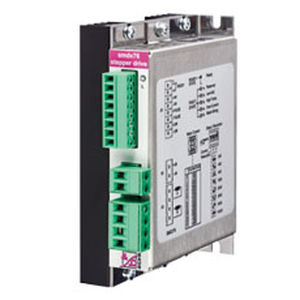
... Wall mount DIN-Rail Application: Step motor driver for 2 & 3-phase step motors Supply voltage: 24V...72V max. 80V Motor current/phase: 1,0A...8Apeak Step resolution: 200 to 10000 steps/revolution Signal ...
Middex-Electronic GmbH

Input voltage: 120 V
Output voltage: 72, 24, 48 V
Current: 5 A - 20 A
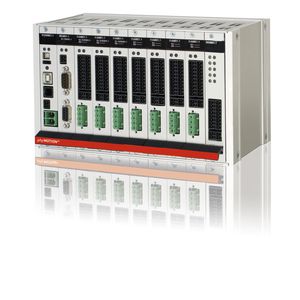
... programmable motion controller (PMC) for multi axes stepper motor applications The phyMOTIONTM freely programmable multi-axes motion controller integrates high performance drive ...
Phytron GmbH
the best suppliers