


- Metrology - Laboratory
- Metrology and Test Equipment
- Salt spray test chamber
- ERICHSEN GmbH & Co. KG
Salt spray test chamber Model 606-Basicsalt spray corrosioncyclic corrosionfor rapid temperature cycling

Add to favorites
Compare this product
Characteristics
- Test type
- for rapid temperature cycling, salt spray, condensation, salt spray corrosion, cyclic corrosion, for environmental simulation
- Product applications
- for vehicles, for materials, for materials testing
- Application domain
- for quality control, for the aeronautical industry, laboratory
- Configuration
- floor-standing, compact, horizontal
- Protection level
- corrosion-resistant
- Number of doors
- 1-door
- Options and accessories
- with window, with temperature and climatic control, temperature regulator
- Other characteristics
- accelerated, alternating, constant, top-loading
- Capacity
Max.: 2,000 l
(528.34 gal)Min.: 300 l
(79.25 gal)- Temperature
Max.: 50 °C
(122 °F)
Description
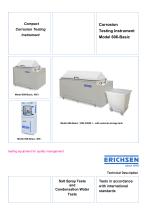
The compact Corrosion Testing Instrument, Model 606-Basic, to perform salt spray and condensation tests, is made of impact resistant, eco-friendly polypropylene material and is delivered in a rectangular design. It consists of a test chamber, available either of 400 l, 1000 l or 2000 l capacity, and a built-in control unit as well as an external storage tank for the spray. The control unit is equipped with the necessary control instruments. The test chamber can be opened manually. A dosing pump serves for an infinitely variable adjustment to achieve optimum consumption of spray solution. The external storage tank for approx. 200 l salt solution allows continuous testing without attention over a period of up to a week. The scope of supply of each test chamber includes three specimen holders for weathering panels.
For testing small quantities or small test specimens, the user has access to a corrosion testing apparatus in a modular design (cabinet unit) with 300 l test chamber volume. The large, transparent access door allows easy mounting of specimens, which may e.g. be hung from the delivered sample rods, to be exposed to aggressive salt spray for a certain period of time. The integrated control unit with storage tank (about 125 l) is located in the base unit.
Purpose and application
Ferrous and non-ferrous metals are attacked continuously by humidity, acids, solutions, gases etc. It is therefore vitally important to choose the correct surface protection. There are many materials and qualities on the market and their properties must be properly assessed. Materials intended to prevent corrosion must be tested if failures are to be avoided. Furthermore the comparative quality control during production is of increasing importance. The best known processes employ spray vapour tests using various salt solutions as well as condensation water climates.
Test principle
Aggressive solutions are turned into a vapour mist in accordance with the tests that are listed below. These vapours surround the specimens in the test chamber either continuously or in a cyclic manner. The corrosion resistance of the individual specimens is established on the basis of the difference in time before the first corrosive effects become apparent.
For testing small quantities or small test specimens, the user has access to a corrosion testing apparatus in a modular design (cabinet unit) with 300 l test chamber volume. The large, transparent access door allows easy mounting of specimens, which may e.g. be hung from the delivered sample rods, to be exposed to aggressive salt spray for a certain period of time. The integrated control unit with storage tank (about 125 l) is located in the base unit.
Purpose and application
Ferrous and non-ferrous metals are attacked continuously by humidity, acids, solutions, gases etc. It is therefore vitally important to choose the correct surface protection. There are many materials and qualities on the market and their properties must be properly assessed. Materials intended to prevent corrosion must be tested if failures are to be avoided. Furthermore the comparative quality control during production is of increasing importance. The best known processes employ spray vapour tests using various salt solutions as well as condensation water climates.
Test principle
Aggressive solutions are turned into a vapour mist in accordance with the tests that are listed below. These vapours surround the specimens in the test chamber either continuously or in a cyclic manner. The corrosion resistance of the individual specimens is established on the basis of the difference in time before the first corrosive effects become apparent.
Exhibitions
Meet this supplier at the following exhibition(s):


Other ERICHSEN GmbH & Co. KG products
Corrosion testing


Related Searches
- ERICHSEN testing machine
- Measuring device
- ERICHSEN test chamber
- Test stand
- ERICHSEN temperature test chamber
- ERICHSEN automatic testing machine
- ERICHSEN material testing machine
- ERICHSEN hardness tester
- ERICHSEN climate chamber
- ERICHSEN quality control test chamber
- PC-controllable testing machine
- ERICHSEN portable tester
- ERICHSEN humidity test chamber
- ERICHSEN environmental test chamber
- Digital testing system
- Benchtop indentation hardness tester
- ERICHSEN industrial testing machine
- ERICHSEN vertical testing machine
- Automatic test stand
- ERICHSEN industrial tester
*Prices are pre-tax. They exclude delivery charges and customs duties and do not include additional charges for installation or activation options. Prices are indicative only and may vary by country, with changes to the cost of raw materials and exchange rates.
About DirectIndustry
DirectIndustry is a marketplace that offers B2B players a complete experience, from product sourcing to purchase. DirectIndustry is an entity of VirtualExpo Group.
Are you a buyer?
Are you a supplier?