


- Metrology - Laboratory
- Metrology and Test Equipment
- Scratch hardness tester
- ERICHSEN GmbH & Co. KG
Scratch hardness tester Model 318manualportablehandheld

Add to favorites
Compare this product
Characteristics
- Type
- scratch
- Mounting
- portable, handheld, manual, pencil
- Load
Min.: 0 N
Max.: 20 N
- Useful height
160 mm
(6.3 in)- Weight
0.3 kg
(0.7 lb)
Description
Short description
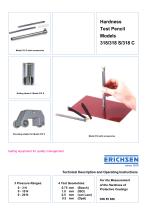
The Hardness Test Pencil Model 318 is used to assess the scratch resistance of surface protective layers and to measure the hardness grades of paints, plastic coatings and similar surface finishes. Small-sized, portable and ready to use for flat or curved surfaces. Four different test probes are available (sold separately). Three force ranges, up to 20 N.
Technical description
The Models 318 / 318S / 318 C are designed to measure the hardness of surface protective layers. These testers allow quick and easy quality control of surface protection layers even during production. Developed originally by Robert Bosch GmbH and manufactured by ERICHSEN, the devices enable determination, documentation and communication of hardness degrees as numerical values.
Test procedure using test tips No. 1, 2 and 3
The handling of the Hardness Test Pencil is simple: set the estimated or known spring tension with the slider. Hold the instrument upright and place its point on the test surface, then draw a 5 to 10 mm long line at approx. 10 mm/s. The stylus should produce a scratch just visible to the naked eye. If the spring pressure is too high the scratch is clearly visible; if too low no scratch appears. The applied pressure, fixed by locking the slider, is marked in Newtons.
Pressure ranges (three engraved scales)
The springs for each pressure range are colour coded and the corresponding scale is marked in the same colour.
Notes on guidance and test head
A sensitive guidance of the test pencil is required for useful results. Excessive pressure or a test head with an insufficiently smooth edge may produce traces that falsify results or complicate interpretation. Imitations with rough edges can cause unreliable results.
Test procedure using test tip No. 4
Test tip No. 4 (Opel, 0.5 mm dia.) has a special tip geometry and a length approx. 15 mm longer than the other marking pins. To ensure the preset test force, the test tip must be pressed into the test pencil by approx. 5 mm during the test.
Standards
Technical data
Accessories (examples)
Test tips (No. 1, No. 2, No. 3, No. 4), additional springs for each force range, chucking adapter (rolling), carrying/handling accessories and calibration certificates are available separately.
Characteristics / specifications
The Hardness Test Pencil Model 318 is used to assess the scratch resistance of surface protective layers and to measure the hardness grades of paints, plastic coatings and similar surface finishes. Small-sized, portable and ready to use for flat or curved surfaces. Four different test probes are available (sold separately). Three force ranges, up to 20 N.
Technical description
The Models 318 / 318S / 318 C are designed to measure the hardness of surface protective layers. These testers allow quick and easy quality control of surface protection layers even during production. Developed originally by Robert Bosch GmbH and manufactured by ERICHSEN, the devices enable determination, documentation and communication of hardness degrees as numerical values.
Test procedure using test tips No. 1, 2 and 3
The handling of the Hardness Test Pencil is simple: set the estimated or known spring tension with the slider. Hold the instrument upright and place its point on the test surface, then draw a 5 to 10 mm long line at approx. 10 mm/s. The stylus should produce a scratch just visible to the naked eye. If the spring pressure is too high the scratch is clearly visible; if too low no scratch appears. The applied pressure, fixed by locking the slider, is marked in Newtons.
Pressure ranges (three engraved scales)
- 0 - 3 N (blue marked)
- 0 - 10 N (red marked)
- 0 - 20 N (yellow marked)
The springs for each pressure range are colour coded and the corresponding scale is marked in the same colour.
Notes on guidance and test head
A sensitive guidance of the test pencil is required for useful results. Excessive pressure or a test head with an insufficiently smooth edge may produce traces that falsify results or complicate interpretation. Imitations with rough edges can cause unreliable results.
Test procedure using test tip No. 4
Test tip No. 4 (Opel, 0.5 mm dia.) has a special tip geometry and a length approx. 15 mm longer than the other marking pins. To ensure the preset test force, the test tip must be pressed into the test pencil by approx. 5 mm during the test.
Standards
- DIN 55 656
- Van Laar
- Bosch
- ISO 1518
- Opel
Technical data
- Drive: Manual
- Diameter: 16 mm
- Weight, net: approx. 250 g
- Total length: 160 mm
- Testing Force: 0-20 N
- Test tip no. 4: spring steel, with special tip geometry
- Scratch profile: Van Laar, Bosch, ISO, Opel
- Compression Springs: spring steel
- Portable / Stationary: Portable
- Test tips no. 1, no. 2, no. 3: tungsten carbide spheres
Accessories (examples)
Test tips (No. 1, No. 2, No. 3, No. 4), additional springs for each force range, chucking adapter (rolling), carrying/handling accessories and calibration certificates are available separately.
Characteristics / specifications
- Model designation: Model 318
- Manufacturer: ERICHSEN
- Testing force range: 0 - 20 N (three selectable ranges: 0-3 N, 0-10 N, 0-20 N)
- Diameter: 16 mm
- Total length: 160 mm
- Net weight: approx. 250 g
- Test tip materials: tungsten carbide spheres (tips No. 1–3); spring steel with special geometry (tip No. 4)
- Compression springs: spring steel (colour coded for ranges)
- Portable: yes
- Standards referenced: DIN 55 656, Van Laar, Bosch, ISO 1518, Opel
Catalogs
Exhibitions
Meet this supplier at the following exhibition(s):


Other ERICHSEN GmbH & Co. KG products
Hardness / Scratch Hardness


Related Searches
- ERICHSEN testing machine
- Measuring device
- ERICHSEN test chamber
- Test stand
- ERICHSEN automatic testing machine
- ERICHSEN material testing machine
- ERICHSEN temperature test chamber
- ERICHSEN hardness tester
- ERICHSEN climate chamber
- ERICHSEN quality control test chamber
- PC-controllable testing machine
- ERICHSEN portable tester
- ERICHSEN humidity test chamber
- ERICHSEN environmental test chamber
- Digital testing system
- Benchtop indentation hardness tester
- ERICHSEN industrial testing machine
- ERICHSEN vertical testing machine
- Automatic test stand
- ERICHSEN industrial tester
*Prices are pre-tax. They exclude delivery charges and customs duties and do not include additional charges for installation or activation options. Prices are indicative only and may vary by country, with changes to the cost of raw materials and exchange rates.
About DirectIndustry
DirectIndustry is a marketplace that offers B2B players a complete experience, from product sourcing to purchase. DirectIndustry is an entity of VirtualExpo Group.
Are you a buyer?
Are you a supplier?