


- Metrology - Laboratory
- Metrology and Test Equipment
- Scratch hardness tester
- ERICHSEN GmbH & Co. KG
Paints and coating hardness tester 430 P-Smartscratchbenchtopfor automobiles


Add to favorites
Compare this product
Characteristics
- Type
- scratch
- Mounting
- benchtop
- Product applications
- for laboratory, for plastics, for quality control, for laboratory applications, for automotive parts, for automotive applications, for polymer samples, for automobiles, for paints and coatings
- Other characteristics
- with control panel, automatic, motorized, mechanical, electric, robotic
- Load
Max.: 50 N
Min.: 1 N
- Weight
50 kg
(110.2 lb)
Description
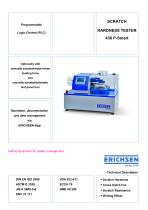
The SCRATCH HARDNESS TESTER 430 P-Smart is an electromotive, all-purpose tester designed for scratching and cutting tasks on paint coats and plastic surfaces. It enables individual cuts, parallel cuts, and cross-hatch cuts (after rotating the sample 90) on test plates of varying thicknesses. This tester is particularly suited for adhesion tests using the cross-hatch method according to all common standards, as well as for special plastic tests such as scratch resistance and writing effect according to Opel specifications. The device offers a significant reduction in workload for series tests, with reproducible and meaningful results.
Design and Function
The SCRATCH HARDNESS TESTER 430 P-Smart is a robust benchtop instrument with a protective cover and touch panel operation. The test procedure is fully automatic, with parameters such as cutting speed, stroke, and cross-cut pattern set via the keyboard. Each motion sequence is driven by a separate step motor, ensuring precise control over transport, cut positioning, and pressure adjustment. The specimen is conveyed linearly at a constant speed under the test tip, which can be set to a maximum pressure load of 40 N. The instrument includes two interchangeable control plates for different cross-cut patterns. Parallel cross hatch cuts with graduated test forces are possible, and up to 80 test tracks with 0.5 mm spacing can be programmed. Four versions are available, differing in manual or motor-driven force regulation and sample rotation. Motor-driven versions allow for trial runs with gradually increasing force to determine the required force for through cuts. An optional 6-piece weight set enables special tests in the lower pressure range (1–15 N, in 1-N steps).
Special Features
Cross Hatch Testing
The tester supports cross hatch tests according to all usual standards, with selectable cross-cuts (e.g., 2 x 5, 6 x 1, 6 x 2, 6 x 3, 8 x 1, 8 x 2, 11 x 1). Cuts are performed automatically at 40 mm/s. After a 90 manual rotation, the procedure is repeated. The required load for cutting through to the substrate is determined via trial runs. A magnifying glass (2.5x) is included for examination. Results are visually compared to standard patterns. The device is compatible with further cupping tests and alternative adhesion test methods.
Scratch Resistance Testing
For Opel-compliant scratch resistance tests (GME 60280 / GMW14688), a 1 mm tip and a 20 x 2 mm grid are used with a 5 N load. Brightness variance (∆L) is measured using a colorimeter with D65 illuminant, d/8 geometry, and 27 mm aperture.
Writing Effect Testing
For Opel-compliant writing effect tests, an optional inset is mounted. The pattern is 80 cuts at 0.5 mm spacing with a 7 N load. Gloss difference is measured using a glossmeter with 60 geometry.
Special Tests
Additional scratch tests can be performed by varying:
Operation via App
The tester can be operated via smartphone or tablet app (available on Google Play Store/Apple Store), allowing for flexible settings, documentation, and data management.
Reference Class
All versions are supplied with a Calibration Certificate according to DIN 55350-18, including:
Comparisons are made for:
Standards
Design and Function
The SCRATCH HARDNESS TESTER 430 P-Smart is a robust benchtop instrument with a protective cover and touch panel operation. The test procedure is fully automatic, with parameters such as cutting speed, stroke, and cross-cut pattern set via the keyboard. Each motion sequence is driven by a separate step motor, ensuring precise control over transport, cut positioning, and pressure adjustment. The specimen is conveyed linearly at a constant speed under the test tip, which can be set to a maximum pressure load of 40 N. The instrument includes two interchangeable control plates for different cross-cut patterns. Parallel cross hatch cuts with graduated test forces are possible, and up to 80 test tracks with 0.5 mm spacing can be programmed. Four versions are available, differing in manual or motor-driven force regulation and sample rotation. Motor-driven versions allow for trial runs with gradually increasing force to determine the required force for through cuts. An optional 6-piece weight set enables special tests in the lower pressure range (1–15 N, in 1-N steps).
Special Features
- 2 cutting speeds and 2 cutting lengths, combinable as needed
- 9 preset cross-cuts compliant with common standards
- 1 freely programmable cross-cut pattern for special applications
- Step motor precision for cut distance setting
- Stop option within cross hatch mode for individual test force adjustment per scratch track
- Visual display when cutting through insulating layers to metal substrate
- Rapid clamping device for test panels with wide clamping range
Cross Hatch Testing
The tester supports cross hatch tests according to all usual standards, with selectable cross-cuts (e.g., 2 x 5, 6 x 1, 6 x 2, 6 x 3, 8 x 1, 8 x 2, 11 x 1). Cuts are performed automatically at 40 mm/s. After a 90 manual rotation, the procedure is repeated. The required load for cutting through to the substrate is determined via trial runs. A magnifying glass (2.5x) is included for examination. Results are visually compared to standard patterns. The device is compatible with further cupping tests and alternative adhesion test methods.
- Adhesion Test Apparatus, Model 525 (manual/inexpensive)
Scratch Resistance Testing
For Opel-compliant scratch resistance tests (GME 60280 / GMW14688), a 1 mm tip and a 20 x 2 mm grid are used with a 5 N load. Brightness variance (∆L) is measured using a colorimeter with D65 illuminant, d/8 geometry, and 27 mm aperture.
Writing Effect Testing
For Opel-compliant writing effect tests, an optional inset is mounted. The pattern is 80 cuts at 0.5 mm spacing with a 7 N load. Gloss difference is measured using a glossmeter with 60 geometry.
Special Tests
Additional scratch tests can be performed by varying:
- Test tip: ball test tools (0.5/0.75/1/3 mm), asymmetric tools (cross cut/Clemen)
- Test load: 50 N (2 N steps, standard), 15 N (1 N steps, optional)
- Cutting grid: preset (2 x 5, 6 x 1, 6 x 2, 6 x 3, 8 x 1, 8 x 2, 11 x 1, 20 x 2, 80 x 0.5), freely programmable (max width 40 mm, 0.5 mm increments)
- Cutting pattern: parallel or cross cuts
- Cutting path: 25 mm or 40 mm (exchangeable guide plates)
- Cutting speed: 16.7 mm/s (1 m/min) or 40 mm/s
Operation via App
The tester can be operated via smartphone or tablet app (available on Google Play Store/Apple Store), allowing for flexible settings, documentation, and data management.
Reference Class
All versions are supplied with a Calibration Certificate according to DIN 55350-18, including:
- Actual and setting values of loading force
- Scratching speed and cutting distance
- Test equipment used with calibration status
- Product identification
- Date
- Name of inspector
Comparisons are made for:
- Loading force (5 values over the load range)
- Cutting speed (both values with both cutting paths)
- Cutting distance (e.g., 0.5 mm setting)
Standards
- GME 60280 GM / Opel
- GMW 14688 GM / Opel
- PV 3952 VW / Audi
- PV 3974 VW / Audi
- PV 3962 VW / Audi
- D45 1047 Renault
- MS210-05K Hyundai / Kia
- STD 4377 Volvo
- ISO 2409 Common
VIDEO
Catalogs
Exhibitions
Meet this supplier at the following exhibition(s):


Other ERICHSEN GmbH & Co. KG products
Hardness / Scratch Hardness


Related Searches
- ERICHSEN testing machine
- Measuring device
- ERICHSEN test chamber
- Test stand
- ERICHSEN temperature test chamber
- ERICHSEN automatic testing machine
- ERICHSEN material testing machine
- ERICHSEN hardness tester
- ERICHSEN climate chamber
- ERICHSEN quality control test chamber
- PC-controllable testing machine
- ERICHSEN portable tester
- ERICHSEN humidity test chamber
- ERICHSEN environmental test chamber
- Digital testing system
- Benchtop indentation hardness tester
- ERICHSEN industrial testing machine
- ERICHSEN vertical testing machine
- Automatic test stand
- ERICHSEN industrial tester
*Prices are pre-tax. They exclude delivery charges and customs duties and do not include additional charges for installation or activation options. Prices are indicative only and may vary by country, with changes to the cost of raw materials and exchange rates.
About DirectIndustry
DirectIndustry is a marketplace that offers B2B players a complete experience, from product sourcing to purchase. DirectIndustry is an entity of VirtualExpo Group.
Are you a buyer?
Are you a supplier?
© 2026 All rights reserved - Terms - Privacy policy - General Terms - Manage cookies - 鄂ICP备2026053537号-2 -