


- Electricity - Electronics
- Switch and Relay
- Electrical network surge arrester
- Siemens Energy – Power transmission
Transient current protection surge arrester 3EL seriesfor substationsfor harsh environmentsfor electrical networks

Add to favorites
Compare this product
Characteristics
- Applications
- for transient current protection, for substations, for harsh environments, for electrical networks
- Other characteristics
- polymer, MOV, high-voltage
- Voltage
Max.: 1,200 kV
Min.: 0 kV
- Primary current
Max.: 500,000 A
Min.: 0 A
Description
Overview
High-voltage surge arresters are protective devices for electrical power systems designed to shield equipment from transient overvoltages caused by lightning strikes, switching operations, and other disturbances. They limit voltage spikes to safe levels by diverting surge currents to ground, protecting transformers, switchgear, transmission lines and other critical assets. Siemens Energy offers a comprehensive portfolio of high-voltage surge arresters for applications up to 1,200 kV, available in silicone rubber and porcelain designs suitable for diverse environmental and mechanical demands.
Key functions and features
Portfolio highlights
Siemens Energy provides multiple high-voltage surge arrester designs tailored to installation and environmental requirements: 3EL silicone Cage Design™, 3EQ composite hollow core (silicone + FRP core), and 3EP porcelain design. These variants cover many applications up to 800 kV, with solutions in the wider portfolio for networks up to 1,200 kV.
3EL silicone Cage Design™ (summary)
3EQ composite hollow core (summary)
3EP porcelain design (summary)
Comparison table
Applications
Technical highlights and benefits
Technical specifications
High-voltage surge arresters are protective devices for electrical power systems designed to shield equipment from transient overvoltages caused by lightning strikes, switching operations, and other disturbances. They limit voltage spikes to safe levels by diverting surge currents to ground, protecting transformers, switchgear, transmission lines and other critical assets. Siemens Energy offers a comprehensive portfolio of high-voltage surge arresters for applications up to 1,200 kV, available in silicone rubber and porcelain designs suitable for diverse environmental and mechanical demands.
Key functions and features
- Overvoltage protection: Rapidly divert transient voltage peaks to safeguard electrical systems.
- Equipment safety: Prevents insulation failure and extends asset service life.
- System reliability: Minimizes downtime and maintenance needs to support continuous power delivery.
- Mechanical stability: Engineered for support applications and regions with seismic or high-wind exposure.
Portfolio highlights
Siemens Energy provides multiple high-voltage surge arrester designs tailored to installation and environmental requirements: 3EL silicone Cage Design™, 3EQ composite hollow core (silicone + FRP core), and 3EP porcelain design. These variants cover many applications up to 800 kV, with solutions in the wider portfolio for networks up to 1,200 kV.
3EL silicone Cage Design™ (summary)
- Design: Silicone rubber housing molded onto MOVs with a fiberglass-reinforced plastic (FRP) rod cage (Cage Design™).
- Protection: Provides overvoltage protection suitable for networks up to 800 kV.
- Applications: Transformers, circuit breakers, generators, motors, capacitors, traction vehicles, bushings, switchgear, and transmission lines.
- Safety features: Soft silicone housing enables controlled arc discharge without ejection of internal parts.
- Durability: Hydrophobic, UV-resistant, fire-retardant, and self-extinguishing silicone.
- Versatility: Usable as station or line arresters; lightweight for easier handling and installation.
3EQ composite hollow core (summary)
- Design: Silicone housing molded onto a fiberglass-reinforced hollow core.
- Sealing: Special flange seals prevent moisture ingress and partial discharges.
- Safety: Directional pressure relief devices provide controlled arc escape during overloads or short circuits.
- Use cases: Suited to seismic zones, high-wind areas, and as support insulators.
- Versatility: Can serve as station arresters or support insulators.
3EP porcelain design (summary)
- Design: Porcelain housing with FRP cage or robust porcelain support.
- Sealing and robustness: Strong sealing to prevent moisture ingress; designed for seismic and high-wind conditions.
- Safety: Porcelain containment prevents ejection of internal parts during faults and provides mechanical support.
Comparison table
- Maximum voltage: 3EL — up to 800 kV; 3EQ — up to 800 kV; 3EP — up to 800 kV.
- Mechanical strength: 3EL — high via FRP rod cage; 3EQ — very high via FRP hollow core; 3EP — high via porcelain housing.
- Housing material: 3EL — silicone rubber (hydrophobic, UV-resistant); 3EQ — silicone rubber + FRP hollow core; 3EP — porcelain.
- Overload safety: 3EL — soft-silicone arc escape; 3EQ/3EP — directional pressure relief devices.
- Maintenance: 3EL — low maintenance due to silicone properties; 3EQ — long-term reliable operation; 3EP — robust in harsh environments.
- Application flexibility: 3EL — station or line arresters; 3EQ/3EP — station arresters in seismic/high-wind zones.
- Weight: 3EL — lightweight; 3EQ — moderate; 3EP — heavier but highly durable.
Applications
- Transmission and distribution substations: Protecting infrastructure from transient overvoltages.
- Power transformers and reactors: Ensuring reliable operation and extended service life.
- Switchgear and control equipment: Safeguarding against electrical disturbances.
- Overhead and underground transmission lines: Maintaining uninterrupted power flow.
- Challenging environments: Sites prone to lightning, seismic activity, coastal or desert pollution, or extreme weather.
Technical highlights and benefits
- Proven reliability: Field-proven designs with decades of experience.
- Advanced materials: Silicone rubber and composite components for enhanced durability and performance.
- Safety-first design: Pressure relief and arc management systems to reduce risk.
- Wide voltage range: Solutions for medium to ultra-high voltage applications (portfolio up to 1,200 kV).
- Customizable: Tailored designs to meet specific project and environmental requirements.
- Environmental compatibility: Materials and sealing strategies to prevent moisture ingress and support long-term operation.
Technical specifications
- Voltage rating: Solutions up to 1,200 kV in the Siemens Energy portfolio; many variants up to 800 kV (3EL / 3EQ / 3EP designs).
- Housing materials: Silicone rubber (hydrophobic, UV-resistant, fire-retardant, self-extinguishing); porcelain options available.
- Mechanical structure: FRP rod cage (3EL), FRP hollow core (3EQ), porcelain housing (3EP).
- Overload safety mechanisms: Soft-silicone arc escape (3EL); directional pressure relief devices (3EQ, 3EP).
- Sealing: Moisture-tight silicone molding and special flange seals to prevent moisture ingress and partial discharges.
- Applications: Station arresters, line arresters, support insulators, transformer and switchgear protection, traction and generator applications.
- Environmental suitability: Coastal, desert, high-pollution regions, seismic and high-wind zones.
Catalogs
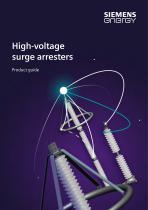
Other Siemens Energy – Power transmission products
Surge arresters


Related Searches
- SIEMENS surge arrester
- SIEMENS circuit breaker
- Type 2 surge protector
- Isolator switch
- Class II surge arrester
- AC surge protector
- Multipole isolator switch
- Plug-in surge protector
- Class I surge arrester
- Remote signaling surge protector
- SIEMENS varistor surge arrester
- Surge protector with fault indication
- 3-pole isolator switch
- Type 3 surge protector
- Single-pole circuit breaker
- Distribution circuit breaker
- Electrical installation surge protector
- Anti-surge surge protector
- MOV surge protector
- Class I surge protector
*Prices are pre-tax. They exclude delivery charges and customs duties and do not include additional charges for installation or activation options. Prices are indicative only and may vary by country, with changes to the cost of raw materials and exchange rates.
About DirectIndustry
DirectIndustry is a marketplace that offers B2B players a complete experience, from product sourcing to purchase. DirectIndustry is an entity of VirtualExpo Group.
Are you a buyer?
Are you a supplier?