

- Metrology - Laboratory
- Analytical Instrumentation
- Circuit breaker analyzer
- Wuhan UHV Power Technology Co.,Ltd.


- Products
- Catalogs
- News & Trends
- Exhibitions
Circuit breaker analyzer UHV-408voltageelectrical resistancevelocity


Add to favorites
Compare this product
Characteristics
- Application domain
- circuit breaker
- Measured value
- voltage, electrical resistance, velocity
- Configuration
- portable
- Other characteristics
- real-time, data acquisition, graphic, with built-in printer, multichannel
Description
Product Introduction
Technical parameters
Features of Circuit Breaker Characteristic Tester
Additional notes
Specifications
Working principle of Circuit Breaker Characteristic Tester
Application Field of Circuit Breaker Test Set
What equipment is the Circuit Breaker Analyzer mainly used to test?
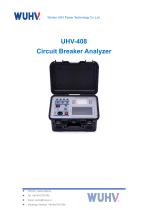
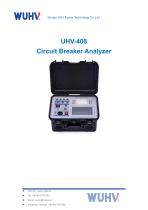
- The UHV-408 Circuit Breaker Analyzer is a portable analyzer for dynamic testing of high-voltage circuit breakers. It measures mechanical dynamic characteristics across technologies and voltage levels (oil, vacuum, SF6, GIS) and supports simultaneous acquisition on up to 12 contact channels, providing time, travel, velocity, coil current and coil resistance measurements with waveform capture.
Technical parameters
- Time measurement: internal/external trigger, 1 ms–10000 ms, resolution down to 0.01 ms; accuracy ≤200 ms: 0.05% ± 0.1 ms.
- Velocity measurement: linear and angle sensors; linear range 0.01–20.00 m/s (0.1 mm sensor); 345° angle encoder with 0.01° resolution.
- Travel measurement: standard linear sensor 0–50 mm (resolution 0.1 mm); optional linear sensors 100–1000 mm; encoder range 0–1000 mm.
- Current/resistance: max current 30 A (resolution 0.01 A); coil resistance up to 1000 Ω (resolution 0.01 Ω).
- Power supply: AC 220 V ±10%, 50 Hz ±10%; DC output adjustable 20–270 V, short-time DC220V ≤ 20 A, power 4400 W.
- External trigger: AC/DC 10–300 V, current ≤ 120 A.
- Operating environment: -20 °C to +50 °C; relative humidity ≤ 90%.
Features of Circuit Breaker Characteristic Tester
- Compatible with SF6 switches, GIS assemblies, vacuum breakers, oil breakers, vacuum contactors and special circuit breakers; supports measurement of up to 12 metal contact points (6 main + 6 auxiliary) with waveform recording.
- 7-inch sunlight-readable color display with menu-driven interface and quick-test operation; bilingual UI (Chinese/English); simultaneous display of 12-channel status, time, travel, velocity and waveforms with segment-average velocity analysis.
- Built-in DC supply (no external secondary power required) adjustable 20–270 V with short-circuit protection and audible alarm; redundant dual-circuit design for continued testing if one control circuit fails.
- Linear and rotary sensors with a multifunctional mounting joint for quick installation; linear sensors configurable in the field from 30 to 1000 mm without factory return.
- Storage for 100 test records with real-time clock; USB (U-disk) and RS232 interfaces for data export and PC connection; optional RS232 online operation and integrated high-speed thermal printer.
- Internal anti-interference design suitable for reliable operation in 500 kV substations.
Additional notes
- Manufactured in China. The UHV-408 is intended for professional use in maintenance, commissioning and acceptance testing of high-voltage circuit breakers.
Specifications
- Model: UHV-408
- Time range: 1 ms–10000 ms; resolution 0.01 ms (≤999 ms)
- Velocity: 0.01–20.00 m/s (linear sensor); encoder 345° / 0.01°
- Travel: 0–50 mm (standard), optional 100–1000 mm; resolution 0.1 mm
- Current/resistance: max 30 A (0.01 A); resistance up to 1000 Ω (0.01 Ω)
- DC output: 20–270 V adjustable; DC220V ≤ 20 A (short time); power 4400 W
- External trigger: AC/DC 10–300 V, current ≤ 120 A
- Display: 7-inch color, sunlight-readable
- Storage: 100 test groups; real-time clock
- Dimensions: 360 × 260 × 170 mm
- Operating temperature: -20 °C to +50 °C; relative humidity ≤ 90%
Working principle of Circuit Breaker Characteristic Tester
- The working principle of the Circuit Breaker Characteristic Tester is based on electrical measurement and signal processing technology. It usually consists of a power supply, signal generator, sampling device, data processing unit, etc. During the testing process, the signal generator generates a series of electrical signals with different frequencies, amplitudes, and phases, which are then transmitted to the high-voltage switch through a sampling device. At the same time, the tester will record the electrical parameters of the high-voltage switch under different signal excitations, and transmit the data to the data processing unit for analysis and processing.
Application Field of Circuit Breaker Test Set
- The Circuit Breaker Test Set has a wide range of applications in the field of power systems. It can be used for testing and evaluation of power substations, power transmission lines, and other power equipment. Specific applications include but are not limited to the following aspects:
- 1. Dynamic characteristic evaluation: By testing the dynamic characteristics of high-voltage switches under different working states, engineers can evaluate their fast switching ability, stability, and other important performance indicators, thereby ensuring the safe and stable operation of the power system.
- 2. Fault analysis: The high-voltage switch dynamic characteristic tester can help engineers analyze fault problems in the power system. By testing the response and dynamic characteristics of the switch under fault conditions, the cause of the fault can be determined and repaired and improved.
- 3. Equipment development: In the development process of high-voltage switches, dynamic characteristic testers play an important role. It can help engineers evaluate the performance and reliability of new high-voltage switches and make necessary improvements and optimizations.
What equipment is the Circuit Breaker Analyzer mainly used to test?
- The Circuit Breaker Analyzer is mainly used to detect the mechanical action characteristics of various high-voltage circuit breakers and switchgear, including:
- vacuum circuit breaker
- SF6 circuit breaker
- Oil circuit breaker
- GIS circuit breaker
- load switch
- disconnecting switch
- It can measure key parameters such as opening and closing time, synchronicity, bounce time, travel, speed, etc.
VIDEO
Other Wuhan UHV Power Technology Co.,Ltd. products
Circuit Breaker Tester


Related Searches
- Gas analyser
- Concentration analyser
- Monitoring analyser
- Liquids analyser
- Automated analyzer
- Desktop analyzer
- Process analyser
- Portable analyser
- Continuous analyser
- Water analyser
- Real-time analyser
- Laboratory analyser
- Compact analyser
- Digital analyser
- Calibration analyser
- Temperature analyser
- Chromatography system
- Power quality analyser
- Sampling analyser
- Control analyser
*Prices are pre-tax. They exclude delivery charges and customs duties and do not include additional charges for installation or activation options. Prices are indicative only and may vary by country, with changes to the cost of raw materials and exchange rates.
About DirectIndustry
DirectIndustry is a marketplace that offers B2B players a complete experience, from product sourcing to purchase. DirectIndustry is an entity of VirtualExpo Group.
Are you a buyer?
Are you a supplier?