

- Metrology - Laboratory
- Metrology and Test Equipment
- Voltage testing device
- Wuhan UHV Power Technology Co.,Ltd.


- Products
- Catalogs
- News & Trends
- Exhibitions
Vacuum testing device UHV-420voltageautomaticelectrical network


Add to favorites
Compare this product
Characteristics
- Test type
- voltage
- Operating mode
- automatic
- Test material
- electrical network, vacuum
- Sector
- for railway applications
- Technology
- electric
- Configuration
- portable
- Other characteristics
- high-voltage
Description
Overview
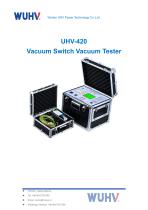
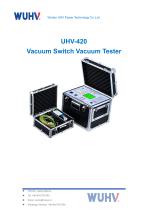
UHV-420 vacuum interrupter test set is a quantitative instrument for on-site measurement of vacuum degree in vacuum interrupters using a non‑destructive excitation coil. It is intended for preventive detection and acceptance testing of vacuum switches.
Product Details
Detection object: Various types of vacuum interrupter tubes
Detection method: New excitation coil enables measurement without disassembly
Scope of application: Multi-purpose, suitable for testing various vacuum interrupters
Measuring range: 10^-5 10^-1 Pa
Measuring accuracy: ±10% across indicated ranges (10^-5–10^-4, 10^-4–10^-3, 10^-3–10^-2, 10^-2–10^-1 Pa)
Magnetic field voltage: 1700 V
Pulsed electric field high voltage: 30 kV
Switch tube opening distance during test: normal operating distance
Operating environment: -20℃ to 40℃
Net weight: 24 kg
Dimensions (W×D×H): 410 × 320 × 370 mm
Sampler: Magnetron coil
Nicknames
Features
Technical specifications
Testing principle:
Precautions
UHV-420 vacuum interrupter test set is a quantitative instrument for on-site measurement of vacuum degree in vacuum interrupters using a non‑destructive excitation coil. It is intended for preventive detection and acceptance testing of vacuum switches.
Product Details
Detection object: Various types of vacuum interrupter tubes
Detection method: New excitation coil enables measurement without disassembly
Scope of application: Multi-purpose, suitable for testing various vacuum interrupters
Measuring range: 10^-5 10^-1 Pa
Measuring accuracy: ±10% across indicated ranges (10^-5–10^-4, 10^-4–10^-3, 10^-3–10^-2, 10^-2–10^-1 Pa)
Magnetic field voltage: 1700 V
Pulsed electric field high voltage: 30 kV
Switch tube opening distance during test: normal operating distance
Operating environment: -20℃ to 40℃
Net weight: 24 kg
Dimensions (W×D×H): 410 × 320 × 370 mm
Sampler: Magnetron coil
Nicknames
- Vacuum Interrupter Tester
- Vacuum Degree Tester
- Vacuum Interrupter Test Set
Features
- Quantitative measurement of vacuum degree in the arc‑extinguishing chamber of various vacuum interrupters.
- Non‑destructive on‑site measurement without disassembling the vacuum interrupter.
- Accurate and reliable test results suitable for preventive maintenance.
- Simple and convenient operation for field technicians.
- Test data can be saved, printed and reviewed.
- Applicable to power, steel, petrochemical, textile, coal, railway and other industries using vacuum switches.
- Relatively light instrument (24 kg) for easy transport.
Technical specifications
- Model: UHV-420
- Detection object: Various vacuum interrupter tubes
- Detection method: Excitation coil for non‑disassembly measurement
- Measuring range: 10^-5 10^-1 Pa
- Measuring accuracy: ≈ ±10% in indicated subranges
- Magnetic field voltage: 1700 V
- Pulsed electric field high voltage: 30 kV
- Operating temperature: -20℃ to 40℃
- Net weight: 24 kg
- Dimensions (W×D×H): 410 × 320 × 370 mm
- Sampler type: Magnetron coil
Testing principle:
- Pull apart the two contacts of the arc extinguishing chamber by a certain distance, apply pulse high voltage, wrap the electromagnetic coil around the outside of the arc extinguishing chamber, and apply a large current to the coil, thereby generating a pulse magnetic field synchronized with the high voltage in the arc extinguishing chamber. Under the action of the pulse magnetic field, the electrons in the arc extinguishing chamber move in a spiral motion and collide with residual gas molecules for ionization. The ion current generated is approximately proportional to the residual gas density, that is, the vacuum degree.
- For different vacuum tubes, the magnitude of ion current varies under the same vacuum conditions. After measuring the ion current, the computer automatically calculates the vacuum degree through the ion current vacuum degree curve and displays the vacuum degree value.
Precautions
- 1. The instrument casing should be reliably grounded; Scientific instrument maintenance and calibration services
- 2. To improve measurement accuracy, the outer surface of the vacuum switch should be wiped clean before testing;
- 3. Please choose the correct type of vacuum tube;
- 4. During the testing process, the high-voltage output terminal will output high voltage. Please maintain an insulation distance of at least 0.5 meters from the human body and the low-voltage line terminal. Please pay attention to safety;
- 5. When conducting experiments on the instrument, the wiring should first be connected to the magnetic coil and vacuum tube, and then connected to the instrument. After the test is completed, the test wires connected to the instrument should be removed first, and then the wires connected to the magnetic coil and vacuum tube should be removed; If you forget to connect the magnetic coil and press the measurement button directly during use, immediately turn off the power and reconnect the magnetic coil. Please note that there will be a high voltage at the output end of the magnetic field voltage. When wiring, do not touch the conductor part to avoid being damaged by residual voltage on the capacitor;
- 6. After the measurement is completed, there may still be residual voltage at the magnetic field output terminal. Please pay attention to safety;
- 7. During the testing process, if any abnormalities occur, please turn off the power first, contact the manufacturer, and do not open the chassis by yourself.
VIDEO
Catalogs
Other Wuhan UHV Power Technology Co.,Ltd. products
Circuit Breaker Tester


Related Searches
- Measuring device
- Test stand
- Portable testing system
- Digital testing system
- Automatic testing system
- Automatic test stand
- Industrial testing system
- Automatic test equipment
- Voltage testing system
- Portable measuring device
- Benchtop testing system
- Industrial gauge
- Test set
- Manual test kit
- Industrial test rig
- Laboratory testing system
- Tester with LCD screen
- Installation tester
- Industrial test equipment
- Insulation testing system
*Prices are pre-tax. They exclude delivery charges and customs duties and do not include additional charges for installation or activation options. Prices are indicative only and may vary by country, with changes to the cost of raw materials and exchange rates.
About DirectIndustry
DirectIndustry is a marketplace that offers B2B players a complete experience, from product sourcing to purchase. DirectIndustry is an entity of VirtualExpo Group.
Are you a buyer?
Are you a supplier?