|
|
| Products 91 to 120 of 195 |
CEFILAIR®
When faced with the problem of sealing between parts which move in relation to one another and capable of being connected and disconnected at will, the easiest, safest and most effective technique is to use pneumatic seals.
“CEFILAIR®” seals, which are expanded and retracted by a pneumatic process, have been designed to meet these multiple applications. Within the scope of these types of seals, the “CEFILAIR®”, as a result of its patented design employing modern.
|
|
These seals are designed to operate with tube testing machines that repeatedly seal and release the steel tube ends as part of the hydrostatic testing process. The quality of the seals used is a crucial factor in the reliability of such machines, and therefore our tube test seals offer the highest levels of performance.
Manufactured from high tensile, impact resistant polyurethane, they provide excellent wear resistance and can operature at high or low pressures. They incorporate a special lip profile to enable tube entry without seal damage.
|
|
Conceived to obtain an excellent level of sealing whatever the pressure level or temperature, the O rings are used in all the fields of industry, in static and dynamic application. It is the integration of a ring with circular section (torus) in a throat dimensioned according to the diameter of the joint which ensures the perfect sealing of the product.
O rings PTFE require a weak tightening torque and adapt to a large range of operating conditions:
- resistance to temperatures of - 200 to + 260 °C
- adaptation to all the aggressive chemical fluids, with cryogenics, the vacuum and the gas
- diameters available from 1 to 12 mm according to the standards
- various materials of composition: rubber, materials plastic or various metals.
Available out of PTFE, silicone, Viton®, EPDM, nitrile, fluorocarbon, chloroprene, perflouélastomère, the Group Eynard Robin also proposes a broad range of O rings metal or covered out of alloy nickel, stainless steel or hastelloy (EYTOR and EYCAP).
|
|
- Dedicated manufacturing facilities
- Quick quote ability
- Multiple material colors
- Banded piston technology
- Global manufacturing
- Small lot manufacturing
- Custom material compounding
- Facility locations : Troy, OH; Findlay, OH
- Certifications: ISO 9001, ISO 9002, QS-9000
|
|
The requirement for low coefficients of friction, less than .08, temperatures ranging from -300F to +550F, pressures in excess of 5000 psi, the need to seal a corrosive acid .....These are the typical kinds of factors that tell you that an elastomeric seal probably wont fit your application.
Seal Science PTFE or Teflon® Seals and Seal Science Perflex perfluoroelastomer are often the answer. Possibly something as simple as a PTFE O-Ring, or a PTFE compound cap to protect the elastomer will do. Or maybe, spring energized PTFE U-Cups, like those in our Polyspring line might be needed.
|
|
|
All SENTINEL® Filter Bags utilize the patented SENTINEL® seal. It's all plastic, polypropylene, polyester or Santoprene® construction, provides a flexible, chemically resistant seal which adapts to any filter housing. This unique design employs a pressure activated sealing lip which responds to increases in differential pressure. As the pressure increases, the seal of the ring improves, insuring by-pass free performance over all ranges of pressure, temperature and micron rating. The elevated bag handles make removal of the bag from the vessel quick and easy. When a SENTINEL® Filter Bag is installed into an Eaton Filtration Housing, the ring snaps into place, holding its position until the housing is closed.
|
|
Canted-coil™ spring energized seals provide high performance and long seal life.
Bal Seal offers numerous designs and materials uniquely suitable for a wider range of reciprocating applications.
|
|
|
|
|
|
The new generation of GFD-rotary shaft lip seals were especially developed for use under difficult and extreme conditions.
The superior properties of PTFE as lip material combined with a corrosion resistant stainless steel housing provide the particular advantages of these GFD-rotary shaft seals.
Advantages and applications:
- Temperature range from -70°C to +260°C
- Lowest friction and power draw
- Long seal life because of wear resistant lip materials
- Almost universal chemical resistance (depending on lip material)
- Suitable for dry running and poorly lubricated conditions
- High shaft speed up to 36 m/s
- Exchangeable with standard lip seals according to DIN 3760
- For food or pharmaceutical industry
Applications:
- Chemical processing equipment
- Hydraulic motors
- Compressors
- Shafts on gearboxes
- Rotary
- Blowers
- Ventilators
- Actuators
- Rotary unions
- Encoders
- Mixers and Dryers
- Robotics
- Milling-machines
- Pumps of all kinds
- Pharmaceutical and food processing equipment
- Centrifugal machines
- Engines and Compressors crankshaft
|
|
OmniLip™ and DynaLip© seals are PTFE-based rotary lip seals. These seals are used in pumps and compressors, engine crankshafts, robotics, diesel engines, pharmaceutical and food processing, blowers, mixers, heavy industry and steel mill applications.
>Sizes to DIN3760 dimensions.
>Low friction, long life.
>Up to 3 meter diameter.
>To suit specific industry needs.
>Broad chemical compatibility.
>Temperature: -50°C up to +200°C.
|
|
Type HS25 are most commonly used rubber bellow seal, Due to its compact design it can be easily mounted.
Type HS25 has a unique rubber bellow secondary seal, which provides a high degree of axial flexibility to compensate for lack of concentricity of the shaft & misalignment & wear due to thrust movement of the shaft.
The seal can be use regardless of direction of rotation, since the driving torque is not transmitted through the coil spring, The required driving torque is enhanced through the unique rubber bellow which fits on the shaft. There are no bonded Joints and all the face materials are interchangeable without having to modify any dimensions.
Applications :
Generally used in sewage applications, waste water pumps, & fuel injection pumps.
Material :
Seal Faces : Carbon Vs Ceramic/Sic/TC
Secondary Seals : Nitrile/ Neoprene/Viton
Metal Components : SS-316
Operating Limits :
Shaft Dia. : 10 to 100mm
Pressure : up to 10 Bars
Temp. : -20 to 150°C
Speed : up to 25 m/s
|
|
Metal Scraper: hydraulics, general purpose
Scraper DA17: hydraulics, general purpose
Scraper DA27: hydraulics, industrial hydraulics, presses
Scraper SA: hydraulics, general purpose
Scraper WRM: hydraulics, general purpose
Scraper WRM/C, Zurcon® Scraper WRM/PC : agricultural machinery, mobile hydraulics, general hydraulic cylinders
Turcon® Excluder® 2: hydraulics, light hydraulics, machine tools
Turcon® Excluder® 5: hydraulics, medium hydraulics, mobile hydraulics
Zurcon® Excluder® 500: hydraulics, general mechanical applications, mobile hydraulics
Zurcon® Scraper ASW: hydraulics, general purpose
Zurcon® Scraper DA22: hydraulics, general purpose, industrial hydraulics, ISO 6195 housing
Zurcon® Scraper DA24: hydraulics, mobile hydraulics
Zurcon® Scraper SWP : mobile hydraulics (construction machinery), link-pin sealing
Zurcon® Scraper WNE: agricultural machinery, mobile hydraulics
Zurcon® Scraper WNV: agricultural machinery, mobile hydraulics, ISO standard cylinders
|
|
The Greene, Tweed RSA Scraper is a compression-actuated exclusion device proven to provide near-perfect contaminant exclusion in extremely rugged service conditions. Based on the well-established principle of compression-actuation, it maintains constant rod and gland contact even in extreme cold and under high linear speeds and heavy side loading, assuring a tight seal at both the dynamic and static interfaces.
The Scraper's straightforward one-piece design eliminates the major contaminant path found in split configurations, and its rectangular cross-section virtually eliminates roll or twist. Actuated with a highly resilient elastomeric energizer, the RSA Scraper is designed to retain sufficient upstream fluid to assure lubrication of the primary seal.
|
|
The protection allows the articulated head to be guarded against external agents such as dust, chemical and atmospheric agents, etc.
Material:
Black Neoprene, resistant at temperatures from -30°C to + 120°C
Advisable for protection from:
oil, grease, chemical agents, saline mist
|
|
Exhaust line seals
Ball joint seal connecting engine to manifold exhaust line
Catalytic converter components : mesh, support, spacer, seals, gaskets
E.G.R. components
|
|
The requirement for low coefficients of friction, less than .08, temperatures ranging from -300F to +550F, pressures in excess of 5000 psi, the need to seal a corrosive acid .....These are the typical kinds of factors that tell you that an elastomeric seal probably wont fit your application.
Seal Science Teflon® Seals and Seal Science Perflex perfluoroelastomer are often the answer. Possibly something as simple as a Teflon O-Ring, or a Teflon compound cap to protect the elastomer will do. Or maybe, spring energized Teflon U-Cups, like those in our Polyspring line might be needed. Many of the possible solutions can be found in our Polyking catalog. Whatever the appropriate choice may be, our Teflon engineers will be able to quickly offer you a recommendation and a quote. Check our how competitive we can be!
|
|
Axial Shaft Seal: general purpose for roller bearings
GAMMA Seal: mobile hydraulics, power transmission
Radial Oil Seal: general purpose, general mechanical applications
Sealing Cap
Shaft Repair Kit
STEFA System 500/3000/5000 Cassette Seals: mobile hydraulics, construction machinery
Turcon® Roto Glyd Ring®: hydraulics, general purpose, rotary applications
Turcon® Roto Variseal®: general mechanical applications, chemical industry
Varilip® PDR Radial Lip Shaft Seal: general purpose, general mechanical applications, compressors, vacuum pumps, gearboxes
Varilip® Radial Lip Shaft Seal: general purpose, general mechanical applications, chemical industry
V-Ring®: general purpose, general mechanical applications
Zurcon® Roto Glyd Ring® S: machine tools, rotary connections, oscillating movements
|
|
|
Bal Seal offers several families of rotary seals suitable for a wide range of temperature and pressure/velocity (pv) applications. Seal solutions include flange seal, insert seals, and seals with metal locking devices.
|
|
PTFE as a fluorocarbon compound (polytetra-ethylene) is a suitable basic compound for sealing and guiding elements used in compressors.
Highlights
even without lubrication PTFE offers an exceptionally low friction coefficient when working together with metals
PTFE is highly anti-adhesive, no stick-slip effect
PTFE offers high elongation properties enabling sealing and guide rings to be mounted on single-part pistons with great ease
Typical Applications
compressors with full or low lubrication
rotary gas pumps
expansion machinery
liquid gas and vacuum pumps
wobble piston compressors
rotary compressors for loading and unloading silos
|
|
Self aligning joints
Characteristics:
The self-aligning joint allows the compensation of
angle bending and radial moves.
Zinc-plated steel 1A (ISO 2081, standard Fe Zn 8)
|
|
Mink AD-System (AD) – the innovative solution for sealing shafts
The Mink AD-System consists of a specially designed brush ring to seal shafts and to prevent coolants, swarf and mists from escaping. In addition the barrier effect created by the flexible bristles prevents the spread of lubricants, for example.
Three different ring sizes enable fitting to shaft diameters ranging from 10mm to 100mm.
The brush ring and the bristles are made from black nylon which has good resistance to chemicals and is suitable for a wide temperature range from - 40 to + 80°C.
Benefits:
• A flexible sealing also when oscillation or vibration occurs
• A reliable barrier is created
• Three fixing holes enable an immediate and quick assembly
• Quick delivery, attractive prices
|
|
Shaft seals with PTFE sealing lip
are primarily used for sealing rotary shafts
Highlights
Outstanding chemical resistance against aggressive media
suitable for high temperature ranges between –60° and +220°C
suitable also for use under low-lube or dry operating conditions
Typical Applications
screw-type compressors
centrifugal devices
meat cutters
fans/blowers
mixers
|
|
standard :
- Featuring the BlueMax® line of standard seals
- Off the shelf availability from Simrit warehouse
- Specialty materials in standard sizes
- Metric and inch sizes
- Based on proven sealing theory
- Standardized cross-sections
- Large offering of rubber O.D.
custom :
- Seal integration into carrier/cover
- Industry leader in high pressure pump/motor applications
- Unique cassette/unitized designs
- Experts at matching exclusion device to application
- Designs and materials specifically formulated for reciprocating applications (shock and strut, valve stem, pneumatic, hydraulic, etc.)
- Combined material seals (rubber, polyurethane, non-woven fabric, slingers, PTFE, etc.)
- Facility locations : Milan, OH; Ashland, NH
- Certifications: ISO 9001, ISO 9002, QS-9000
|
|
|
|
|
|
The PSS Shaft Seal, manufactured for 25 years, uses the well-known system of mechanical seal in order to assure complete water tightness between the propeller shaft and the boat, unlike other brand which uses either a lip seal or a packing gland.
Because of its choice of material, the PSS Shaft Seal can operate in all kind of environment, including salty/sandy waters. Also unlike other type of seals there is no contact, therefore no wear, between the sealing surface and the shaft.
All these qualities make the PSS Shaft Seal the most common brand of Shaft Seals found on the pleasure boat industry today.
Less known is the fact that the PSS Shaft Seals are also very common on all type of work boats (Small ferries, crew boats, fishing boats, coast guards, tugs etc...) as these seals are manufactured for shafts up to 200mm. One huge advantage of these seals on a commercial boat is the lack of maintenance required added to the fact that these seal do not wear the shaft down.
The PSS is approved by RINA, VERITAS, and ABS.
|
|
HIRSCHMANN Axial Shaft Seals have a sealing effect on any hardened and sealed mating surface. Therefore there is no shaft wear. The sealing lip is of tapered design in order to keep friction, heatup and wear at a minimum.
Available for sealing dimensions of 6mm to 380mm, in Perbunan and Viton® fluoroelastomers.
Features:
* Minimum friction
* Minimum heat-up
* Minimum space requirement
* Easy installation
* High head resistance
* High chemical resistance
* High rubbing speed
* Long life
|
|
An element forms a sealing function when it prevents the passage of a fluid from a one enclosure to another. Such elements are called "Seals".
If the object is to prevent the flow of a fluid from an enclosure into a neighbouring enclosure, the seal is called a Single Seal. If the seal must prevent the flow of another fluid which may be in the second enclosure into the first, the seal is called a double seal.
If the two mechanical parts between which the leakage is likely to occur are fixed with relation to each other, the seal is called static seal. If one or both of these parts is moving relative to the other, the seal is called a dynamic seal.
|
|
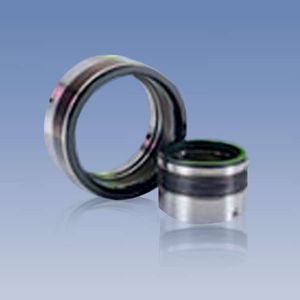
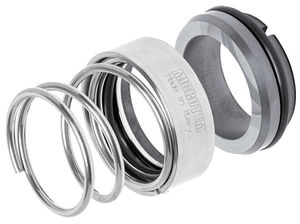
Mechanical seals manufactured in a wide range of general services, made according to standard UNI EN 12756 (ex DIN 24960).
Using a conical spring is wound onto the shaft allows the seal to compensate greater positioning errors than usual and there is no risk of clogging when it is in contact with very dirty and/or viscous liquids.
This type of seal is available for both clockwise or anticlockwise shaft rotation.
|
|
H15/H16 Are single coil spring unbalanced seals, these seals are simple in design & reliable & rugged enough for the most difficult applications.
Designated as H15 & H16 for 'O' Rings & 'V' Packing used as Secondary seals respectively.
Special notches enhance the required driving torque & hence the seal is independent of direction of rotation. Non-clogging spring design enables these seals to be reliably used in situations involving abrasive, corrosive & viscous fluids generally handled by high Temperature pumps.
Applications :
Generally used in refineries, fertilizers, nuclear plants & petroleum pipelines.
Material :
Seal Faces : Carbon/TC/Sic. Vs Ceramic/RB Sic./TC
Secondary Seals : Viton/PTFE/GFT
Metal Components : SS-316
Operating Limits :
Shaft Dia. : 25 to 150mm
Pressure : up to 10 Bars
Temp. : -50 to 280°C
Speed : up to 15 m/s
|
|
Type B76 & B76W are single coil balanced mechanical seals, reliable & rugged enough for variety of applications.
Designated as B76 & B76W for 'O' Ring & PTFE wedge type Secondary Seals respectively. The balanced & unbalanced version can just be obtained by simply changing the carbon face assembled through circlip provided.
Non-clogging spring design enables these seals to be reliably used in situations involving abrasive, corrosive, and viscous media. generally handled by high-pressure pumps.
Applications :
Used in high pressure pumps, refineries, fertilizers, nuclear plants & petroleum products.
Material :
Seal Faces : Carbon Vs Sic./TC
Secondary Seals : Viton/PTFE/GFT
Metal Components : SS-316
Operating Limits :
Shaft Dia. : 10 to 150mm
Pressure : up to 30 Bars
Temp. : -50 to 180°C
Speed : up to 15 m/s
|
|
Spring Energized PTFE-Seals
The GFD spring energized PTFE seal is the newest generation of spring actuated Teflon seals. These seals consist of a special precision jacket/lip made of Teflon (or other high performance polymers) and a corrosion resistant stainless steel spring.
In this combination, the spring is forcing the seal lips against the gland and the rod walls. The pressure assists the spring force.
The spring compensates the lip wear, hardware tolerances, eccentricities and provides permanent resilience to the seal lips. The GFD design with sealing lip and spring arrangement guarantees more leakage protection than conventional lip seals.
More than 50 different PTFE compounds (and other high performance polymers) are available or can be composed for jacket fabrication within a very short time.
The standard designs cover radial and axial seals for dynamic as well as static applications.
|
|
OmniSeal® seals are high performance spring energized PTFE seals. These are capable of handling extreme service conditions and are used in a variety of applications, such on high temperature / high pressure (HTHP) Ball Valves, rocket and jet engines, robotics, racing cars, oil and gas applications and others.
>Temperature: -260°C to +300°C.
>Pressure: Vacuum to 10,000 bar.
>Surface speeds: 40m/s.
>Low and controlled friction, low wear.
>Broad chemical compatibility.
>High pressure and temperature combinations.
|
|
|
|