


{{product.productLabel}} {{product.model}}
{{#if product.featureValues}}{{product.productPrice.formattedPrice}} {{#if product.productPrice.priceType === "PRICE_RANGE" }} - {{product.productPrice.formattedPriceMax}} {{/if}}
{{#each product.specData:i}}
{{name}}: {{value}}
{{#i!=(product.specData.length-1)}}
{{/end}}
{{/each}}
{{{product.idpText}}}
{{product.productLabel}} {{product.model}}
{{#if product.featureValues}}{{product.productPrice.formattedPrice}} {{#if product.productPrice.priceType === "PRICE_RANGE" }} - {{product.productPrice.formattedPriceMax}} {{/if}}
{{#each product.specData:i}}
{{name}}: {{value}}
{{#i!=(product.specData.length-1)}}
{{/end}}
{{/each}}
{{{product.idpText}}}
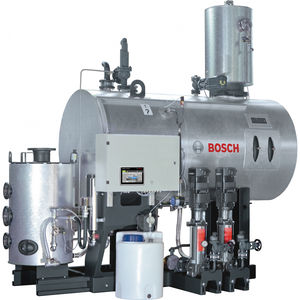

... Bosch Water service module WSM-V, WSM-T - Water treatment for steam boiler systems - Prevention of corrosion in the boiler - Outstanding deaeration efficiency and reduced consumption of chemicals with WSM-V complete deaeration system - Partial deaeration ...


... n the NETZSCH Vacuum De-Aerator, micronized gases are removed from fluids with a wide range of viscosities. By means of the VTR Principle (vacuum – thin-film – rotary process), it is possible to process products from offset ink and shampoo, ...


... deaerating system can help you with the precision deaeration of your beverage water. Using the two-stage, horizontal water deaerator this system provides you can also deaerate large quantities of water within the shortest space of time. ...
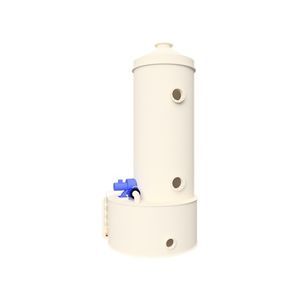

... Deaeration CD is a CO2 degasser that reduces dissolved carbon dioxide in water, enhancing filtration in demineralization units or dealkalisers. It uses atmospheric air, ensuring uninterrupted flow and no consumables Efficient CO₂ ...
GRUNDFOS

... Vacuum deaerators, also known as vacuum degasifiers, use a vertical pressure vessel, multiple vacuum stages and vacuum pumps to continuously remove objectionable gases from liquids. Packed towers, supported by powerful vacuum pumps, ...

... Permutit Products deaerating heaters and L*A Water tray style deaerators are just perfect for people looking for trouble-free deaerating heaters. It would be the ideal choice for people looking for spare parts or internals if they want ...
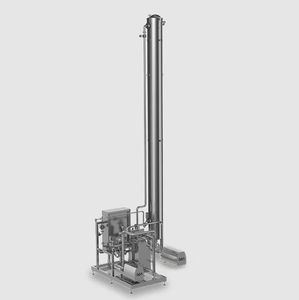

Oxygen in beer or beverages may increase product perishability and spoil taste, so using optimally deaerated water for beverage manufacture and for the redilution of beer can have an impact on final quality. The GEA VARIDOX-C cold water deaeration system ...
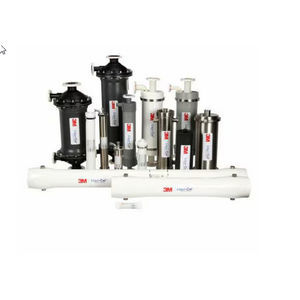

... Microporous hollow fiber membrane in hydrodynamically optimized contactor designs that enable rapid and efficient gas transfer performance Capable of achieving very low dissolved gas levels down to 1 ppb O2 and 0.5 ppm CO2 at outlet with proper ...
Solventum


... deaeration of liquid food products. Benefits Enhanced Aroma Recovery for Improved Product Quality The VFJ and VFN deaerators incorporate advanced adaptations—especially in aroma recovery—to meet the evolving demands of both new ...


The DR1000x and D2R15001x consist of one or two-welded sheet steel autoclaves, each. They feature high-quality vacuum seals, provided with transparent methacrylate lids, that can be manually eliminated. They also have oil-bath rotating vane pumps for ...
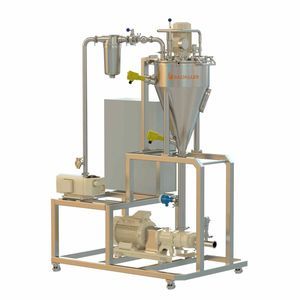

... The vacuum deaerator designed and manufactured by Bachiller is a specific equipment for the elimination of dissolved gases in liquids, semi-solids, and solids. The deaerator process allows the product to be distributed ...


... The model DG is a thermal deaerator for boiler's feed water . The deaerator is made of two parts: Boiler feed water tank and deaerating column for steam condensate recovery and make-up water, with deaerator ...
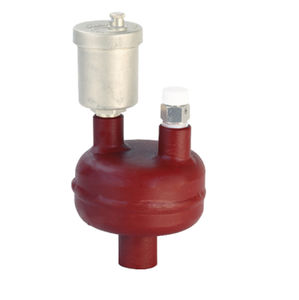

... The DEAERATOR is specifically used for eliminating air in heating systems. It can be fitted with automatic release and manual release. Tools and safety devices are not included. Material: carbon Steel EN 10255: Paint: water-based ...
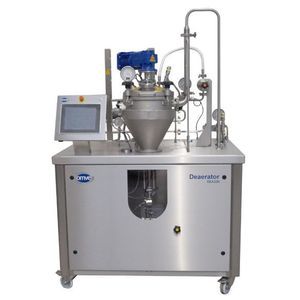

... Overview
The DEA220 is a batch
deaerator designed for pilot-scale and laboratory processing. It removes dissolved air and gases from liquid products using controlled vacuum and temperature to optimise downstream operations such ...

... quality
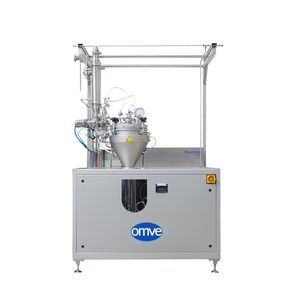
The DEA310 batch-
deaerator can be applied as a standalone system or prior to the heat treatment of your product. The benefits of deaeration include reduced oxidation and improved product shelf life. As such, a
deaerator ...
... The DEA320 inline deaerator is designed for the continuous deaeration of your product. By removing dissolved air and gas, deaerator systems play an important role in optimizing product conditions, reducing foaming and ...
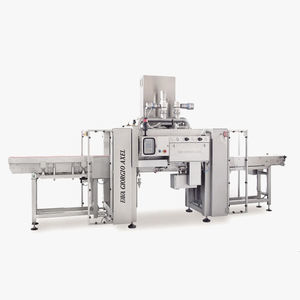

During molding, it is normal for air to be present between the parts that make up cooked ham, or similar products. The presence of air does not allow the parts to adhere, even with pressing, resulting in defects at slicing due to the presence of pockets ...
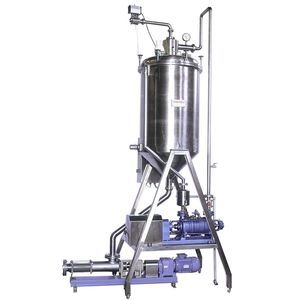

... For deaerating (degasing) in the product against color darkning. • Product contact points made of AISI 316 Cr-Ni st. Steel and the others made of AISI 304 Cr-Ni st. steel. • Conical bottom shaped. • Openable top cover with sealed and screwed. • Totally ...
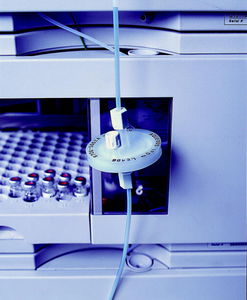

Whatman in-line filter/degassers (IFD) connect directly into an HPLC line to simultaneously filter and degas the mobile phase as it is being used. The Aqueous IFD provides pure filtration of aqueous based HPLC mobile phases. Specifically, the Aqueous ...


... Continuous Vacuum Deaerator is a totally compact sanitary device designed for the continuous automatic removal of air or other occluded gases from any type of liquid or paste, by means of vacuum. The PerMix PDA series Continuous Vacuum ...


... • Capacities up to 30.000 kg/hour* • From lab to industrial scale Functions: • vacuum deaeration Main applications: • mustard • paper coatings • honey • liquid detergents • carbomer suspensions • lubrication grease ...
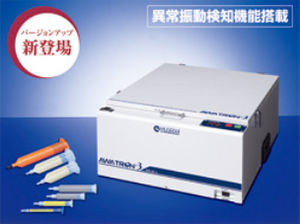

... Furthermore, it is easy to use and degases certain speedy! Overseas correspondence, 220-230V Specifications are lineups, too. ・When we put liquid materials in syringe, we occurred Syringe which removes bubble by centrifugal force It is business ...


The Degasser, developed by Eurowater, is specifically built suitable for pre-treatment of feed water for steam boilers. It can be insulated with mineral wool and covered with aluminium plates. The standard unit is specially constructed with compliance ...
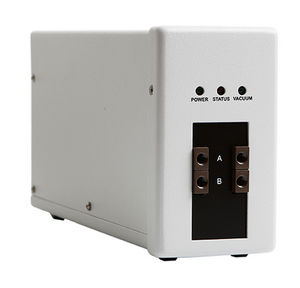

... degassing of the solvent.This small analytical 2-channel degasser is equipped with two degassing chambers and can thus degas two solvents simultaneously. In contrast to other degassers, this degasser is especially suitable ...


... with high density mineral wool and aluminium sheet finish The deaerator is available in the S235JR steel or AISI 304 stainless steel versions. Data concerning the feed water in the deaerator: - Inlet water pressure: ...
ICI POWERING EVOLUTION
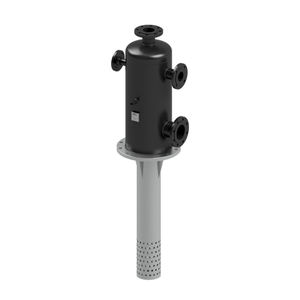

... The ADCATherm ADG series atmospheric semi- deaerators are designed to heat boiler feed water and to reduce oxygen and carbon dioxide (oxygen values in the feed water of less than 1,6 mg/L can be achieved). Remaining oxygen can be completely ...
VALSTEAM ADCA Engineering S.A.
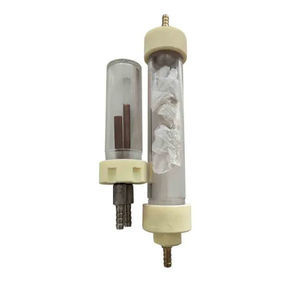

... Mud logging Ex proof Degasser Mud logging Ex proof Degasser for oil and gas exploration. CL-DT electric degasser has two types: CL-DT11 (220V motor) and CL-DT12 (380V motor). It is composed of air ...
the best suppliers