


{{product.productLabel}} {{product.model}}
{{#if product.featureValues}}{{product.productPrice.formattedPrice}} {{#if product.productPrice.priceType === "PRICE_RANGE" }} - {{product.productPrice.formattedPriceMax}} {{/if}}
{{#each product.specData:i}}
{{name}}: {{value}}
{{#i!=(product.specData.length-1)}}
{{/end}}
{{/each}}
{{{product.idpText}}}
{{product.productLabel}} {{product.model}}
{{#if product.featureValues}}{{product.productPrice.formattedPrice}} {{#if product.productPrice.priceType === "PRICE_RANGE" }} - {{product.productPrice.formattedPriceMax}} {{/if}}
{{#each product.specData:i}}
{{name}}: {{value}}
{{#i!=(product.specData.length-1)}}
{{/end}}
{{/each}}
{{{product.idpText}}}


... world of polishing machines that brings great advantages in terms of efficiency and increased productivity. Thanks to Breton Tetrix technology, you can finally polish slabs of different widths, one ...
Breton SpA | Advanced technologies and materials

Working width: 2,200 mm
Single head stone slab polishing machine Polishing machine with single head on mobile beam for marble, granite, engineered stone or ceramic slabs. Robustness, reliability, ...
Breton SpA | Advanced technologies and materials

Working width: 2,200 mm
Polishing machine with single head on mobile beam for marble, granite, engineered stone or ceramic slabs. This solution is characterised by ease of programming and automatic management of the work cycle ...
Breton SpA | Advanced technologies and materials


Working width: 1,810 mm
... with fewer tool changes and reduces polishing tool inventory and complexity. Multi-FLEX-2 lens polisher features an evolution polishing process for knife-edge lenses and a better polishing ...
Satisloh

Working width: 48 mm - 85 mm
... working range of Rx lenses Stable process and optimized lens surfacing quality due to its tangential polishing kinematics Equipped with polishing tool storage with LEDs that indicate wear and selection, ...
Satisloh

Working width: 1,810 mm
... entry-level lens polisher for mid-volume lens polishing. It simultaneously processes two lenses in two independently controlled polishing chambers. The lens polisher features a universal polishing ...
Satisloh


Working width: 250 mm - 300 mm
... and robust design featuring the latest technology delivers a more effcient, safe, and clean solution for your grinding and polishing needs. PX500 model has platen sizes: 250 and 300mm; delivered with five built-in peristaltic ...

Working width: 200 mm - 250 mm
... and robust design featuring the latest technology delivers a more effcient, safe, and clean solution for your grinding and polishing needs. •The Latest Technology Energy effcient AC drives and induction motors provide ...


... and surface polishing without micro-scratches for large parts as well. Reliable, precise and efficient, this technology sets new standards for surface quality and cost-effectiveness. HIGHLIGHTS OF THE EF-PERFORMANCE High-gloss ...

Electro Finishing Machine - EF-Flex Processing of delicate and intricate pieces of jewellery with complex geometries requires particularly gentle smoothing and polishing. The EF-Flex reaches a new dimension ...

The new OTEC EF-Smart is perfect for smoothing and polishing intricate jewellery. It polishes hard-to-reach inner contours without compromising intricate geometries. Finishing stone-set jewelry is easy in the EPAG-Smart. ...


Polishing Machine "LDT/1000" Special machine to polish small items: pipes, caps, rings etc., made of brass, steel, plexiglas etc. Functioning: The first piece is clamped between ...
SIBO engineering

POLISHING MACHINE "LDT/2500" Special machine to polish small items: pipes, caps, rings etc., made of brass, steel, plexiglas etc. Functioning: The first piece is clamped between 2 ...
SIBO engineering

CNC POLISHING MACHINE model "4LDQ/25" Machine with numerical control suitable to polish sheets and round, square, rectangular, oval bars, made of brass, steel, etc. Functioning: The ...
SIBO engineering


Working width: 300 mm
... frequency inverter thus improving machine output. -Selection of four different speeds to optimize working of the floor. -Machine level adjustment by eccentric wheel axis. -Transport handle and pivoting ...
Achilli s.r.l.

Grinding and polishing single phase machine specific for marble, terrazzo, concrete and similar floors. Advantages LM30-CE is a simple and powerful floor grinder, it is the most used single-phase ...
Achilli s.r.l.

... grinding of large surfaces: •2 heads to improve machine output. •Machine level adjustment by handwheel. •Machine lift by manual hydraulic pump. Technical details Power 5.5 kW ...
Achilli s.r.l.


Orbital polishing machine with buffing belts for grinding and finishing operations on straight, bent and shaped parts with round, oval, elliptical or irregular section, made of steel, brass, aluminum ...
GARBOLI

Orbital polishing machine with buffing belts for grinding and finishing operations on straight, bent and shaped parts with round, oval, elliptical or irregular section, made of steel, brass, aluminum ...
GARBOLI

Innovative machine for surface preparation and mirror polishing process on straight and bent tubes with special belts carrying liquid polishing paste.
GARBOLI


Machine for polishing, buffing, brushing and scotching of surfaces, such as stainless steel sinks, aluminum trim rails, wood trim parts and aluminum roof rails. The OMEGA in the one buff version is designed ...
IMM Maschinenbau GmbH

Machine for polishing, buffing, burnishing, gloss finishing, brushing and scotching of surfaces, such as stainless steel sinks, aluminum trim parts, wood trim parts and aluminum roof rails. The RHO is ...
IMM Maschinenbau GmbH

KAPPA F – PLC controlled copy table polishing machine Machine for polishing aluminum trim parts and various other trim rails.
IMM Maschinenbau GmbH


Working width: 203 mm
P-1 Metallgraphic Sample Polishing Machine Application: P-1 laboratory grinding machine/Metallographic Specimen grinding Polishing Machine ...


Working width: 0 mm - 4,000 mm
... field of automatic metal polishing with rotary table systems. Our C.N.C: type polishing units represent a technological evolution -entirely carried on and developed by C.O.S.M.A.P.- ...
COSMAP

This solution combines the rotary table’s characteristics with the possibility to add polishing units equipped with two mops. The mops can perform straight and oscillating movements controlled by two ...
COSMAP

This double-joined wheel CNC2 polishing unit is a further step towards the innovation and development of the already consolidated and renowned CNC polishing unit. The combination of ...
COSMAP


finish polishing & grinding machine Polished profitability. What are the benefits of using a grinding and polishing machine? Quite simply, it accelerates and completes ...


MLB is the new bilateral edge polishing machine that works simultaneously on both sides of the marble, granite and agglomerated materials. The standard model has 20 (10+10) spindles: 12 smoothing, 4 ...
Ferrari & Cigarini srl
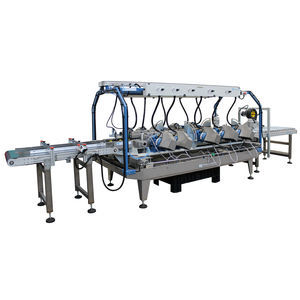
MWT is the new bilateral automatic machine for windowsills and thresholds that works simultaneously on both sides of the marble, granite and agglomerated materials. The standard model has 10 (5+5) spindles: 4 smoothing ...
Ferrari & Cigarini srl
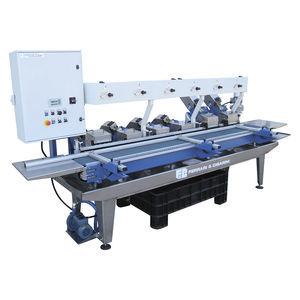
Working width: 350 mm
Machine to polish and bevel the edge of marble, granite, agglomerates. It is made of 4 polishing spindles and 2 spindles at 45° for chamfering. The spindles have a higher power and they are able to ...
Ferrari & Cigarini srl


ARBOGA PO 312 POLISHING MACHINE– designed for heavy-duty work! With its solid construction and powerful motor, the PO 312 Polisher from ARBOGA is the perfect polishing machine ...
Scantool Group
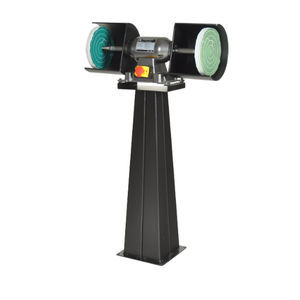
• Total encapsulated motor • Tapered spindle for quick change of polishing mops • Large polishing guards are standard according to CE regulation • Lockable safety switch with emergency stop • ...
Scantool Group

• Total encapsulated motor • Tapered spindle for quick change of polishing mops • Large polishing guards are standard according to CE regulation • Lockable safety switch with emergency stop • ...
Scantool Group


... 1. Grinding Wheel- for Polishing 2 PCS 2. Grinding Wheel- for Grease Dirt 2 PCS 3. Grinding Wheel- for Rust 2 PCS 4. Transformer-1 SET 5. 6mm Chuck-1 PC 6. Chuck Wrench-1 PC Optional Accessories: 1. Grinding Wheel- for ...
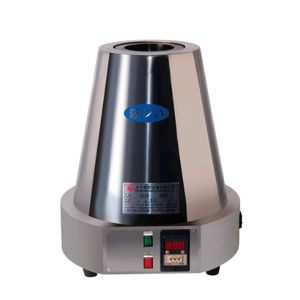
1. Extend tool holder life. 2. Increase tool holder accuracy. 3. Polish & clean the grease and dirt on holder. 4. One setting for the maximum convenience of operation.
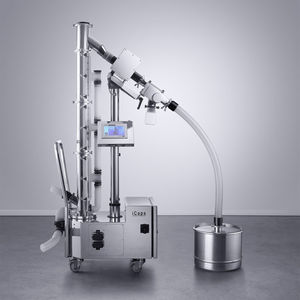

... Central HMI with OPC UA, CFR 21 Part 11 compliant The modular design offers 4 different conveying heights: 1000, 1400, 1800, and 2200mm. Each section includes a rotating brush, specifically designed for capsule elevation, ...
Pharma Technology
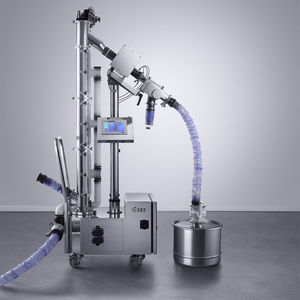
The iCaps range offers great flexibility, enhanced output, and superior polishing efficiency. Thanks to its modular design, the iCaps is customizable to meet specific customer requirements. Key benefits • Operator ...
Pharma Technology
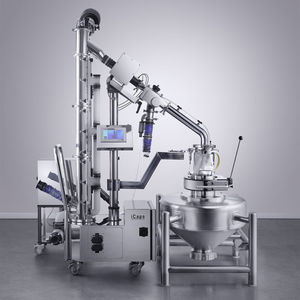
The iCaps range offers great flexibility, enhanced output, and superior polishing efficiency. Thanks to its modular design, the iCaps is customizable to meet specific customer requirements. Key benefits • Operator ...
Pharma Technology
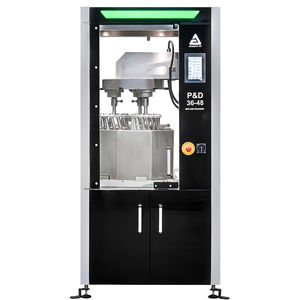

... is easy to operate and do not require high-level qualifications. Highlights of Pharma P&D 36-48 polishing machine Pharma P&D automatic polishing process allows to obtain the highest ...


Exclusive BOX methacrylate polishing machine with reduced dimensions capable of achieving high-quality finishes. The BOX is a portable desktop machine created for polishing ...
BERMAQ

Working width: 11 mm
... acrylic bevelling machine PRISMA for polishing angled edges at 44° and 45° of small pieces with a high-quality finish. Portable tabletop machine with vacuum system for continuous chip ...
BERMAQ

... Elements for stands Gifts and jewellery Machine designed for the machining and polishing of methacrylate PMMA workpieces. This model appeals to the user that requires a flexible ...
BERMAQ


... and rpm settings Polishing Head Independent Powered Polish Head Digital Timer 1 ¼” holder comes with Machine as a Standard Single Speed AC Motor (220 V, 40W, 100 RPM) Machine ...
TECNIMETAL

Metal Polishing machine TEKNIPOL DOUBLE DISC 0.5 HP high torque AC motor single phase input 220v/50Hz or 110v/60Hz Imported AC Drive 8" disc dia. standard 10" & 12" dia options Feather touch control 50 ...
TECNIMETAL

Metal polishing machine TEKNIPOL DOUBLE DISC AD. 12" disc dia, 8" & 10" dia option 0.5 HP AC motors Single Phase input Variable speed AC drive 50 - 600 RPM Individual drive for high power Storage ...
TECNIMETAL
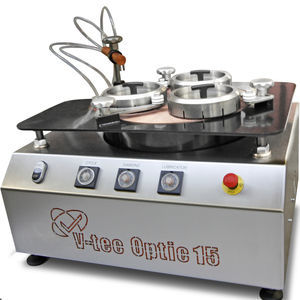

Working width: 140, 125 mm
The Ventil OPTIC 15 open face, flat lapping and polishing machine is the complete solution for high precision finishing of safety valve seats, nozzles and mechanical seals. The bench top machine ...
Ventil Test Equipment BV

Working width: 220, 248 mm
The Ventil OPTIC 24 open face, flat lapping and polishing machine is the complete solution for high precision finishing of safety valve seats, nozzles and mechanical seals. The bench top machine ...
Ventil Test Equipment BV
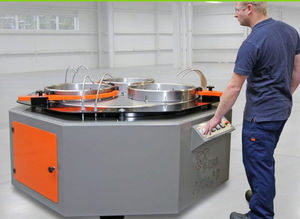
Working width: 380, 350 mm
The Ventil OPTIC 36 open face, flat lapping and polishing machine is the complete solution for high precision finishing of safety valve seats, nozzles and mechanical seals. The machine ...
Ventil Test Equipment BV


... leading polishing philosophy, based on programmable electronic polishing by numerical control, is born and applied to the PULIPROM machine. For the first time, a polishing ...
MEPSA


Working width: 360 mm
Precision four-station CMP polishing machine ●Can be installed and customized according to actual needs ● The polishing disc and four polishing heads are independently ...


... this machine reflects “Swiss made” know-how, high quality and aesthetics. By virtue of its kinematics and design, our single-sided equipment PB 304 SF can obtain perfectly flat surfaces with a remarkable polish quality ...

... undergoing thickness setting on the machine exhibit excellent geometric stability in the subsequent machining phases. The dynamic design of the chassis, along with the latest drive technologies, ensure ...


The Polini is a reliable polishing unit with one spindle for polishing brushes (2900rpm), dust extraction and a transparten cover.
Elma Schmidbauer GmbH


... processes. From grinding to mirror finishing, this new set-up offers a new easy way to process any casting, sintering or milling metal parts CHARACTERISTICS Based on DryLyte dry electrochemistry technology Retains ...
Groupe Recomatic

... 3 types of machine Types of machine H (low frequency) - steel and chromium-cobalt HF (high frequency) - steel and titanium H+HT (low and high frequency - steel, chromium-cobalt and titanium Technical ...
Groupe Recomatic

The DLytePRO is the most advanced, powerful and versatile of electrolysis surface finishing machines and is specially designed for mass production.. They use the DryLyte tchnique, dry electro-finishing, enabling workpieces ...
Groupe Recomatic


... this goal with our unique, comprehensive scope of high-precision processing double sided honing machines. The high productivity double-sided lapping machines of the Peter Wolters AC microLine® range display ...
Lapmaster Wolters GmbH

The high productivity double-sided polishing machines of the Peter Wolters AC microLine® range display state-of-the-art design and concept. The modular system of main components together with the precision ...
Lapmaster Wolters GmbH
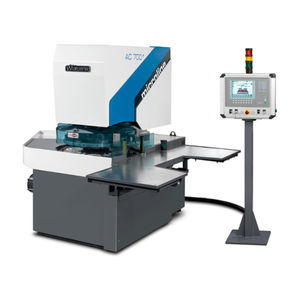
The high productivity double-sided polishing machines of the Peter Wolters AC microLine® range display state-of-the-art design and concept. The modular system of main components together with the precision ...
Lapmaster Wolters GmbH
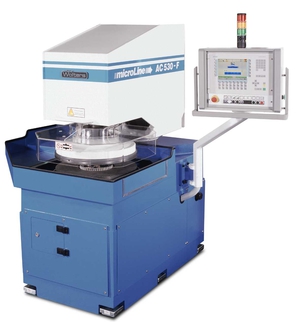
A polishing machine smooths the surfaces of a product. The process can use abrasion or work hardening methods to furnish a surface meeting aesthetic or technical requirements.
ApplicationsThese machines are used in gold and silver smithing, iron working, foundries and woodworking, as well as in optical and medical domains.
TechnologiesVarious polishing techniques are employed. Machines use vibrations, centrifugal force, abrasive discs and belts and different kinds of polishing compounds.
How to chooseChoice will depend on the shape of the product to be polished and the degree of smoothness required.
Please specify:
Help us improve:
remaining