

- Metrology - Laboratory
- Metrology and Test Equipment
- Manual hardness tester
- ERICHSEN GmbH & Co. KG

- Company
- Products
- Catalogs
- News & Trends
- Exhibitions
Buchholz hardness tester Model 263manual

Add to favorites
Compare this product
Characteristics
- Type
- Buchholz
- Mounting
- manual
- Load
Min.: 0.5 kgf
Max.: 0.505 kgf
- Useful height
Min.: 40 mm
(1.6 in)Max.: 40 mm
(1.6 in)- Useful width
Min.: 50 mm
(2 in)Max.: 50 mm
(2 in)- Weight
Min.: 1 kg
(2.2 lb)Max.: 1 kg
(2.2 lb)
Description
Short description
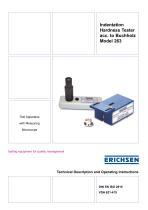
The Indentation Hardness Tester Model 263 performs the Buchholz impression hardness test: a defined impression body acts on the coating under a specified load and time, and the resulting impression length is measured with a microscope to calculate hardness and approximate impression depth.
Principle and evaluation
The test measures the impression length l (mm) after a prescribed recovery time. From l the following values are derived:
Application range
The method is applicable under the following conditions:
Design
Model 263 comprises a metal block containing two pointed support feet and a carbide-steel impression body in the form of a wheel with a blade-type edge ground to 120°. The total instrument mass is 1000 ± 5 g. The test load is set between 4.90 N and 4.95 N (equivalent to 500–505 g) to meet relevant standards. A measuring microscope with 20× magnification, integrated illumination and a 4 mm measuring range with 0.1 mm reticle is supplied.
Test procedure
Typical test steps:
Reference class / certificate
Model 263 is supplied with a Manufacturer's Certificate M (factory calibration) documenting actual and setting values for the impression body (diameter, thickness, cutting angle, cutting radius, test load, material hardness, surface roughness), product identification, calibration status of test equipment, date and inspector name. The loading weight is adjusted to (500 ± 5) g.
Scope of delivery
Standards
Technical data / specifications
The Indentation Hardness Tester Model 263 performs the Buchholz impression hardness test: a defined impression body acts on the coating under a specified load and time, and the resulting impression length is measured with a microscope to calculate hardness and approximate impression depth.
Principle and evaluation
The test measures the impression length l (mm) after a prescribed recovery time. From l the following values are derived:
- Buchholz indentation hardness = 100 / l
- Approx. depth of impression (μm) = 8 × l²
Application range
The method is applicable under the following conditions:
- Coating must be even, smooth and clean on a level substrate that will not yield under the test force.
- Coating thickness must exceed the calculated impression depth by at least 10 μm.
- For comparison tests use specimens with equal coating thickness and identical conditioning and ambient test conditions.
Design
Model 263 comprises a metal block containing two pointed support feet and a carbide-steel impression body in the form of a wheel with a blade-type edge ground to 120°. The total instrument mass is 1000 ± 5 g. The test load is set between 4.90 N and 4.95 N (equivalent to 500–505 g) to meet relevant standards. A measuring microscope with 20× magnification, integrated illumination and a 4 mm measuring range with 0.1 mm reticle is supplied.
Test procedure
Typical test steps:
- Affix the supplied adhesive template so the circular cut-out marks the impression position and the microscope can be positioned at right angles to the impression.
- Level the specimen and position the instrument so the support points align with the template centres.
- Lower the instrument slowly so the impression body contacts the specimen without impact; after 30 ± 1 s lift vertically.
- 35 ± 5 s after lift-off measure the impression length with the microscope using the integrated illumination and reticle alignment.
- Check the indentation visually to confirm method applicability, then calculate impression depth and Buchholz hardness from the measured length.
Reference class / certificate
Model 263 is supplied with a Manufacturer's Certificate M (factory calibration) documenting actual and setting values for the impression body (diameter, thickness, cutting angle, cutting radius, test load, material hardness, surface roughness), product identification, calibration status of test equipment, date and inspector name. The loading weight is adjusted to (500 ± 5) g.
Scope of delivery
- Indentation Hardness Tester acc. to Buchholz, Model 263
- Measuring microscope (20×, integrated illumination)
- Spirit level
- Adhesive templates
- Plastic case
- Operating instructions
- Manufacturer's Certificate M
Standards
- DIN EN ISO 2815
- VDA 621-415
Technical data / specifications
- Model: Model 263
- Order number: 00580131
- Drive: Manual
- Instrument dimensions (L×W×H): approx. 100 mm × 50 mm × 40 mm
- Instrument net weight: approx. 0.2 kg (instrument body) / total mass 1000 ± 5 g
- Test load / loading weight: set to 4.90–4.95 N (500–505 g)
- Impression body: carbide steel wheel, blade-type edge ground to 120°
- Measuring microscope: 20× magnification, integrated illumination, measuring range 4 mm, reticle 0.1 mm
- Scope of delivery: instrument, microscope, spirit level, adhesive templates, plastic case, operating instructions, certificate
Catalogs
Other ERICHSEN GmbH & Co. KG products
Hardness / Scratch Hardness


Related Searches
- ERICHSEN testing machine
- Measuring device
- ERICHSEN test chamber
- Test stand
- ERICHSEN temperature test chamber
- ERICHSEN material testing machine
- ERICHSEN automatic testing machine
- ERICHSEN hardness tester
- ERICHSEN climate chamber
- ERICHSEN quality control test chamber
- PC-controllable testing machine
- ERICHSEN portable tester
- ERICHSEN humidity test chamber
- ERICHSEN environmental test chamber
- Digital testing system
- Benchtop indentation hardness tester
- ERICHSEN industrial testing machine
- ERICHSEN vertical testing machine
- Automatic test stand
- Tensile test machine
*Prices are pre-tax. They exclude delivery charges and customs duties and do not include additional charges for installation or activation options. Prices are indicative only and may vary by country, with changes to the cost of raw materials and exchange rates.