


- Metrology - Laboratory
- Metrology and Test Equipment
- Multi-parameter testing machine
- ERICHSEN GmbH & Co. KG
Multi-parameter testing machine Model 161pressure dropdeformationautomatic


Add to favorites
Compare this product
Characteristics
- Test type
- multi-parameter, pressure drop, deformation
- Operating mode
- automatic, PLC-controlled
- Test material
- for sheet metal
- Sector
- industrial, for laboratory, for research and development, for the automotive industry, for quality control
- Technology
- hydraulic
- Other characteristics
- with touchscreen
Description
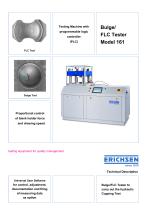
The Model 161 Bulge/FLC tester is an electro-hydraulic testing machine that is used to carry out hydraulic cupping tests on all ferrous and non-ferrous metals. Samples up to 400 x 650 mm in size can be tested. In addition to the actual hydraulic forming, its construction also enables it to be used with ball stamps (FLC) of any diameter from 100 to 199 mm.
The hydraulic cylinder, the hydraulic aggregate as well as the control devices are housed within the body of the machine.
The four-column frame with integrated test tool, allows the test of specimens up to a size of 400 x 650 mm.
The Bulge-/FLC Tester, Model 161, with programmable logic controller (PLC) is provided with a maximum drawing force (bulge force) of 1,000 kN . The bulge diameter is max. 200 mm. The control of the maximum drawing speed is effected via a proportional distribution valve with pressure balance. The blank holder force of max. 1,000 kN is infinitely variable and is controlled by a proportional pressure regulating valve. The clamping stroke is 180 mm.
The Bulge-/FLC Tester, Model 161, is equipped with analogue outputs for data acquisition when using an own evaluation systems. The captured data of drawing force and blank holder force can be processed in this way by a separate evaluation unit.
For safety reasons the test area of the Bulge-/FLC Tester, Model 161, is provided with high-rigidity, transparent protective lids. The Testing Machine can only be started, when all protective lids are closed and thus it is no longer possible to reach into the tool area.
Purpose and Application
Operating the Bulge/FLC tester, model 161, is very simple. After the specimen has been placed into the test head, the hydraulic system is started with the help of a push button whereupon in the first instance the test panel is clamped tightly. Thereafter the drawing piston moves upwards and presses the quantity of oil that is located between the piston and the test panel, into the direction of the test panel so that the specimen is formed into a spherical bulge.
The automatic crack detection can be activated by using the “crack switch.
At specimen failure the drawing piston is stopped by way of the crack detection automatism and returns into its starting position. Since the crack detection automatism acts on a retrograde signal, it is possible that the sheet metal panel tested does not yet show a fracture, especially in the case of thick material. With the help of a time lag relay the switching-off can be delayed until the fracture occurs.
The acquisition and evaluation of the measuring points on the bulge surface can be carried out by optical evaluation systems like Aramis from GOM or Auto Grid from VIALUX.
The hydraulic cylinder, the hydraulic aggregate as well as the control devices are housed within the body of the machine.
The four-column frame with integrated test tool, allows the test of specimens up to a size of 400 x 650 mm.
The Bulge-/FLC Tester, Model 161, with programmable logic controller (PLC) is provided with a maximum drawing force (bulge force) of 1,000 kN . The bulge diameter is max. 200 mm. The control of the maximum drawing speed is effected via a proportional distribution valve with pressure balance. The blank holder force of max. 1,000 kN is infinitely variable and is controlled by a proportional pressure regulating valve. The clamping stroke is 180 mm.
The Bulge-/FLC Tester, Model 161, is equipped with analogue outputs for data acquisition when using an own evaluation systems. The captured data of drawing force and blank holder force can be processed in this way by a separate evaluation unit.
For safety reasons the test area of the Bulge-/FLC Tester, Model 161, is provided with high-rigidity, transparent protective lids. The Testing Machine can only be started, when all protective lids are closed and thus it is no longer possible to reach into the tool area.
Purpose and Application
Operating the Bulge/FLC tester, model 161, is very simple. After the specimen has been placed into the test head, the hydraulic system is started with the help of a push button whereupon in the first instance the test panel is clamped tightly. Thereafter the drawing piston moves upwards and presses the quantity of oil that is located between the piston and the test panel, into the direction of the test panel so that the specimen is formed into a spherical bulge.
The automatic crack detection can be activated by using the “crack switch.
At specimen failure the drawing piston is stopped by way of the crack detection automatism and returns into its starting position. Since the crack detection automatism acts on a retrograde signal, it is possible that the sheet metal panel tested does not yet show a fracture, especially in the case of thick material. With the help of a time lag relay the switching-off can be delayed until the fracture occurs.
The acquisition and evaluation of the measuring points on the bulge surface can be carried out by optical evaluation systems like Aramis from GOM or Auto Grid from VIALUX.
VIDEO
Catalogs
Exhibitions
Meet this supplier at the following exhibition(s):


Other ERICHSEN GmbH & Co. KG products
Sheet metal testing


Related Searches
- ERICHSEN testing machine
- Measuring device
- ERICHSEN test chamber
- Test stand
- ERICHSEN temperature test chamber
- ERICHSEN material testing machine
- ERICHSEN automatic testing machine
- ERICHSEN hardness tester
- ERICHSEN climate chamber
- ERICHSEN quality control test chamber
- PC-controllable testing machine
- ERICHSEN portable tester
- ERICHSEN humidity test chamber
- ERICHSEN environmental test chamber
- Digital testing system
- Benchtop indentation hardness tester
- ERICHSEN industrial testing machine
- ERICHSEN vertical testing machine
- Automatic test stand
- ERICHSEN industrial tester
*Prices are pre-tax. They exclude delivery charges and customs duties and do not include additional charges for installation or activation options. Prices are indicative only and may vary by country, with changes to the cost of raw materials and exchange rates.
About DirectIndustry
DirectIndustry is a marketplace that offers B2B players a complete experience, from product sourcing to purchase. DirectIndustry is an entity of VirtualExpo Group.
Are you a buyer?
Are you a supplier?