

- Power Transmission - Mechanical components
- Actuator and Positioning System
- Valve solenoid
- Weilong Intelligent Technology (Dongguan) Co., Ltd.


- Company
- Products
- Catalogs
- News & Trends
- Exhibitions
Valve solenoid WL0916linearlockingminiature


Add to favorites
Compare this product
Characteristics
- Type
- linear, for solenoid valves, locking
- Other characteristics
- compact, miniature, small, IP65, tubular, IP40, push-pull, DC
- Voltage
9 V
- Force
0.1 kgf
- Stroke
2.7 mm
(0.11 in)
Description
Overview
Micro tubular solenoids are compact electromagnetic actuators that convert electrical energy into precise linear motion. The WL0916 reference denotes a tubular construction with typical dimensions and small stroke suitable for confined assemblies where repeatable push/pull actuation is required.
Key product description
Available in push and pull variants, these solenoids feature a seamless tubular steel case, precision-wound copper coil, stainless steel plunger with anti-friction coating, and an internal return spring. Typical electrical options span DC 3 V to 24 V and duty cycles from intermittent to continuous (model dependent). Units can be produced with environmental sealing up to IP67 and to ISO 9001 traceability standards.
Features
Product Details (functional highlights)
Applications
Advantages & Disadvantages
Pros
Cons
Troubleshooting & Maintenance
Common checks: verify supply voltage and wiring if no movement; measure coil resistance and inspect for obstructions if stroke is limited; check duty cycle and ventilation for overheating; confirm secure electrical connections for intermittent faults; clean tube and inspect spring/plunger alignment if sticking occurs. Preventive maintenance: operate within rated voltage/duty, keep unit free of debris, avoid side loads, and periodically verify coil resistance and temperature.
Product Datasheet summary
Technical specifications
Micro tubular solenoids are compact electromagnetic actuators that convert electrical energy into precise linear motion. The WL0916 reference denotes a tubular construction with typical dimensions and small stroke suitable for confined assemblies where repeatable push/pull actuation is required.
Key product description
Available in push and pull variants, these solenoids feature a seamless tubular steel case, precision-wound copper coil, stainless steel plunger with anti-friction coating, and an internal return spring. Typical electrical options span DC 3 V to 24 V and duty cycles from intermittent to continuous (model dependent). Units can be produced with environmental sealing up to IP67 and to ISO 9001 traceability standards.
Features
- Small envelope: common case diameters 6–20 mm (example units from 8 mm).
- Customizable stroke: typical 2–5 mm, model-dependent up to ~15 mm.
- Voltage range: DC 3 V, 6 V, 9 V, 12 V, 24 V (tolerance ±10% where specified).
- Duty options: intermittent or continuous (verify thermal limits for continuous use).
- Plunger: stainless steel with anti‑friction coating; materials rated for elevated temperatures (insulation Class F up to 155°C for some designs).
- Sealing: options from IP40 to IP67 for harsh or washdown environments.
- Long life designs: target lives from 200,000 cycles to 1,000,000+ cycles depending on duty management.
Product Details (functional highlights)
- Construction: seamless tubular case (high-nickel or high-carbon steel), copper coil, movable plunger, internal return spring.
- Motion: precise straight-line actuation with low side-load when aligned.
- Magnetic circuit: tubular design concentrates flux for improved force-to-size ratio.
- Configurations: push (plunger extends when energized) or pull (plunger retracts when energized).
- Terminations: bare leads, JST/Molex connectors, PCB pins or custom terminations.
Applications
- Medical devices: infusion pumps, surgical instruments, ventilators, diagnostic equipment requiring precise, cleanable actuation.
- Industrial automation: miniature valve actuation, safety locks, pick-and-place, compact mechanisms.
- Automotive: door locks, transmission/fuel modules, EV charging locks and small actuated mechanisms.
- Aerospace & defense: lightweight actuation for avionics and satellite mechanisms.
- Security: electronic locks, safes, access control systems.
Advantages & Disadvantages
Pros
- High force-to-size thanks to tubular magnetic circuit.
- Precise, repeatable stroke and positioning.
- Suitable material and sealing options for harsh environments.
- Low power consumption relative to provided actuation when correctly specified.
Cons
- Limited stroke compared with pneumatic cylinders or linear motors.
- Heat buildup under continuous high-duty operation; requires thermal consideration.
- Force decreases with increasing plunger extension (force vs. stroke characteristic).
- Possible magnetic interference near ferrous components unless shielded.
- Audible click on actuation may be unsuitable for noise-sensitive applications.
Troubleshooting & Maintenance
Common checks: verify supply voltage and wiring if no movement; measure coil resistance and inspect for obstructions if stroke is limited; check duty cycle and ventilation for overheating; confirm secure electrical connections for intermittent faults; clean tube and inspect spring/plunger alignment if sticking occurs. Preventive maintenance: operate within rated voltage/duty, keep unit free of debris, avoid side loads, and periodically verify coil resistance and temperature.
Product Datasheet summary
- Typical case diameters: 6 mm – 20 mm (example series from 8 mm).
- Typical stroke options: 2 mm – 5 mm (design-dependent; some up to ~15 mm).
- Voltage range: DC 3 V to 24 V (model-dependent).
- Sealing options: IP40 to IP67.
- Insulation/temperature: Class F materials available (up to 155°C for some components).
Technical specifications
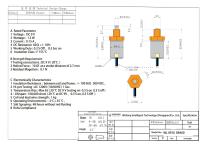
- Model: WL0916 (product family reference).
- Example dimensions: Ø9.5 × 16 mm.
- Example plunger diameter: Ø2.8 mm.
- Example rated voltage: DC 9 V.
- Example stroke: 2.7 mm.
- Example force: 10 gf (model-dependent).
- Example power: 1.3 W; example current: 0.15 A; example resistance: 60 Ω.
- Working duty example: continuous (verify specific part rating); rated life example: ≥200,000 cycles (some designs 1,000,000+ with correct duty control).
- Materials: seamless tubular steel case, copper coil, stainless steel plunger with anti-friction coating, return spring.
- Standards & options: ISO 9001 production, RoHS/REACH, UL and medical-grade traceability available for specific variants.
VIDEO
Catalogs
Other Weilong Intelligent Technology (Dongguan) Co., Ltd. products
Linear Solenoid


Related Searches
- Actuator
- Linear actuator
- Electric actuator
- Compact actuator
- Industrial actuator
- DC actuator
- Electromagnet
- Rotary actuator
- 24 V actuator
- 12 V actuator
- Linear electromagnet
- DC electromagnet
- Actuator for medical applications
- ISO actuator
- Voltage solenoid
- Compact electromagnet
- Holding electromagnet
- 24-volt electromagnet
- Single-acting actuator
- Electromagnetic electromagnet
*Prices are pre-tax. They exclude delivery charges and customs duties and do not include additional charges for installation or activation options. Prices are indicative only and may vary by country, with changes to the cost of raw materials and exchange rates.
About DirectIndustry
DirectIndustry is a marketplace that offers B2B players a complete experience, from product sourcing to purchase. DirectIndustry is an entity of VirtualExpo Group.
Are you a buyer?
Are you a supplier?