

- Hydraulics - Pneumatics
- Valve
- Direct-operated solenoid valve
- Weilong Intelligent Technology (Dongguan) Co., Ltd.


- Company
- Products
- Catalogs
- News & Trends
- Exhibitions
Direct-operated solenoid valve WL1033normally closedfor waterbrass


Add to favorites
Compare this product
Characteristics
- Control
- direct-operated
- Function
- normally closed
- Medium
- for water
- Body
- stainless steel, brass
- Other characteristics
- corrosion-resistant, electromagnetic, spring
- Voltage
12 V
- Temperature
Min.: 1 °C
(34 °F)Max.: 75 °C
(167 °F)- Pressure
Min.: 0.2 bar
(2.9 psi)Max.: 5 bar
(72.5 psi)
Description
Overview
The WL1033 drip irrigation solenoid valve is an electronically actuated valve designed to control water delivery in drip irrigation systems. Rated DC 12V and normally closed, it opens when the coil is energized and closes on de-energization. Built for precise zone control, the WL1033 supports automatic scheduling with timers, controllers and sensors to improve irrigation efficiency and uniform plant development.
Key Features & Benefits
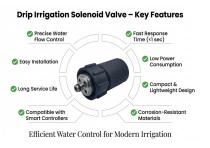
Compact footprint for installation in confined manifolds or inline assemblies; fast response time with low power draw suitable for DC/solar systems; corrosion-resistant materials for outdoor and agricultural use; wide controller compatibility for programmable irrigation sequences; helps reduce water waste and optimize irrigation scheduling.
Applications
Applicable to vegetable and row-crop irrigation, greenhouses, nurseries, orchards, vertical farming systems, sports turf and commercial/residential drip networks. Typical uses include zone-based scheduling, greenhouse moisture control integrated with climate systems, and farm automation projects.
How It Works
Advantages
Limitations / Problems
Troubleshooting Guide (Common Faults & Remedies)
Technical Datasheet (table)
Product name: Drip Irrigation Solenoid Valve
Model: WL1033
Rated Voltage (V): DC 12V
Type: Normally closed
Response Time (ms): on ≤ 0.15; off ≤ 0.5
Working Pressure (MPa): 0.02–0.5
Flow Characteristics: 0.05 MPa ≥ 3 L/min; 0.1 MPa ≥ 5 L/min; 0.8 MPa ≥ 7 L/min
Medium Temperature (℃): 1–75
Media: Water
Coil Resistance (Ω): 27 Ω ± 0.5
Lifespan (cycles): ≥ 500,000
Application: vegetable irrigation valve, etc.
Material: stainless threads, POM body parts, brass solenoid
How to Choose
Match required flow rate and working pressure; size inlet/outlet to piping to avoid unnecessary pressure loss; select correct voltage (DC for battery/solar systems, AC where mains supply is used); verify maximum pressure rating exceeds system pressure; prefer corrosion-resistant materials (brass, stainless steel, high-grade plastics) for outdoor use; assess water quality and install filtration upstream if necessary. Normally closed valves are recommended for drip systems to reduce accidental water loss.
Technical Specifications
The WL1033 drip irrigation solenoid valve is an electronically actuated valve designed to control water delivery in drip irrigation systems. Rated DC 12V and normally closed, it opens when the coil is energized and closes on de-energization. Built for precise zone control, the WL1033 supports automatic scheduling with timers, controllers and sensors to improve irrigation efficiency and uniform plant development.
Key Features & Benefits
Compact footprint for installation in confined manifolds or inline assemblies; fast response time with low power draw suitable for DC/solar systems; corrosion-resistant materials for outdoor and agricultural use; wide controller compatibility for programmable irrigation sequences; helps reduce water waste and optimize irrigation scheduling.
Applications
Applicable to vegetable and row-crop irrigation, greenhouses, nurseries, orchards, vertical farming systems, sports turf and commercial/residential drip networks. Typical uses include zone-based scheduling, greenhouse moisture control integrated with climate systems, and farm automation projects.
How It Works
- Power on: current flows through the solenoid coil.
- Magnetic field: the energized coil creates a magnetic field.
- Plunger movement: magnetic force lifts the armature (plunger) to actuate the valve.
- Valve operation: the valve opens, allowing water to flow into the irrigation zone.
- Power off: return spring closes the plunger and stops flow.
Advantages
- Accurate on/off control for zoned drip irrigation.
- Ready for automation — compatible with timers, controllers and IoT/sensor systems.
- Efficient water use compared with manual valves.
- Fast electromagnetic actuation improves timing precision.
- Compact design for simple installation and wiring.
- Low power consumption — suited to DC/solar-powered installations.
Limitations / Problems
- Sensitivity to water quality — suspended solids and debris can clog pilot passages, diaphragms or damage seals.
Troubleshooting Guide (Common Faults & Remedies)
- Valve won’t open: verify power supply and controller output; measure coil resistance; inspect wiring; clean blocked inlet or diaphragm; confirm minimum operating pressure.
- Valve won’t close / leaks: remove debris from diaphragm; replace damaged diaphragm or worn seals/O-rings; tighten fittings; ensure controller is not continuously energizing the coil.
- Low/unstable flow: check and clean filters; flush lines; verify correct valve sizing for required flow; install pressure regulator if necessary.
- Buzzing/chattering: check supply voltage stability; tighten loose internal components; remove obstructions.
- Coil overheating: confirm correct coil voltage, check duty cycle and wiring for shorts, replace faulty coil if needed.
- Slow response: clean pilot passages; address low system pressure; replace worn internal parts (spring, diaphragm).
Technical Datasheet (table)
Product name: Drip Irrigation Solenoid Valve
Model: WL1033
Rated Voltage (V): DC 12V
Type: Normally closed
Response Time (ms): on ≤ 0.15; off ≤ 0.5
Working Pressure (MPa): 0.02–0.5
Flow Characteristics: 0.05 MPa ≥ 3 L/min; 0.1 MPa ≥ 5 L/min; 0.8 MPa ≥ 7 L/min
Medium Temperature (℃): 1–75
Media: Water
Coil Resistance (Ω): 27 Ω ± 0.5
Lifespan (cycles): ≥ 500,000
Application: vegetable irrigation valve, etc.
Material: stainless threads, POM body parts, brass solenoid
How to Choose
Match required flow rate and working pressure; size inlet/outlet to piping to avoid unnecessary pressure loss; select correct voltage (DC for battery/solar systems, AC where mains supply is used); verify maximum pressure rating exceeds system pressure; prefer corrosion-resistant materials (brass, stainless steel, high-grade plastics) for outdoor use; assess water quality and install filtration upstream if necessary. Normally closed valves are recommended for drip systems to reduce accidental water loss.
Technical Specifications
- Model: WL1033
- Rated Voltage: DC 12 V
- Type: Normally Closed
- Response Time: On ≤ 0.15 ms; Off ≤ 0.5 ms
- Working Pressure: 0.02–0.5 MPa
- Flow Rates: 0.05 MPa ≥ 3 L/min; 0.1 MPa ≥ 5 L/min; 0.8 MPa ≥ 7 L/min
- Medium Temperature Range: 1–75 ℃
- Media: Water
- Coil Resistance: 27 Ω ± 0.5
- Lifespan: ≥ 500,000 cycles
- Materials: stainless threads, POM, brass solenoid
VIDEO
Catalogs
Other Weilong Intelligent Technology (Dongguan) Co., Ltd. products
Medical Valve


Related Searches
- Valve
- Hand valve
- Control valve
- Stainless steel valve
- Water valve
- Threaded valve
- Electrically operated valve
- Regulating valve
- Valve with flange
- Stop valve
- Electric valve
- Gas solenoid valve
- 2/2-way solenoid valve
- Normally closed solenoid valve
- Directional control valve
- Direct-acting solenoid valve
- Metal solenoid valve
- Valve for industrial applications
- Steel valve
- Oil valve
*Prices are pre-tax. They exclude delivery charges and customs duties and do not include additional charges for installation or activation options. Prices are indicative only and may vary by country, with changes to the cost of raw materials and exchange rates.
About DirectIndustry
DirectIndustry is a marketplace that offers B2B players a complete experience, from product sourcing to purchase. DirectIndustry is an entity of VirtualExpo Group.
Are you a buyer?
Are you a supplier?