

- Electricity - Electronics
- Electronic Component
- Ferrite inductor
- Weilong Intelligent Technology (Dongguan) Co., Ltd.


- Company
- Products
- Catalogs
- News & Trends
- Exhibitions
Wire-wound inductor WL1210ferritemagneticferrite core

Add to favorites
Compare this product
Characteristics
- Technology
- wire-wound, ferrite, magnetic, ferrite core
- Electrical characteristics
- RF, RFI, high-frequency, EMI, inductive
- Configuration
- through-hole type
- Applications
- for telecom applications, EMI suppression, for industrial applications, for electronics, for automotive applications
- Other characteristics
- epoxy resin, copper, enameled round copper wire, copper wire
Description
Product Overview
Ferrite rod and coil assemblies are precision magnetic components designed to provide stable inductance and efficient signal transmission in compact electronic systems. The ferrite rod concentrates magnetic flux, increasing coil inductance and enabling smaller component sizes. Coils are produced by winding enameled copper wire around high-quality ferrite rods with controlled electrical characteristics.
How it works
The ferrite rod and coil operate on electromagnetic induction: current in the copper winding creates a magnetic field concentrated by the ferrite material, increasing magnetic flux and coil inductance. For antenna applications, incoming electromagnetic waves induce variable magnetic fields around the ferrite rod, which generate electrical signals in the coil for subsequent electronic processing. The ferrite core reduces energy loss, improves frequency response and reduces electromagnetic interference. Final performance depends on number of turns, ferrite grade and operating frequency.
Key Features
Applications
Advantages & Disadvantages
Troubleshooting / Common Issues
Product Datasheet (summary)
Item / Description
Ferrite Coil Inductor / Enameled copper wire
Wire Diameter / 0.1 mm (AWG options available)
Winding Type / Single-layer round or sectional winding
Core Material / Magnetic rod (ferrite)
Footprint length / 8 mm
Encapsulation / Optional varnish, epoxy or coating
Mounting / Through-foot or custom mounting
Electrical Specifications (Typical)
Parameter / Description
Inductance Range / 0.1 µH – 100 µH (customizable)
Inductance Tolerance / ±2%, ±5%, ±10%
DC Resistance (DCR) / Custom per design
Q Factor / High Q, optimized for frequency range
Self-Resonant Frequency / High, application-dependent
Operating Frequency / kHz to MHz range
Rated Current / Custom per design
Insulation Resistance / ≥100 MΩ
Technical characteristics / specifications
Ferrite rod and coil assemblies are precision magnetic components designed to provide stable inductance and efficient signal transmission in compact electronic systems. The ferrite rod concentrates magnetic flux, increasing coil inductance and enabling smaller component sizes. Coils are produced by winding enameled copper wire around high-quality ferrite rods with controlled electrical characteristics.
How it works
The ferrite rod and coil operate on electromagnetic induction: current in the copper winding creates a magnetic field concentrated by the ferrite material, increasing magnetic flux and coil inductance. For antenna applications, incoming electromagnetic waves induce variable magnetic fields around the ferrite rod, which generate electrical signals in the coil for subsequent electronic processing. The ferrite core reduces energy loss, improves frequency response and reduces electromagnetic interference. Final performance depends on number of turns, ferrite grade and operating frequency.
Key Features
- High magnetic permeability and inductance stability
- Compact structure and good electromagnetic coupling
- Low power loss and high frequency performance (kHz to MHz)
- Good temperature stability and mechanical strength
- High Q factor optimized per frequency range
- Customizable designs: ferrite material, rod dimensions, wire diameter, winding turns and electrical parameters
Applications
- RF receivers and AM antennas
- Wireless communication modules and antennas
- Sensors and detection equipment
- Industrial automation and control systems
- Electromagnetic filtering and inductive circuits in power electronics
- Medical equipment signal processing
- Automotive electronics and IoT devices
Advantages & Disadvantages
- Advantages: compact size with higher inductance, improved signal sensitivity, low electromagnetic energy loss, versatile customization and cost-effective ferrite materials
- Disadvantages: ferrite materials are relatively brittle and require careful mechanical protection; potential saturation at very high power levels if inappropriate ferrite grade is used
Troubleshooting / Common Issues
- Weak signal strength: check coil winding, ferrite integrity and installation
- Incorrect inductance: verify number of turns, wire diameter and ferrite selection
- Excess noise / interference: improve shielding, grounding and filtering
- Temperature-related performance changes: select ferrite grade suitable for operating temperature
- Mechanical damage: inspect for cracked ferrite rods and reinforce mounting
- Production variability: ensure consistent winding tension, material quality and QC tests
Product Datasheet (summary)
Item / Description
Ferrite Coil Inductor / Enameled copper wire
Wire Diameter / 0.1 mm (AWG options available)
Winding Type / Single-layer round or sectional winding
Core Material / Magnetic rod (ferrite)
Footprint length / 8 mm
Encapsulation / Optional varnish, epoxy or coating
Mounting / Through-foot or custom mounting
Electrical Specifications (Typical)
Parameter / Description
Inductance Range / 0.1 µH – 100 µH (customizable)
Inductance Tolerance / ±2%, ±5%, ±10%
DC Resistance (DCR) / Custom per design
Q Factor / High Q, optimized for frequency range
Self-Resonant Frequency / High, application-dependent
Operating Frequency / kHz to MHz range
Rated Current / Custom per design
Insulation Resistance / ≥100 MΩ
Technical characteristics / specifications
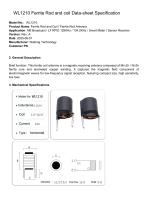
- Model: WL1210
- Core: ferrite magnetic rod (various ferrite grades available)
- Conductor: enameled copper wire
- Wire diameter: typically 0.1 mm (other AWG options available)
- Inductance: 0.1 µH – 100 µH (customizable)
- Tolerances: ±2%, ±5%, ±10%
- Operating frequency: kHz to MHz
- Insulation resistance: ≥100 MΩ
- Encapsulation options: varnish, epoxy or special coatings
- Mounting: through-foot or custom fixtures
- Customization: ferrite material, rod dimensions, wire diameter, winding turns, electrical tests and rated current per design
Catalogs
Other Weilong Intelligent Technology (Dongguan) Co., Ltd. products
Ferrite Coil


Related Searches
- Transformer
- Dry transformer
- Encapsulated transformer
- Power transformer
- Isolation transformer
- Transformer for industrial applications
- Compact transformer
- Choke coil
- Electrical power supply transformer
- Transformer with copper windings
- Frequency inductor
- Wire-wound inductor
- Current inductor
- Electronic transformer
- Transformer for photovoltaic applications
- DC inductor
- Magnetic inductor
- Electronic inductor
- Power inductor
- Wire-wound choke
*Prices are pre-tax. They exclude delivery charges and customs duties and do not include additional charges for installation or activation options. Prices are indicative only and may vary by country, with changes to the cost of raw materials and exchange rates.
About DirectIndustry
DirectIndustry is a marketplace that offers B2B players a complete experience, from product sourcing to purchase. DirectIndustry is an entity of VirtualExpo Group.
Are you a buyer?
Are you a supplier?